
- ■
Samsung wins Gold at Engage for Good’s 2026 Halo Awards for Ocean Mode coral conservation initiative
- ■
Partnership with Seatrees and Scripps Institution has planted 20,000+ coral fragments and built 80+ 3D reef models
- ■
Ocean Mode turns Galaxy phones into affordable alternatives to $10,000+ DSLR underwater rigs for marine research
- ■
Fast Company names Samsung to 2026 Most Innovative Companies list for environmental research work
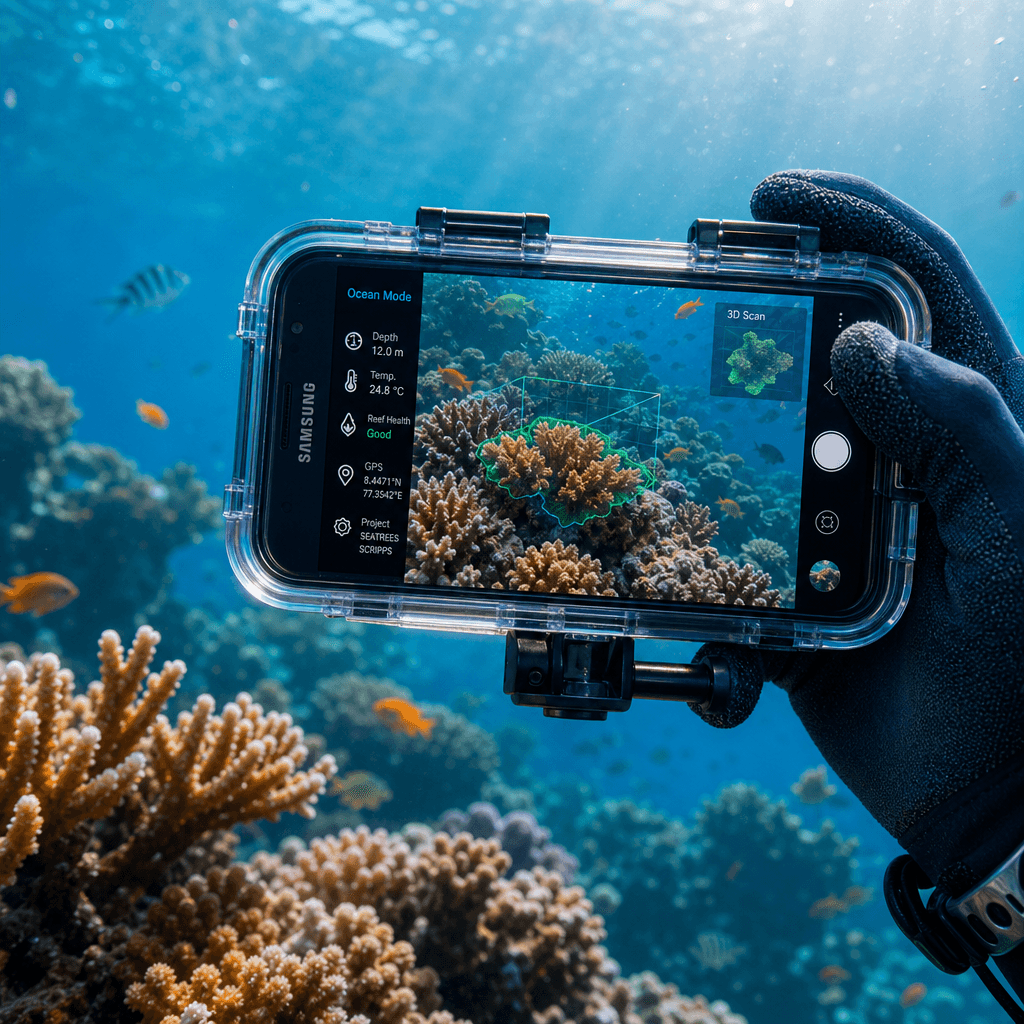
Samsung’s bet on turning smartphones into scientific instruments just paid off. The company’s Ocean Mode camera feature, built into newer Galaxy devices, snagged Gold at Engage for Good’s 2026 Halo Awards for its role in coral reef conservation. Working with nonprofit Seatrees and UC San Diego’s Scripps Institution, Samsung’s planted over 20,000 coral fragments across five countries while making underwater research tools accessible to communities that could never afford traditional equipment.
Samsung just proved that conservation tech doesn’t need to look like a research vessel. The company’s Ocean Mode feature, now standard on Galaxy S26 devices and rolling out to older models, won Gold in the “Best Sustainability or Conservation Initiative” category at this year’s Halo Awards. But the real story isn’t the trophy – it’s how Samsung turned consumer phones into scientific instruments that rival equipment costing tens of thousands of dollars.
The “Coral in Focus” initiative started with a simple problem: coral reef restoration requires constant monitoring, but the equipment traditionally used – waterproof DSLR housings, specialized lenses, processing software – puts it out of reach for the communities that need it most. According to the Smithsonian Museum of Natural History, coral reefs cover less than 1% of the ocean floor yet support roughly 25% of all marine life. Without intervention, many reefs face extinction by 2050 due to climate change, pollution, and overfishing.
Samsung’s answer was to build the research tools directly into phones people already own. Ocean Mode, available through the Expert RAW app on compatible Galaxy devices, corrects for the color distortion and motion blur that plague underwater photography. The feature uses computational photography to restore natural colors at depth and improve clarity – critical for generating the 3D photogrammetric models scientists use to track reef health.
The partnership with Seatrees, a U.S.-based nonprofit, and the Scripps Institution of Oceanography at UC San Diego turned this technology into measurable impact. Together, they’ve deployed Ocean Mode-equipped Galaxy devices to restoration sites in Costa Rica, Fiji, the Galápagos Islands, Indonesia, and the United States. Local communities receive the phones, waterproof housings, and training to capture high-quality underwater imagery.
The numbers tell the impact story. Since launch, the initiative has planted more than 20,000 coral fragments and built over 80 3D reef models, according to Seatrees’ partnership metrics. These models provide researchers with detailed data on coral growth rates, colony health, and ecosystem recovery – data that would previously require expensive expeditions and specialized equipment.
“Coral in Focus,” a documentary about the initiative, picked up the Coastal and Island Culture Award at the 23rd International Ocean Film Festival. Separately, Fast Company named Samsung to its 2026 Most Innovative Companies list for advancing mobile innovation in environmental research.
The broader implications extend beyond coral. By democratizing access to scientific-grade imaging tools, Samsung’s essentially created a distributed network of environmental monitors. Regions with limited technical infrastructure can now participate in marine research without waiting for grant funding or institutional support.
Ocean Mode launched on the Galaxy S26 series and is expanding to the S25, S24, Fold 7, Flip 7, Z Tri-Fold, Fold 6, and Flip 6 throughout the first half of 2026, according to Samsung’s announcement. The feature requires waterproof housing for seawater use – Galaxy phones aren’t designed for direct ocean exposure – but the total cost still undercuts traditional research equipment by orders of magnitude.
This fits into Samsung’s larger “Galaxy for the Planet” sustainability push, which includes incorporating recycled materials into devices and reducing carbon footprints across manufacturing. But Ocean Mode represents something different: consumer tech directly enabling scientific research at scale.
The competitive landscape is watching. While Apple’s iPhone has dominated underwater photography among consumers, Samsung’s carved out a niche in scientific and conservation applications. The company’s essentially betting that purpose-built features for specialized use cases can differentiate its devices in a saturated smartphone market.
What makes this work is the intersection of three capabilities: Samsung’s computational photography algorithms, Seatrees’ community-driven restoration model, and Scripps’ marine science expertise. Remove any one element and the initiative loses its scaling potential. The tech enables the monitoring, the nonprofit provides the distribution network, and the research institution validates the scientific rigor.
For Samsung, the awards provide tangible proof that sustainability initiatives can deliver both environmental impact and brand differentiation. For the broader tech industry, it’s a template for how consumer devices can be repurposed for scientific work without requiring entirely new product lines.
Samsung’s Ocean Mode awards validate a bigger shift in how consumer tech companies approach sustainability – not as marketing window dressing but as genuine product differentiation. By embedding research-grade tools into mass-market devices, Samsung’s created a scalable model for environmental monitoring that doesn’t depend on institutional funding or specialized equipment. The 20,000 coral fragments and 80 reef models represent real conservation impact, but the long-term play is about establishing Galaxy devices as essential tools for field research. As climate challenges intensify and coral reefs face existential threats, the ability to turn smartphones into scientific instruments could matter more than another camera megapixel upgrade. For now, Samsung’s got the first-mover advantage in a category it essentially created.










Leave a Reply