
- ■
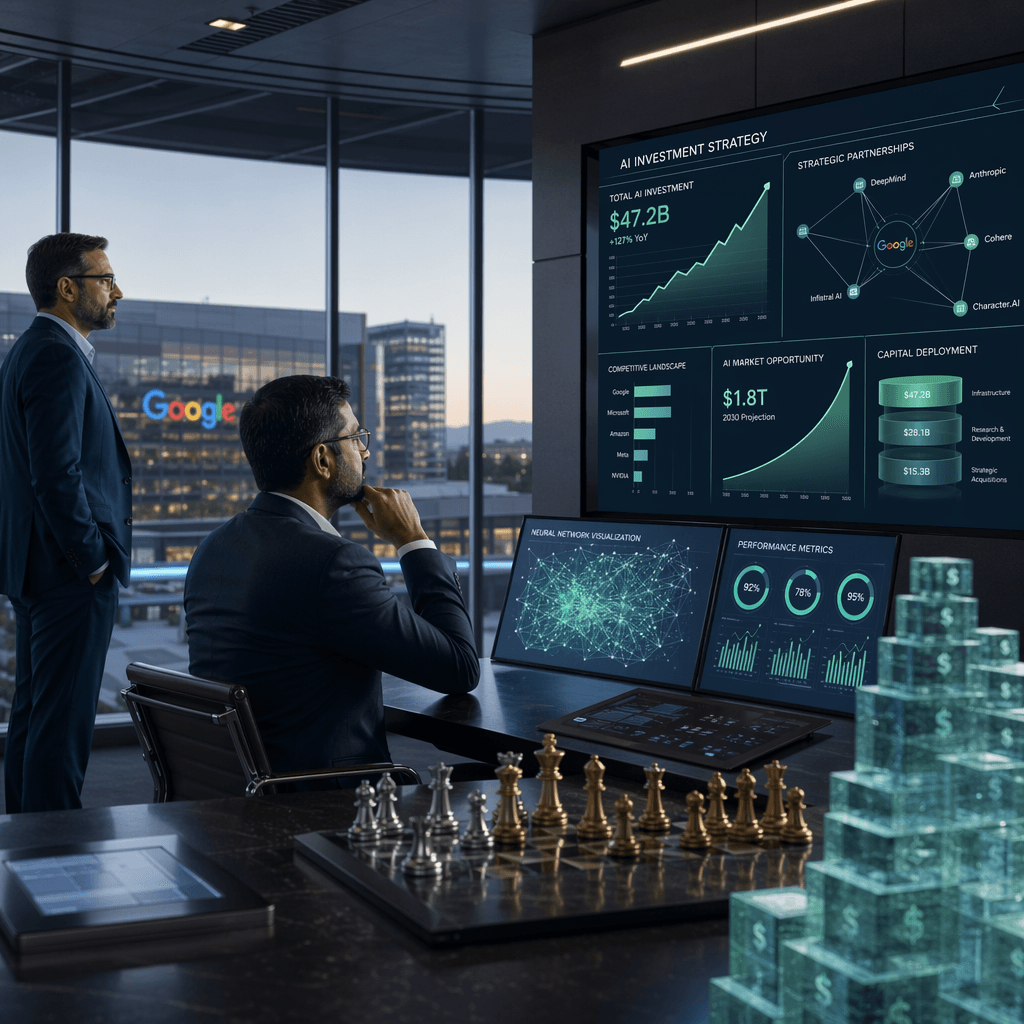
Google commits up to $40 billion to Anthropic in what could be the largest AI investment ever, according to CNBC
- ■
The deal expands Google’s multi-billion partnership with Anthropic while Amazon maintains its own $4 billion stake in the Claude maker
- ■
Investment positions Google across competing AI architectures as big tech companies scramble to lock in relationships with leading labs
- ■
Anthropic’s valuation likely soars past $60 billion, cementing its position as OpenAI’s most formidable competitor
Google just made the largest bet in AI history. The search giant is investing up to $40 billion in Anthropic, the ChatGPT rival behind Claude, in a deal that dwarfs previous tech investments and signals an all-out war for AI supremacy. The move comes as Google races to defend its search empire against AI-powered threats while hedging its bets across multiple frontier labs.
Google isn’t just spreading its AI bets anymore – it’s going all in. The company’s up-to-$40 billion commitment to Anthropic represents a seismic shift in how big tech is approaching the AI arms race, with investment figures that would’ve seemed unthinkable even a year ago.
The deal significantly expands what was already a substantial partnership between the two companies. Google previously invested hundreds of millions in Anthropic and provides the cloud infrastructure that powers Claude, Anthropic’s flagship AI assistant. But this new capital injection – potentially reaching $40 billion – puts Google’s commitment on an entirely different scale. For context, Microsoft’s much-publicized investment in OpenAI totaled around $13 billion across multiple rounds.
“This latest agreement expands on a longstanding partnership between the two companies,” Anthropic said in a statement reported by CNBC. The carefully worded announcement signals that both companies view this less as a one-off funding round and more as a strategic realignment of the AI landscape.
The timing is revealing. Google finds itself in an unusual position – simultaneously developing its own Gemini AI models while backing external labs like Anthropic. This dual-track strategy reflects deep uncertainty about which approach to large language models will ultimately win. While Google’s internal teams push forward with Gemini, the company’s leadership clearly wants insurance in case Anthropic’s constitutional AI methods or training approaches prove superior.
The investment also highlights how AI development costs have spiraled beyond what even the largest tech companies want to shoulder alone. Training runs for frontier models now cost hundreds of millions of dollars, with some estimates suggesting the next generation could hit $1 billion per training run. Data center infrastructure, specialized chips, and talent acquisition add billions more. By spreading investments across multiple labs, Google gains exposure to different technical approaches without bearing the full R&D burden itself.
But there’s a competitive calculus here too. Amazon already committed $4 billion to Anthropic in a deal that made Amazon Web Services the startup’s primary cloud provider. Google’s vastly larger investment effectively ensures Anthropic won’t become solely dependent on a cloud rival. It’s a defensive play wrapped in an offensive package – keeping Anthropic’s technology accessible while denying competitors exclusive access.
The deal likely values Anthropic at somewhere north of $60 billion, though exact terms haven’t been disclosed. That would make it the second-most valuable AI startup after OpenAI, which hit a $157 billion valuation in its latest funding round. The gap between those two numbers tells you everything about the current AI pecking order – and what Google is trying to change.
For Anthropic, the capital provides years of runway to pursue its vision of safer, more interpretable AI systems. The company has positioned itself as the responsible alternative to OpenAI’s “move fast” culture, emphasizing research into AI alignment and constitutional approaches that bake ethical guidelines into model training. Whether those technical bets pay off remains uncertain, but Google’s investment suggests at least one tech giant thinks the approach has merit.
The broader market is watching closely. If Google is willing to deploy $40 billion to secure access to Anthropic’s technology, what does that signal about AI’s expected returns? Venture capitalists and corporate development teams are already recalculating the value of AI assets across the board. Expect a fresh wave of mega-deals as other tech giants rush to lock up relationships with remaining independent labs.
There’s also a regulatory dimension. Antitrust authorities have already scrutinized Microsoft’s OpenAI partnership and Amazon’s Anthropic investment. Google’s even larger commitment will likely trigger investigations into whether these deals constitute de facto acquisitions designed to circumvent merger review. The companies will argue these are arm’s-length investments, but when $40 billion changes hands, independence becomes a relative concept.
Google’s $40 billion Anthropic bet isn’t just about backing a promising AI startup – it’s a fundamental repositioning in the race that will define the next decade of tech. By hedging between internal development and external partnerships, Google is essentially admitting that no single company, not even one with its resources, can afford to go it alone anymore. The deal sets a new benchmark for AI investments and practically guarantees we’ll see similar mega-commitments from other tech giants in the coming months. For the rest of the industry, the message is clear: the table stakes for playing in frontier AI just went up by an order of magnitude.






Leave a Reply