
- ■
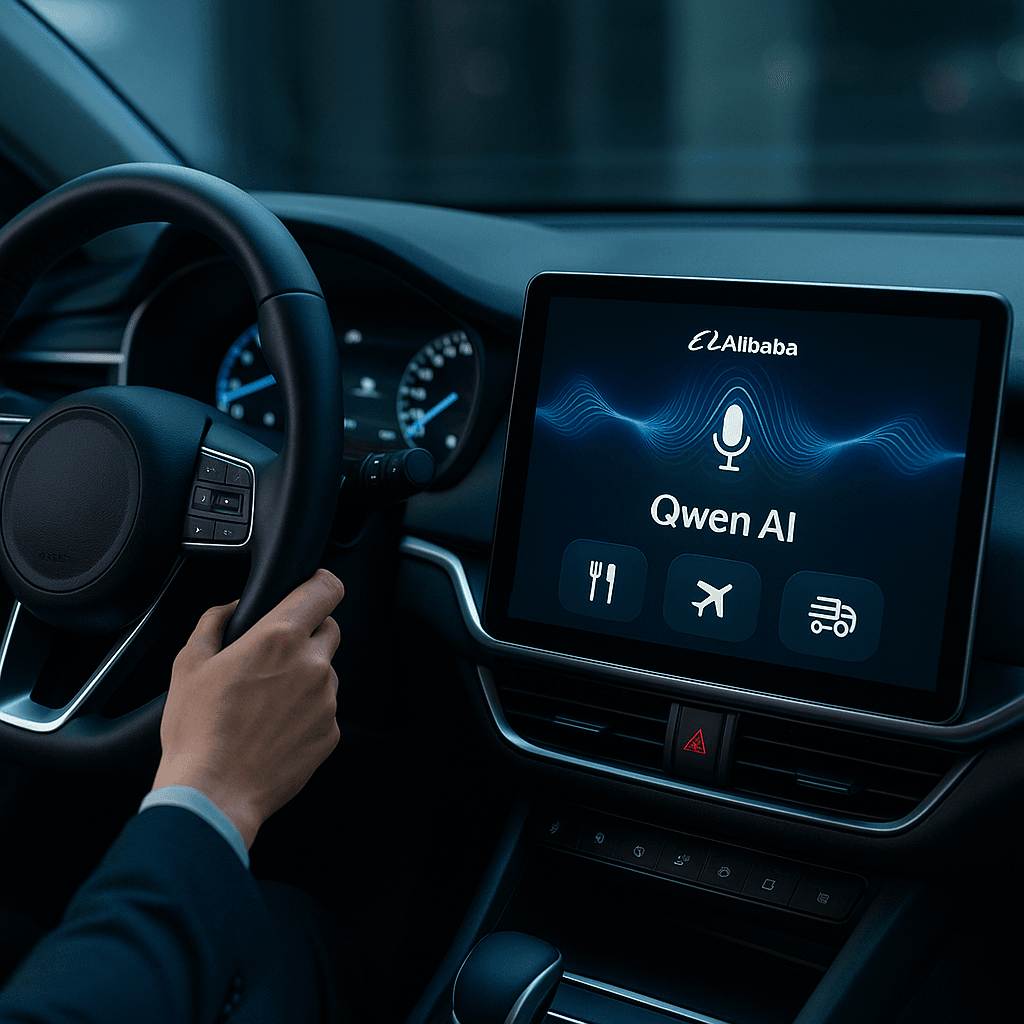
Alibaba announces Qwen AI integration across multiple Chinese car brands at Beijing Auto Show, enabling voice-controlled food ordering and hotel booking
- ■
The move puts Alibaba in direct competition with Tesla’s voice assistant and emerging automotive AI platforms from tech giants
- ■
Hands-free features target China’s massive connected car market, where voice assistants are becoming key differentiators
- ■
Watch for announcements on which specific automakers are integrating Qwen and when vehicles hit showrooms
Alibaba just made a major play to turn Chinese cars into AI-powered digital assistants on wheels. The tech giant unveiled plans to integrate its Qwen large language model across multiple automakers at the Beijing Auto Show, letting drivers order takeout, book hotels, and manage deliveries without touching their phones. It’s the clearest sign yet that the battle for AI dominance is shifting from smartphones to dashboards.
Alibaba is betting that the next frontier for AI assistants isn’t your pocket – it’s your car. The Chinese tech giant revealed at the Beijing Auto Show that its Qwen large language model is rolling out across multiple automotive brands, transforming vehicles into voice-activated command centers for daily tasks.
The integration lets drivers do everything from ordering meals to booking hotels without ever reaching for their phone, according to CNBC’s reporting from the show floor. More intriguingly, the system can manage package deliveries – a strategic tie-in to Alibaba’s massive e-commerce ecosystem that rivals like Tesla and Google can’t easily replicate.
The timing isn’t coincidental. China’s automotive market has become ground zero for the AI assistant wars, with local manufacturers racing to differentiate their EVs through software experiences rather than just hardware specs. While Western automakers spent years treating voice controls as an afterthought, Chinese brands have made conversational AI a centerpiece of their pitch to tech-savvy buyers.
Alibaba’s approach differs from competitors by leveraging its existing consumer ecosystem. A driver could theoretically ask Qwen to order dinner from Ele.me (Alibaba’s food delivery platform), book a room through Fliggy (its travel service), and track an incoming package from Cainiao (its logistics arm) – all through natural conversation. That vertical integration gives Alibaba an edge that pure-play AI companies or automakers building standalone assistants can’t match.
The announcement comes as OpenAI, Google, and Microsoft all push their own AI models into vehicles through partnerships. But Alibaba has home-field advantage in the world’s largest auto market, where regulatory barriers and local preferences favor domestic tech platforms. The company’s been quietly building Qwen’s capabilities for months, and automotive represents its most ambitious deployment yet outside of cloud services.
What Alibaba didn’t reveal at the show: which specific automakers are integrating Qwen, rollout timelines, or whether the AI runs locally in vehicles or requires cloud connectivity. Those details matter enormously for user experience – cloud-dependent systems can lag or fail in areas with spotty coverage, while on-device processing raises questions about computing power and model size.
The automotive AI market is heating up fast. Tesla recently upgraded its voice assistant capabilities, while traditional automakers scramble to partner with AI providers rather than build from scratch. Mercedes-Benz integrated ChatGPT into its MBUX system last year, and Volkswagen announced similar plans. But most of these implementations feel bolted-on rather than deeply integrated into the broader user experience.
Alibaba’s ecosystem play could change that calculus. If a driver’s car already knows their food preferences, travel history, and shopping patterns through Alibaba’s various platforms, the AI can offer genuinely personalized suggestions rather than generic responses. That contextual awareness – what you ordered last week, where you usually stay on business trips – transforms a voice assistant from a novelty into something actually useful.
The strategic implications extend beyond convenience features. Automotive is becoming a crucial data collection point, and whoever controls the AI layer gains insights into consumer behavior that feeds back into other business lines. Alibaba’s seeing what Amazon learned with Alexa: the assistant is less about the hardware it runs on and more about becoming the interface layer between users and services.
For Chinese automakers, partnering with Alibaba offers a faster path to competitive AI features than developing proprietary systems. Building a large language model from scratch requires massive investment and expertise most car companies lack. Licensing Qwen lets them focus on vehicle engineering while outsourcing the AI complexity – though it also means ceding a crucial customer touchpoint to a tech giant.
The announcement positions Alibaba to capture automotive AI market share while Western competitors navigate China’s regulatory landscape. But execution will determine whether Qwen becomes genuinely indispensable or just another overhyped voice assistant that drivers ignore after the novelty wears off.
Alibaba’s Qwen automotive push represents more than just another voice assistant – it’s a strategic play to own the interface layer between drivers and digital services in the world’s largest car market. The real test comes when vehicles actually ship and drivers discover whether conversational AI in cars proves genuinely useful or becomes another ignored feature. With rivals from Silicon Valley to Shenzhen racing to crack the same problem, the company that figures out automotive AI first stands to capture an enormously valuable touchpoint in consumers’ daily routines. For now, Alibaba’s ecosystem advantage gives it a head start, but converting that into sustained adoption requires flawless execution on experience and privacy.







Leave a Reply