
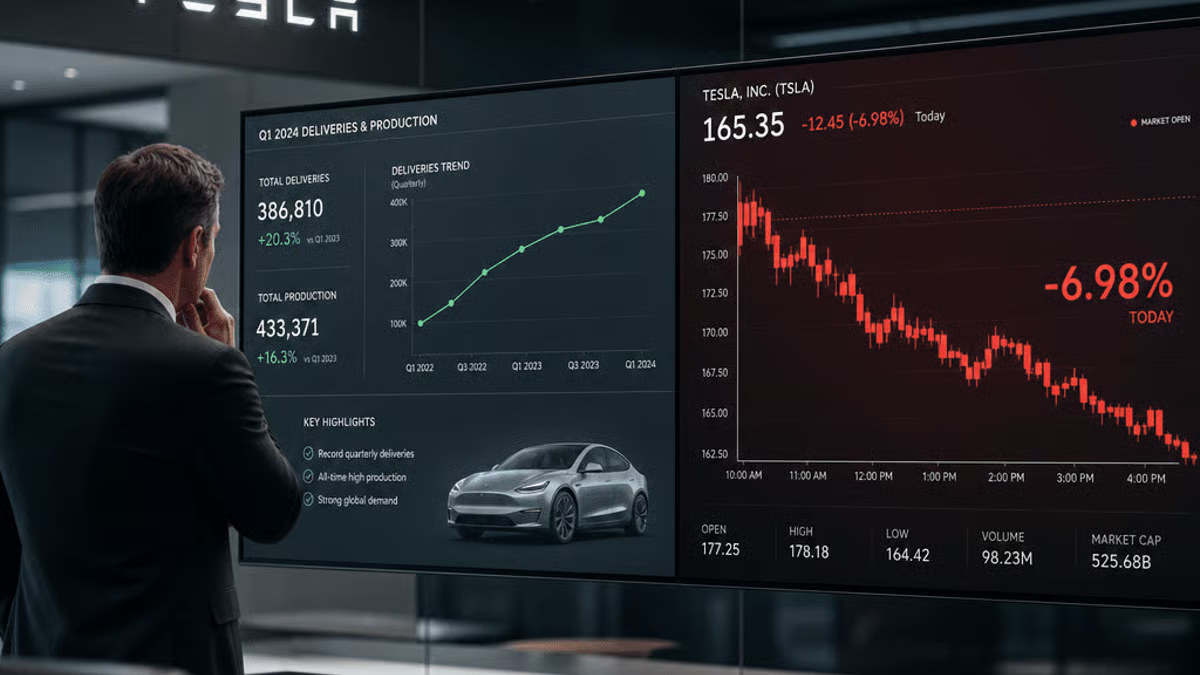
Tesla just posted what should’ve been a victory lap – but Wall Street isn’t buying it. The EV maker’s stock plunged 7% Thursday despite reporting stronger-than-expected Q2 2026 deliveries, marking its worst single-day decline in nearly a year. The counterintuitive sell-off reveals a deeper crisis: investors are losing faith in CEO Elon Musk’s ability to steer the company past consecutive annual sales declines and mounting brand damage from his increasingly polarizing public persona.
Tesla can’t seem to catch a break – even when it beats expectations. The electric vehicle pioneer reported solid Q2 2026 delivery numbers Thursday morning, topping analyst forecasts in what should’ve triggered a relief rally. Instead, shares nosedived 7% in the worst single-day rout since summer 2025, wiping out billions in market value and leaving investors with an uncomfortable question: what exactly will it take to restore confidence?
The brutal market reaction tells a story that delivery spreadsheets can’t capture. While Tesla demonstrated it can still move metal off lots, Wall Street is pricing in a different risk entirely – the Elon Musk factor. According to the CNBC report, the company is battling to recover from back-to-back annual sales declines “partly caused by a consumer backlash” against its CEO’s increasingly divisive public behavior.
That’s a remarkable admission for a company that built its brand on Musk’s cult of personality. What was once Tesla’s greatest asset – an iconoclastic founder willing to take on Detroit, Big Oil, and conventional wisdom – has morphed into a liability as Musk’s political stances and erratic social media presence alienate the very progressive, eco-conscious buyers who formed Tesla’s core customer base.
The numbers paint a company stuck in neutral despite tactical wins. While Q2 deliveries exceeded lowered expectations, they still trail year-ago levels in a market where competitors like Ford and Rivian are gaining ground with fresh EV lineups. Traditional automakers have closed the technology gap that once made Tesla the only game in town, and they’re doing it without the baggage of a CEO who dominates news cycles for non-automotive reasons.
Investors are clearly doing the math on brand erosion. A 7% single-day drop on ostensibly good news suggests the market sees the delivery beat as noise and the underlying sales trend as signal. Institutional money managers are reassessing whether Tesla can maintain premium valuations when it’s fighting a two-front war: operational challenges in a maturing EV market and self-inflicted reputation damage that’s harder to quantify but impossible to ignore.
The timing couldn’t be worse for Tesla. The company needs every advantage as it ramps production of the Cybertruck, navigates softening demand in China, and fends off aggressive competition in Europe. Instead, it’s spending energy managing fallout from Musk’s latest provocations and trying to win back customers who’ve taken their business to brands without the drama.
What’s particularly striking is how quickly sentiment has shifted. Just two years ago, Tesla bulls could dismiss concerns about Musk’s antics as irrelevant to the company’s fundamentals. Today, those antics are the fundamentals – or at least Wall Street is treating them that way. When a company posts better-than-feared results and still gets hammered, the market is sending a message about what it values and what it’s lost patience with.
The sell-off also reflects growing skepticism about Tesla’s ability to hit ambitious targets for its next-generation affordable EV platform and full self-driving technology. With Musk’s credibility taking hits on multiple fronts, analysts are applying steeper discounts to future promises and demanding proof of execution rather than accepting aspirational timelines.
For long-term shareholders, Thursday’s action raises uncomfortable questions about governance and leadership accountability. If strong operational performance can’t move the stock because of CEO-related headwinds, at what point does the board have to address whether the company has outgrown its founder’s management style? It’s a conversation that would’ve been unthinkable in Tesla’s high-growth years but feels increasingly urgent as the company matures into a different competitive phase.
The contradiction at the heart of Tesla’s current predicament is that Musk’s risk-taking built the company into an industry disruptor, but that same instinct for provocation now threatens to undermine what he built. Separating those two sides of the same personality may be impossible, leaving investors to price in permanent CEO risk as long as Musk remains at the helm.
The message from Thursday’s trading is brutally clear: Tesla’s operational performance is no longer enough to satisfy investors worried about deeper structural issues. Until the company finds a way to decouple its brand from Musk’s controversies – or Musk finds a way to stop creating them – even good quarters may not be good enough to restore the growth trajectory that once made Tesla Wall Street’s darling. What happens next likely depends less on production ramps and delivery targets than on whether leadership can acknowledge that winning back consumer trust requires more than just building better cars.










Leave a Reply