
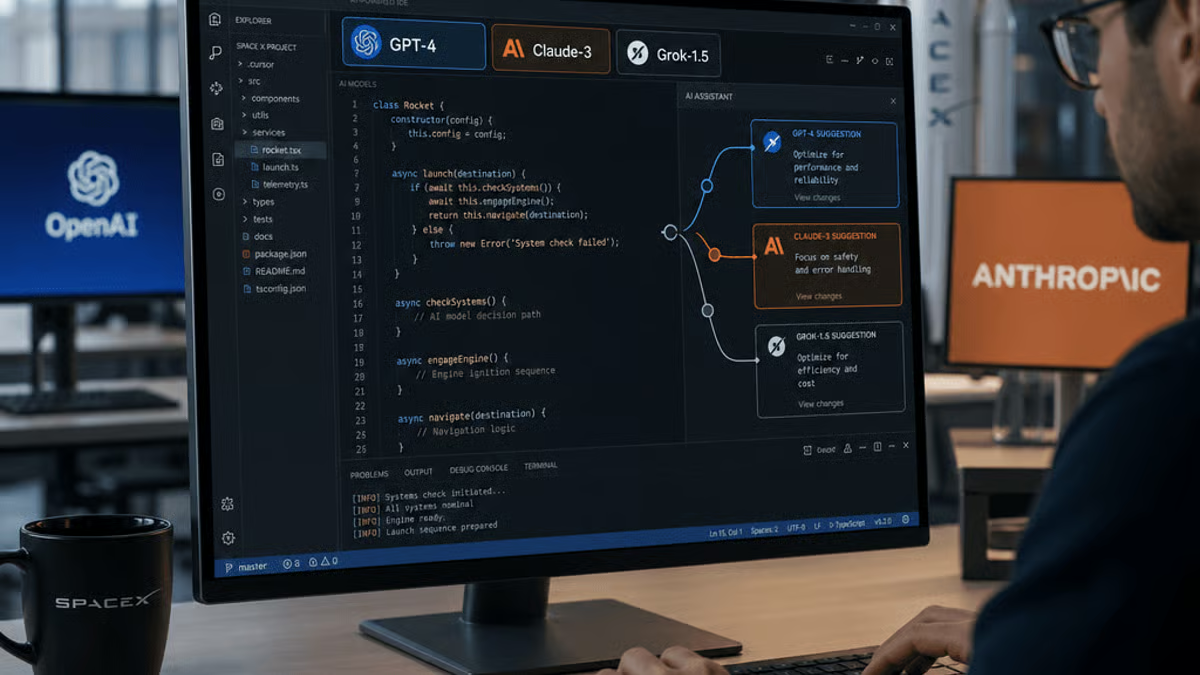
SpaceX just acquired AI coding assistant Cursor, and the developer tool’s promise to remain model-agnostic is already putting pressure on the relationships between frontier AI labs. The deal, first reported by Wired, raises a critical question: Can Cursor continue serving OpenAI and Anthropic models when its new parent company’s sister venture, xAI, competes directly with both?
Cursor built its reputation on choice. Developers love the AI-powered code editor precisely because it doesn’t lock them into a single model provider. But that Switzerland-style neutrality just got a lot more complicated now that SpaceX owns it.
The acquisition, confirmed Thursday, immediately puts OpenAI and Anthropic in an awkward position. Both companies currently power Cursor’s AI features, letting developers toggle between GPT-4, Claude, and other models depending on their needs. Now they’re effectively supporting a tool owned by Elon Musk’s empire, which includes xAI and its Grok models that compete head-to-head with their offerings.
Cursor’s leadership insists nothing will change. According to sources familiar with the deal, the company plans to continue offering third-party models and maintain its platform approach. But the tech industry has seen this movie before. Microsoft acquired GitHub and gradually tightened its integration with OpenAI. Google bought countless startups that promised independence before being absorbed into the mothership.
The stakes here go beyond just another acquisition. Developer tools have become the primary battleground for AI model adoption. Whoever controls the tools developers use daily controls which models they reach for first. It’s why Microsoft poured resources into GitHub Copilot, why Google launched Duet AI for Google Cloud, and why every major tech company is racing to embed AI into IDEs and development workflows.
Cursor’s multi-model approach gave it an edge in a crowded market. Developers aren’t loyal to models the way consumers might be loyal to brands. They want the best tool for each specific task, and Cursor delivered that flexibility. The question now is whether that flexibility survives under SpaceX ownership, especially as xAI continues scaling its own models.
OpenAI and Anthropic have difficult decisions ahead. Cutting off Cursor would mean losing access to a growing developer base and ceding that territory entirely to xAI. But continuing to power a competitor’s tooling feels like funding your own disruption. It’s the classic platform dilemma, but with the added wrinkle of Elon Musk’s track record of aggressive competition.
The acquisition also signals SpaceX’s broader ambitions in the AI tooling space. The company hasn’t traditionally played in developer tools, but acquiring Cursor gives it immediate credibility and distribution. If xAI’s models can be seamlessly integrated while still offering alternatives, Cursor becomes a trojan horse for Grok adoption without forcing developers to abandon their preferred workflows.
Industry observers note this tests a critical assumption about the AI ecosystem: that infrastructure and tooling can remain neutral even as model providers wage increasingly bitter platform wars. The next few months will reveal whether that’s realistic or naive. If OpenAI or Anthropic pull their API access, it would validate fears that the AI industry is heading toward the kind of walled gardens that defined the mobile era.
For developers, the worry is more practical. They’ve built workflows around Cursor’s flexibility, and any reduction in model options would force painful migrations. Some are already exploring alternatives like Continue and other open-source code assistants that promise true model independence.
The deal also highlights how quickly the AI developer tools market has consolidated. Just two years ago, Cursor was a scrappy startup competing against GitHub Copilot. Now it’s part of the Musk ecosystem, joining the constellation of companies that includes xAI, X (formerly Twitter), and Tesla. That consolidation mirrors broader trends in AI, where the companies with the deepest pockets are snapping up anything that touches the developer experience.
The Cursor acquisition is less about the deal itself and more about what it reveals: the AI industry’s neutral ground is shrinking fast. Developer tools were supposed to be the one layer where model providers could coexist peacefully, each competing on merit rather than platform lock-in. SpaceX’s move tests whether that was ever realistic or just a brief interlude before the real platform wars begin. For developers caught in the middle, the answer will determine whether they keep the flexibility that made Cursor valuable in the first place or get dragged into another round of ecosystem warfare.






Leave a Reply