
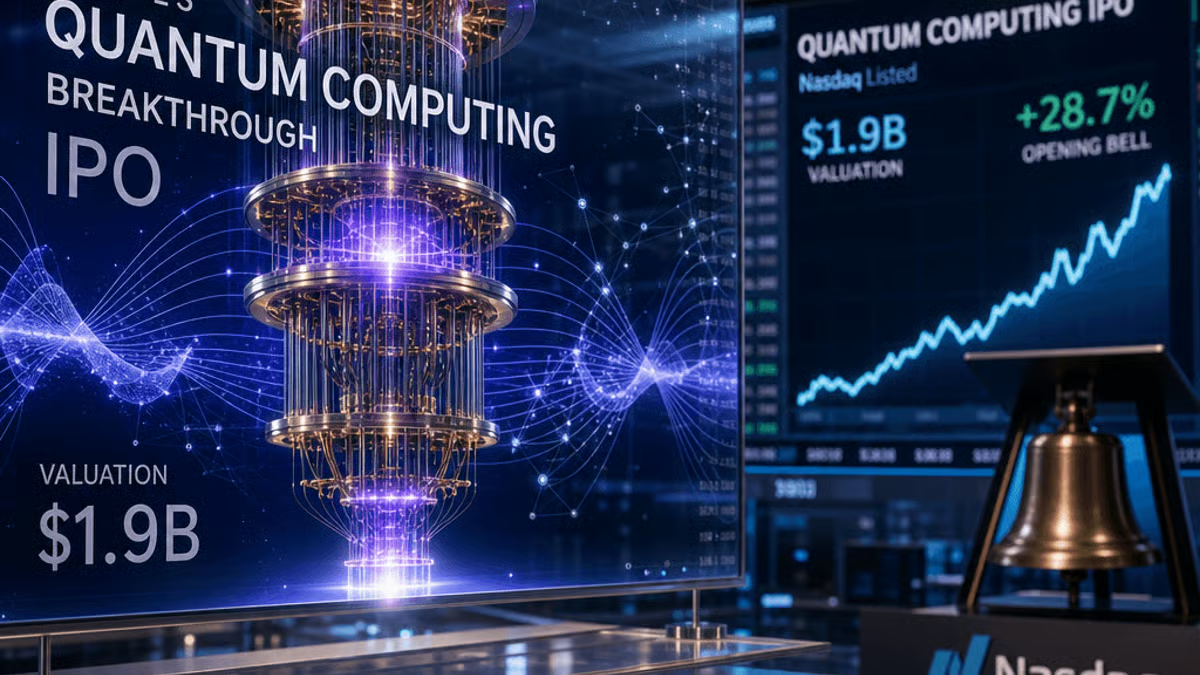
Europe just got its first publicly traded quantum computing company. IQM, a Finnish full-stack quantum hardware firm, started trading on Nasdaq today with a $1.9 billion valuation, marking a watershed moment for the continent’s deep tech ambitions. But the company’s own filings acknowledge what the entire industry whispers: the future of quantum computing remains fundamentally uncertain.
IQM just made history, but it’s the kind of history that comes with asterisks. The Espoo-based quantum computing company priced its Nasdaq debut at a $1.9 billion valuation, becoming the first European quantum firm to go public. That’s a milestone for a continent that’s watched IBM, Google, and a parade of well-funded American startups dominate the quantum narrative.
But here’s the tension: even as IQM rings the opening bell, the company’s own regulatory filings contain language that should give investors pause. The future of quantum computing technology itself remains unproven at commercial scale, a reality that every quantum company grapples with but few discuss publicly during their market debuts.
Founded in Finland, IQM positions itself as a full-stack quantum computing company, meaning it builds everything from the superconducting qubits at the heart of quantum processors to the control systems that make them work. That vertical integration strategy mirrors what IBM and Google have pursued, but with a distinctly European approach focused on serving research institutions and government clients across the continent.
The $1.9 billion valuation puts IQM in rarified air for European deep tech. It’s significantly smaller than IBM’s quantum division or the implied valuations of well-funded U.S. players like Rigetti and IonQ, but it represents serious capital for a technology that still hasn’t proven it can solve real-world problems faster than classical supercomputers for most applications.
Quantum computing has been the next big thing for about a decade now. The technology promises to revolutionize drug discovery, financial modeling, cryptography, and materials science by exploiting quantum mechanical phenomena like superposition and entanglement. But the gap between laboratory demonstrations and practical quantum advantage keeps widening. IBM recently scaled back some of its quantum timelines, while Google continues to report progress on error correction but hasn’t delivered the transformative applications many predicted by now.
IQM’s public market entry comes as quantum computing faces a credibility test. Venture funding for quantum startups dropped nearly 40% in 2025 compared to the previous year, according to industry trackers, as investors grew wary of long development cycles and uncertain commercialization paths. Government funding, particularly from the EU’s quantum flagship program, has kept European players like IQM alive, but public market investors operate under different timelines and expectations.
The Finnish company has been building quantum computers for research centers and has partnerships with institutions across Germany, Spain, and the Nordic countries. Unlike consumer tech IPOs, IQM’s investor base will likely skew toward institutional players with long time horizons and deep tech expertise. That’s probably wise, given the technology’s current state.
What makes IQM’s approach interesting is its focus on superconducting quantum processors, the same architecture IBM and Google favor. The company has been working on reducing error rates and increasing qubit counts, the two holy grails of quantum computing that determine whether these machines can ever be useful. Recent technical papers suggest IQM has made incremental progress, but nothing that fundamentally changes the quantum timeline.
The IPO also serves as a geopolitical statement. Europe has watched anxiously as the U.S. and China pour billions into quantum research, viewing the technology as strategically critical for future computing dominance. Finland and other Nordic countries have positioned themselves as quantum-friendly jurisdictions, offering research funding and regulatory support that helped IQM reach this milestone.
But going public means exposing quantum computing’s uncomfortable truths to quarterly earnings calls. Can IQM generate meaningful revenue before its cash runs out? Will quantum computers actually deliver on their promise? And what happens if a breakthrough from IBM, Google, or a Chinese lab makes IQM’s approach obsolete?
The broader quantum sector is watching closely. If IQM can maintain its valuation and deliver on development milestones, it could open the public markets for other quantum players. If it stumbles, it might slam that door shut for years. Nasdaq listings carry prestige, but they also demand performance.
For now, IQM’s debut represents optimism winning over uncertainty, European ambition challenging American dominance, and deep tech believing it can thrive in public markets despite long timelines. Whether that bet pays off depends on whether quantum computing can finally transition from potential to practical sometime this decade.
IQM’s Nasdaq debut marks a pivotal moment for European quantum computing, but it also exposes the sector’s central paradox: massive valuations built on technology that remains unproven at commercial scale. The $1.9 billion question isn’t whether IQM can execute on its roadmap, it’s whether quantum computing itself can deliver on a decade of promises before investor patience runs out. Europe now has skin in the quantum game through public markets, which means the technology’s ultimate viability will be tested not just in laboratories but in earnings reports and stock performance. That’s either the pressure quantum computing needs to mature, or the scrutiny that reveals it wasn’t ready for prime time.










Leave a Reply