
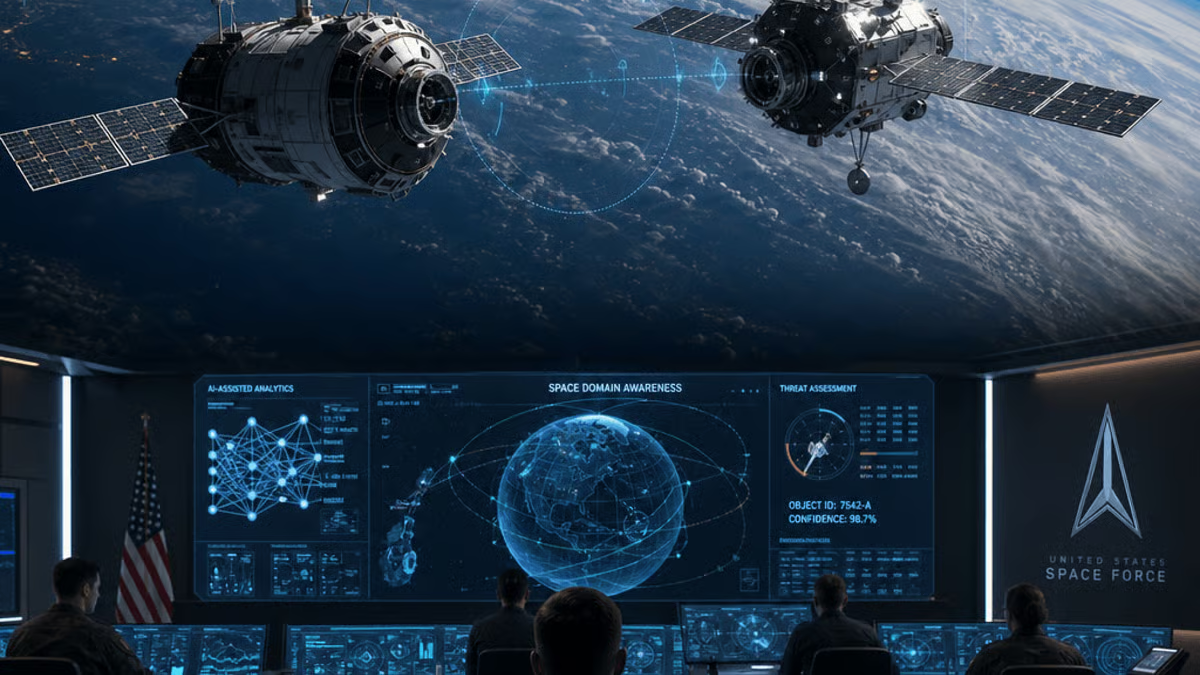
The US Space Force just handed the keys to orbital combat training to two private space companies. True Anomaly and Rocket Lab are now flying Top Gun-style proximity operations around military satellites, marking a shift in how America’s newest military branch conducts space operations. It’s a validation of the defense tech startup model and signals billions in future contracts as the Pentagon outsources increasingly sensitive missions to commercial operators.
True Anomaly and Rocket Lab are performing what sources describe as Top Gun-style maneuvers in orbit for the US Space Force, according to reports from TechCrunch. The contracts mark a turning point in military space operations, where startups are now executing missions that would’ve been unthinkable to outsource just five years ago.
The satellite fly-bys mirror the close-quarters aerial combat training that fighter pilots practice, except these maneuvers happen at 17,000 miles per hour in the vacuum of space. True Anomaly, founded just three years ago, has built autonomous spacecraft specifically designed for what the industry calls rendezvous and proximity operations, or RPO. It’s the space equivalent of tailing an adversary’s satellite to understand its capabilities without actually touching it.
Rocket Lab’s involvement suggests the Space Force is hedging its bets across multiple providers. The New Zealand-founded company, which went public via SPAC in 2021, has been aggressively pivoting from pure launch services into satellite manufacturing and space systems. Adding military proximity operations to its portfolio puts Rocket Lab in direct competition with legacy defense primes like Northrop Grumman and Lockheed Martin.
The timing isn’t coincidental. China and Russia have been demonstrating their own orbital maneuvering capabilities for years, sparking concerns about anti-satellite weapons and space-based surveillance. The Space Force needs rapid response capabilities that traditional procurement timelines can’t deliver. Enter the startups.
True Anomaly raised $100 million in Series B funding earlier this year, led by Riot Ventures with participation from Eclipse and ACME Capital. The company’s pitch has always centered on autonomous space security, and these Space Force contracts validate that thesis in the most tangible way possible. Investors are betting the Pentagon will spend billions building out America’s orbital defense infrastructure over the next decade.
What makes these missions particularly significant is the level of autonomy involved. Unlike traditional satellite operations where ground controllers plan every maneuver days in advance, True Anomaly’s spacecraft can make real-time decisions using onboard AI. That capability becomes critical when you’re tracking potentially hostile satellites that might change course without warning.
Rocket Lab hasn’t disclosed specifics about its Space Force work, but the company’s Photon satellite bus has been flying military missions since 2020. Adding proximity operations suggests Photon is getting upgraded with new sensors and propulsion systems designed for close-range inspection work.
The broader trend here is the commercialization of military space, following the playbook that SpaceX pioneered with launch services. Why pay Lockheed Martin $500 million for a satellite when a startup can deliver similar capabilities for a tenth of the cost? The Space Force is clearly asking that question across more mission categories.
But proximity operations are exponentially more complex than launching satellites. Getting within meters of another spacecraft without causing a collision requires precision navigation, advanced sensors, and split-second decision-making. The fact that the Space Force trusts startups with these missions indicates how far commercial space technology has progressed.
There’s also a strategic element. Distributing these capabilities across multiple commercial providers makes the US space architecture more resilient. If one contractor gets hacked or a satellite fails, others can fill the gap. It’s the same distributed approach that’s reshaped Pentagon thinking on everything from cloud computing to drone operations.
The contracts haven’t been publicly valued, and both companies declined to comment on specifics given the classified nature of the work. But defense industry analysts estimate the Space Force will spend upwards of $2 billion on space domain awareness and orbital security over the next five years, with a growing percentage going to commercial operators rather than traditional primes.
For True Anomaly, this represents a bet-the-company moment. The startup has been burning through venture capital to build spacecraft and hire talent from SpaceX, Planet Labs, and the national security community. Landing repeatable Space Force contracts provides the revenue stability needed to scale operations and potentially go public.
Rocket Lab faces different pressures as a public company. Investors have been waiting for the space systems division to prove it can generate meaningful revenue beyond launch services. Military proximity operations could become a nine-figure business line if Rocket Lab executes well and the Space Force expands the program.
The Space Force betting on True Anomaly and Rocket Lab for orbital proximity missions isn’t just about these specific contracts. It’s a signal that the Pentagon’s decade-long experiment with commercial space has reached a new maturity level. Startups are now trusted with the most sensitive space operations, not just launching payloads. That shift opens up enormous market opportunities while simultaneously raising the stakes for these young companies. Execute well and they become the next generation of defense primes. Stumble and the window closes as quickly as it opened. With China and Russia advancing their own space capabilities, the pressure to deliver has never been higher.









Leave a Reply