
- ■
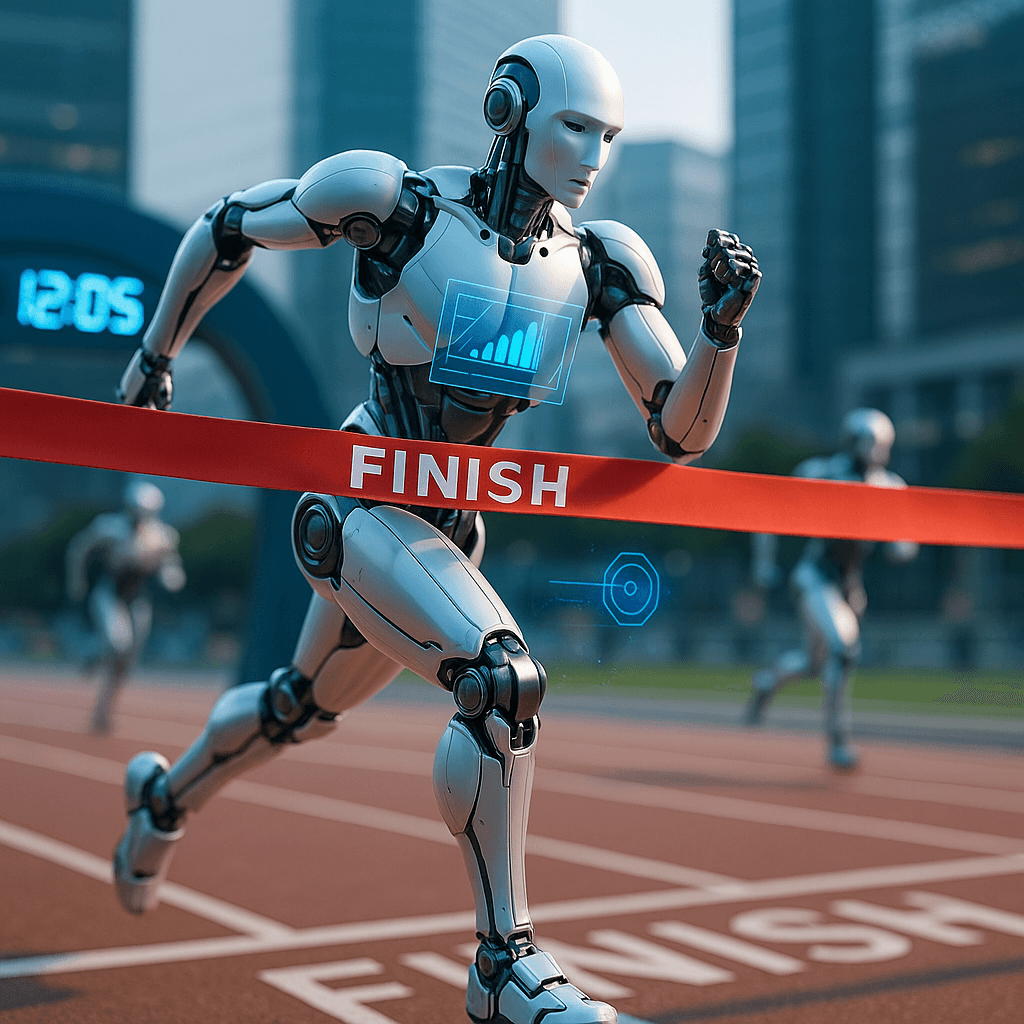
Humanoid robots finished Beijing’s half-marathon with times vastly improved over last year’s 2:40 record, according to TechCrunch
- ■
The performance leap demonstrates major advances in bipedal locomotion, balance control, and energy efficiency in robotics
- ■
This marks a pivotal moment where humanoid robots prove they can sustain complex physical tasks over extended periods
- ■
The achievement could accelerate development of humanoid robots for warehouse logistics, disaster response, and industrial applications
Humanoid robots just crossed a threshold that seemed years away. At Beijing’s annual humanoid half-marathon, machines didn’t just compete – they demolished previous records, finishing the 13.1-mile course in times that would’ve seemed impossible just a year ago. The winning robot’s performance marks a massive leap over 2025’s best time of two hours and 40 minutes, signaling that robotics has entered a new era of athletic capability.
The results from Beijing’s humanoid half-marathon are sending shockwaves through the robotics community. What started as a novelty event in 2025 has become a proving ground for the world’s most advanced bipedal machines, and this year’s race shows just how fast the technology is evolving.
Last year’s fastest robot crawled across the finish line at two hours and 40 minutes – respectable for a machine, but nowhere near human elite performance. This year’s winning time represents such a dramatic improvement that it’s forcing researchers to recalibrate their expectations for what humanoid robots can achieve in the near term.
The Beijing humanoid half-marathon isn’t just about bragging rights. It’s become the de facto stress test for companies developing general-purpose humanoid robots. Running 13.1 miles requires sustained balance, adaptive terrain navigation, energy management, and real-time decision-making – exactly the capabilities needed for robots to work alongside humans in factories, warehouses, and disaster zones.
What makes this achievement particularly significant is the sustained nature of the task. Building a robot that can run for a few minutes in controlled conditions is one thing. Engineering a machine that can maintain bipedal locomotion for over an hour while adapting to changing conditions, managing battery consumption, and avoiding obstacles represents a completely different level of technological sophistication.
The improvements likely stem from advances across multiple domains. Better actuators provide more efficient power delivery to joints. Enhanced computer vision and AI allow faster terrain analysis and gait adjustment. Improved battery technology extends operational time without adding prohibitive weight. And machine learning models trained on millions of steps help robots recover from stumbles that would’ve ended races in previous years.
This progress comes as major tech companies and startups pour billions into humanoid robotics development. The race results offer tangible proof that the field is advancing faster than many experts predicted. While these robots still can’t match elite human marathon times – the men’s half-marathon world record stands at 57:31 – the rate of improvement suggests that gap could narrow quickly.
The implications extend far beyond athletics. Companies developing humanoid robots for commercial applications are watching these results closely. If a robot can run a half-marathon, it can handle eight-hour warehouse shifts. If it can navigate a race course with other competitors, it can work safely in dynamic human environments. The Beijing race essentially serves as a high-profile product demo for the entire humanoid robotics industry.
But there’s also a competitive intelligence angle at play. The event reveals which research teams have made breakthroughs in crucial areas like energy efficiency, balance control, and autonomous navigation. Those capabilities translate directly to commercial value in sectors from logistics to eldercare to construction.
The rapid improvement in robot athletic performance mirrors what we’ve seen with AI in other domains. Just as large language models suddenly crossed capability thresholds that unlocked new applications, humanoid robots appear to be hitting inflection points where accumulated advances create qualitative shifts in what’s possible.
The Beijing half-marathon results represent more than an athletic milestone – they’re a signal that humanoid robotics is accelerating faster than most observers expected. The dramatic improvement over just one year suggests we’re in the steep part of the development curve, where incremental technical advances compound into breakthrough capabilities. For companies betting billions on humanoid robots as the next computing platform, these results validate the investment thesis. For the rest of us, they offer a glimpse of a future where general-purpose robots move from research labs into real-world applications sooner than we thought possible.










Leave a Reply