
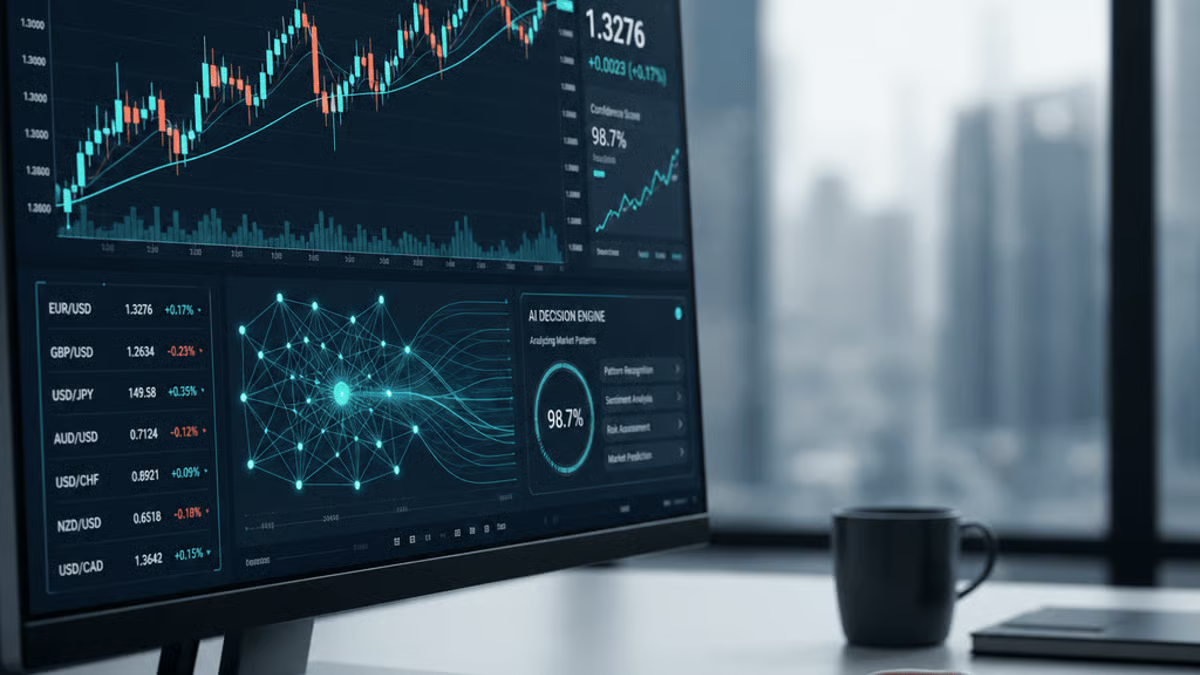
Robinhood CEO Vlad Tenev just dropped a bold prediction that could reshape retail investing. In a CNBC interview this morning, Tenev said AI agents are approaching human-level trading capabilities, signaling a potential transformation in how millions of everyday investors interact with financial markets. The statement comes as Wall Street races to integrate autonomous AI systems into trading infrastructure, with firms already deploying experimental agents that can analyze market data, execute trades, and manage risk without human intervention.
Robinhood CEO Vlad Tenev is betting big on a future where artificial intelligence doesn’t just assist traders but replaces them entirely. Speaking with CNBC this morning, Tenev made the case that AI agents are rapidly approaching the point where they can match human decision-making in trading – a statement that carries weight coming from the CEO of a platform that democratized stock trading for millions of retail investors.
The timing of Tenev’s comments isn’t accidental. Wall Street’s been quietly building out AI agent infrastructure for months, with major firms testing systems that can autonomously analyze earnings reports, process market sentiment from social media, and execute complex multi-leg options strategies. What Tenev’s signaling is that this technology is moving from institutional trading desks to retail platforms like Robinhood faster than most anticipated.
The implications are massive for Robinhood’s business model. The company built its reputation on making trading accessible and simple, but AI agents could fundamentally change that equation. Instead of users manually researching stocks and placing orders, they could delegate entire investment strategies to AI systems that trade on their behalf, constantly monitoring markets and adjusting positions in milliseconds.
This isn’t purely theoretical. OpenAI and Anthropic have both been developing AI agents capable of complex reasoning and multi-step task execution. Meanwhile, financial firms are racing to figure out how to safely deploy these systems in live trading environments where mistakes can cost millions. The regulatory questions alone are staggering – who’s liable when an AI agent makes a bad trade? How do you ensure these systems aren’t manipulating markets?
For Robinhood specifically, AI agents represent both opportunity and existential threat. The platform revolutionized trading by eliminating commissions and creating an intuitive mobile interface. But if AI agents become the primary way people interact with markets, the competitive advantage shifts to whoever builds the smartest, most reliable agent. That’s a very different game than competing on user experience and pricing.
Tenev’s background gives him credibility on this front. Before founding Robinhood, he built high-frequency trading systems, so he understands both the technical complexity and the business dynamics at play. His prediction suggests Robinhood is actively working on AI agent features, though the company hasn’t announced specific products yet.
The broader fintech industry is watching closely. If Robinhood successfully integrates AI agents, competitors like Webull, E*TRADE, and traditional brokerages will face pressure to follow suit. We’re potentially looking at a complete reimagining of retail investing, where the average user’s relationship with their portfolio becomes mediated entirely through AI.
But there are serious hurdles. AI agents need to be explainable – users will want to understand why their AI made certain trades. They need to be safe, with guardrails preventing catastrophic losses. And they need to navigate complex regulations that weren’t written with autonomous AI systems in mind. The SEC and FINRA are already grappling with how to regulate algorithmic trading; AI agents add several layers of complexity.
What Tenev’s betting on is that these challenges are solvable, and soon. His timeline of AI agents matching human traders suggests he sees this happening within months, not years. That’s an aggressive prediction that puts Robinhood on the clock to deliver.
Tenev’s prediction puts a stake in the ground for where retail investing is headed. If he’s right and AI agents reach human-level trading performance in the near term, we’re looking at a fundamental shift in how regular people build wealth through the stock market. The question isn’t whether this technology arrives, but whether platforms like Robinhood can deploy it safely and profitably before competitors do. For the 24 million users who’ve trusted Robinhood to democratize finance, the next chapter might be about democratizing AI-powered investing – assuming regulators, technology, and user trust can all align.




Leave a Reply