
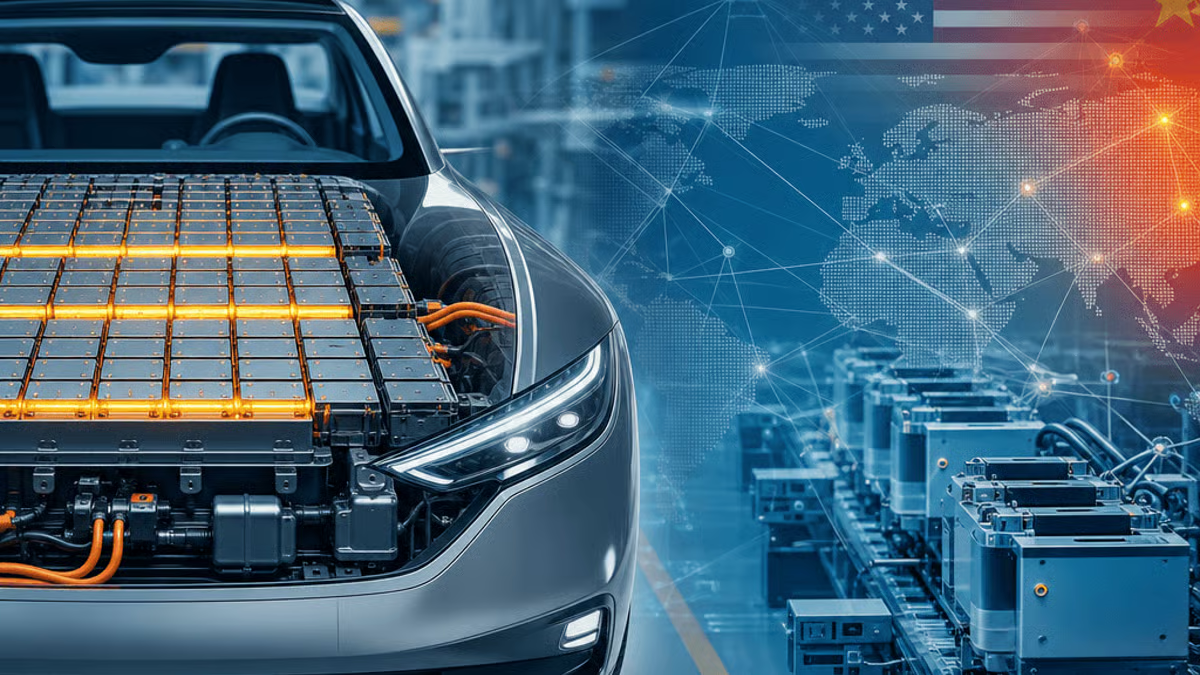
The repeal of domestic sourcing requirements for EV tax credits just reshaped America’s electric vehicle landscape. Slate, an emerging American automaker, is pivoting to Chinese-manufactured batteries, becoming the latest casualty – or beneficiary – of the Trump administration’s reversal on battery material sourcing rules. The move promises to deliver what could be America’s most affordable EV, but at the cost of the domestic supply chain ambitions that defined the original Inflation Reduction Act.
The Trump administration’s decision to repeal domestic sourcing requirements for electric vehicle tax credits is already reshaping the American automotive landscape. Slate, a rising player in the American EV market, just announced it’s transitioning to Chinese-manufactured batteries – a move that would’ve been financially impossible under the previous tax credit structure.
The timing reveals just how quickly policy can redirect entire industries. When the Inflation Reduction Act passed in 2022, it included strict requirements that battery components and critical minerals be sourced domestically or from free-trade partners to qualify for the $7,500 consumer tax credit. Those rules were designed to build American battery manufacturing capacity and reduce dependence on Chinese supply chains. But the recent repeal has opened the floodgates.
Chinese manufacturers spent the last decade perfecting lithium iron phosphate (LFP) battery technology – a chemistry that trades some energy density for dramatically lower costs and better safety profiles. Companies like CATL and BYD have driven LFP costs down to roughly $80 per kilowatt-hour, compared to $120-140 for the nickel-based batteries favored by American manufacturers. For an automaker trying to break into the mass market, that cost difference is existential.
Slate‘s decision reflects a broader industry calculation. With domestic sourcing requirements eliminated, automakers no longer face the penalty of losing tax credit eligibility by using Chinese batteries. The policy change essentially removed the main incentive to pay premium prices for American-made cells. According to industry analysts, battery costs represent roughly 30-40% of an EV’s total manufacturing expense, making them the single biggest lever for reducing sticker prices.
The irony isn’t lost on industry observers. The original EV tax credit structure aimed to bootstrap American battery manufacturing by creating guaranteed demand for domestic production. Companies like Panasonic, LG Energy Solution, and Samsung SDI have invested billions in US factories based on those policy commitments. Now those investments face direct competition from Chinese imports that no longer carry a tax penalty.
Several American automakers had been vocal about the challenges of meeting the domestic sourcing requirements. Ford and General Motors both warned that the rules would limit which vehicles could qualify for credits, potentially slowing EV adoption. But the solution – eliminating the requirements entirely – swings the pendulum dramatically in the opposite direction.
For Slate, the Chinese battery strategy could be the difference between remaining a niche player and achieving mass-market scale. The company has been positioning itself as the affordable EV option for middle-income Americans, a market segment that remains largely underserved as most EVs cluster at premium price points. Chinese LFP batteries make that positioning financially viable.
The competitive dynamics are already shifting. Tesla has been using Chinese LFP batteries in its standard-range Model 3 and Model Y variants for years, even manufacturing some of those vehicles domestically with imported cells. That approach now makes even more sense without domestic sourcing requirements. Other automakers are reportedly reevaluating their battery supply contracts.
But the policy reversal raises thorny questions about industrial strategy and national security. Battery manufacturing represents one of the defining industries of the energy transition. The original tax credit structure reflected a bipartisan consensus – however fragile – that America needed domestic production capacity for both economic and security reasons. Chinese dominance of the battery supply chain, from raw material processing to cell manufacturing, has been a persistent concern among policymakers.
Trade policy experts point out that the repeal doesn’t occur in isolation. It follows years of escalating trade tensions, tariffs, and restrictions on Chinese technology. The decision to remove battery sourcing requirements seems to contradict broader efforts to reduce economic dependence on China, creating confusion about long-term policy direction.
For American battery manufacturers, the outlook just got considerably more challenging. Without policy support to offset cost disadvantages during the scaling phase, domestic producers will need to compete head-to-head with Chinese manufacturers that have massive scale advantages and years of production experience. Some industry observers predict consolidation and possible factory closures if the policy remains in place.
Consumers, however, stand to benefit from lower EV prices – at least in the short term. If Slate and other automakers can leverage Chinese battery costs to deliver genuinely affordable EVs, it could accelerate the transition away from internal combustion engines. That’s been the goal all along, even if the path there looks different than originally envisioned.
The Slate battery decision crystallizes the tension between short-term affordability and long-term industrial strategy. American consumers might finally get the affordable EVs they’ve been promised, but at the cost of the domestic manufacturing base policymakers spent years trying to build. Whether this represents pragmatic policy correction or strategic shortsightedness will depend largely on what happens next – and whether other policy tools emerge to support American battery manufacturing. For now, Chinese battery makers are the clear winners, and the future of America’s EV supply chain looks considerably more uncertain than it did just months ago.






Leave a Reply