
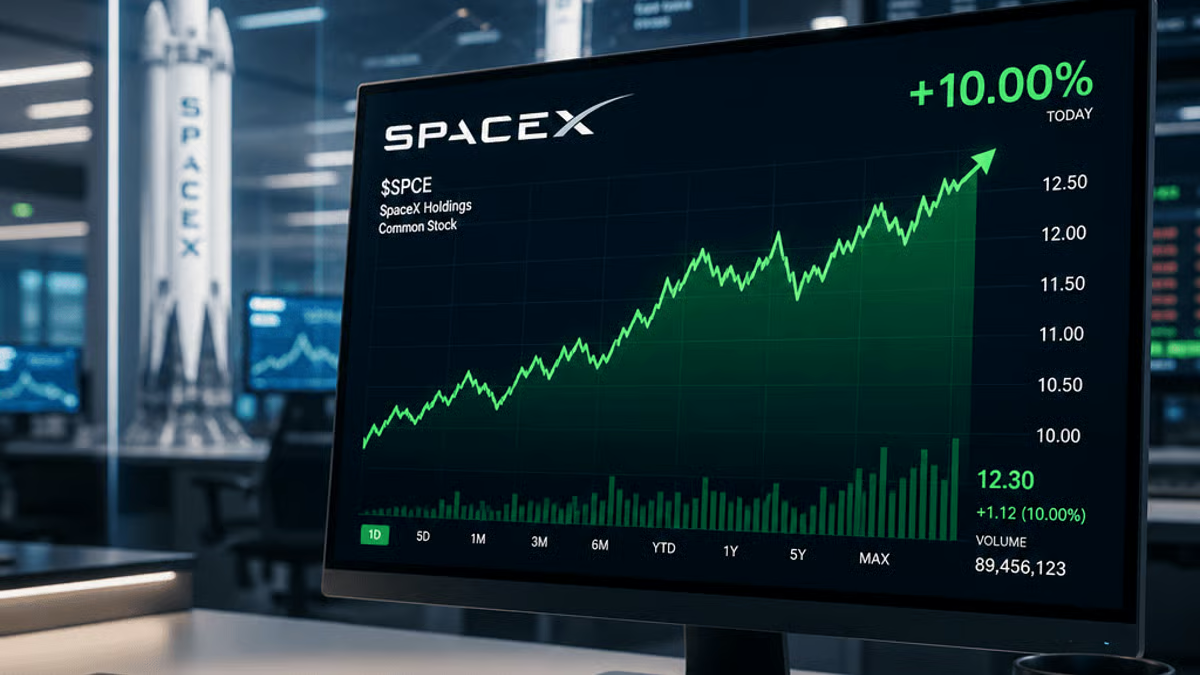
SpaceX is about to pull back the curtain on its financials for the first time as a public company, and Wall Street is already buzzing. The rocket maker’s stock jumped nearly 10% in extended trading ahead of its Q2 2026 earnings report, marking a watershed moment for the space industry. Investors are hungry for details on Starlink’s revenue trajectory, AI infrastructure spending, and Starship’s path to profitability—all while Elon Musk’s company navigates the scrutiny that comes with being a publicly traded entity.
SpaceX shares are climbing in anticipation of a moment the space industry has been waiting years to see. The company’s stock jumped nearly 10% in after-hours trading Tuesday as investors positioned themselves ahead of SpaceX’s debut earnings report as a public company. It’s a remarkable milestone for a firm that spent two decades operating in the shadows of private markets, and now finds itself answering to quarterly expectations.
The Q2 2026 report, expected after market close, will offer unprecedented visibility into the financial engine powering humanity’s most ambitious space ventures. Until now, SpaceX’s revenue mix—split between launch services, Starlink satellite internet, and government contracts—has been the subject of industry speculation and occasional leaks. Wall Street analysts have been scrambling to build models based on limited data points, and tonight they’ll finally get the real numbers.
Starlink is emerging as the crown jewel investors want to understand. The satellite constellation, which now beams internet to more than 4 million subscribers globally, is believed to be generating several billion dollars in annual revenue. But the unit economics remain opaque. How much is SpaceX spending to manufacture and launch tens of thousands of satellites? What’s the customer acquisition cost? These questions will determine whether Starlink becomes the cash cow that funds Mars ambitions or a capital-intensive drag on margins.
Then there’s the AI angle that’s got tech investors particularly intrigued. SpaceX has been quietly building out ground infrastructure to support AI training workloads, leveraging Starlink’s low-latency network. The company’s capital expenditure on AI-related hardware and data centers could signal a strategic pivot beyond traditional aerospace, potentially opening up a lucrative B2B revenue stream. If SpaceX reveals meaningful AI spending figures, it’ll be a clear sign the company is positioning itself at the intersection of space and machine learning.
Starship, the fully reusable super heavy-lift rocket that NASA is counting on for moon missions, represents both SpaceX’s biggest opportunity and its most significant financial question mark. The program has burned through billions in development costs, and investors want to know when it’ll start generating returns. Launch cadence projections, payload capacity commitments, and pricing strategy for commercial customers will be critical data points in tonight’s call.
The stock’s pre-earnings surge reflects broader optimism about SpaceX’s ability to execute across multiple fronts. Unlike traditional aerospace contractors that rely heavily on government contracts with razor-thin margins, SpaceX has built a vertically integrated model that spans commercial satellite deployment, crewed missions, cargo resupply, and now consumer internet services. This diversification is appealing to investors who’ve watched the company undercut competitors while maintaining what’s believed to be healthy profitability.
But going public means facing new pressures. Quarterly earnings cycles could force difficult tradeoffs between long-term R&D investments and near-term profit delivery. Elon Musk’s dual role as CEO of both SpaceX and Tesla will face renewed scrutiny, especially as both companies navigate AI investments and manufacturing scaling challenges. The transparency required of public companies also means competitors and customers alike will gain insights into SpaceX’s cost structure and strategic priorities.
Analysts polled by financial data providers are expecting strong top-line growth, with revenue estimates clustering around $8-10 billion for the quarter. If accurate, that would represent a significant acceleration from the company’s last disclosed private financials. Gross margins on Falcon 9 launches, which benefit from booster reusability, are believed to be among the highest in the aerospace industry. But investors will be watching free cash flow closely, especially given the capital intensity of Starlink expansion and Starship development.
The earnings call will also offer the first official guidance on full-year 2026 expectations and potentially a peek into 2027 planning. Launch manifest visibility, Starlink subscriber growth trajectories, and any commentary on international expansion plans will be parsed for signals about the company’s growth runway. SpaceX has demonstrated an ability to execute on ambitious technical goals; now it must prove it can deliver predictable financial performance.
What happens after the numbers drop will set the tone for how Wall Street values the new space economy. A strong report could validate SpaceX’s premium valuation and spark a rally in space-adjacent stocks. Disappointment, on the other hand, might force a reckoning about the true economics of reusable rockets and satellite mega-constellations. Either way, the space industry is about to get a crash course in public market realities.
SpaceX’s transition from private powerhouse to public company marks more than just a financial milestone—it’s a test of whether the space industry’s economics can satisfy Wall Street’s growth demands. The 10% pre-earnings pop shows investors are optimistic, but the real work begins once quarterly scrutiny becomes the norm. If SpaceX can maintain its technical execution while delivering transparent financials and consistent growth, it’ll prove that space isn’t just the final frontier for exploration, but a viable frontier for public market returns. Tonight’s report is just the opening act in that much longer story.










Leave a Reply