
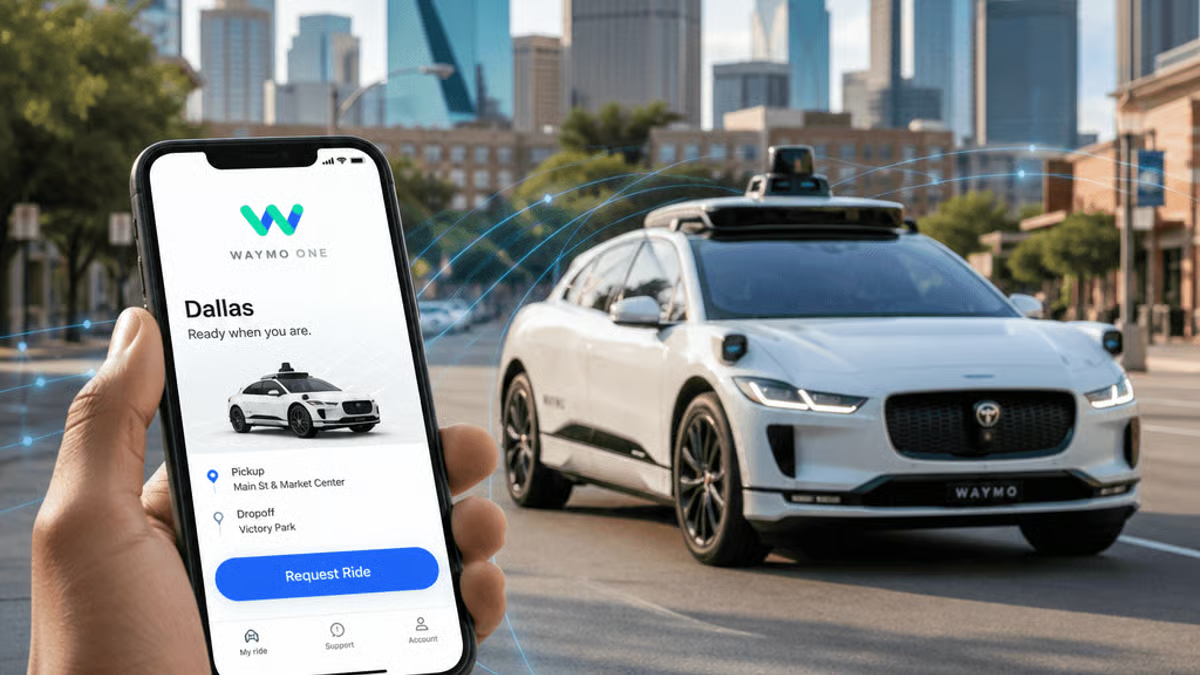
Waymo just made its biggest accessibility move yet. The Google-owned autonomous vehicle company dropped the waitlist for its robotaxi service in Dallas, letting anyone download the app and hail a driverless ride starting today. It’s a major signal that Waymo thinks its technology is ready for prime time, and marks a turning point in the race to commercialize self-driving cars across major U.S. cities.
Waymo isn’t testing anymore. The Alphabet-backed autonomous vehicle pioneer just flipped the switch in Dallas, removing the waitlist barrier that’s kept thousands of curious riders on the sidelines since the company first rolled into Texas.
Anyone with a smartphone can now download the Waymo One app and summon a driverless Jaguar I-PACE to their location. No invitation needed, no waiting in line. It’s the kind of move that signals serious confidence in the technology and a hunger to capture market share before competitors catch up.
The Dallas expansion comes as Waymo pushes an ambitious international growth strategy. The company’s already operating commercially in San Francisco and Phoenix, but Dallas represents something different – it’s a sprawling, car-dependent metro with notoriously complex highway systems and unpredictable weather patterns. If Waymo can crack Dallas, it can crack anywhere.
“We’ve been methodically expanding our service area and fleet capacity,” the company said in its announcement, though they declined to share specific numbers on how many vehicles are now operating in Dallas or how many rides they’re completing daily. That opacity is standard for Waymo, which tends to focus on safety metrics over volume statistics.
The timing isn’t accidental. Tesla keeps promising its own robotaxi network is imminent, while Cruise – backed by General Motors – is rebuilding trust after a series of high-profile incidents forced it to pause operations. Waymo sees an opening and it’s moving fast.
What makes this rollout particularly aggressive is the international ambition. Waymo’s not just targeting U.S. cities anymore. The company’s been conducting tests and building partnerships across the U.K. and parts of Europe, laying groundwork for what could be the first truly global autonomous ride-hail network. That’s a massive operational lift that requires navigating different regulatory frameworks, road conditions, and driving cultures.
The economics are starting to make sense too. Autonomous vehicles eliminate the biggest cost in ride-hailing: the driver. If Waymo can achieve reliable 24/7 operations with minimal human intervention, the unit economics could undercut Uber and Lyft significantly. Those companies are watching nervously and hedging their bets with their own autonomous partnerships.
But scale remains the challenge. Even without a waitlist, Waymo needs to flood Dallas with enough vehicles to ensure wait times stay competitive. Nothing kills adoption faster than opening an app and seeing a 25-minute pickup time. The company’s been ramping production with manufacturing partner Magna International, but going from hundreds to thousands of vehicles across multiple cities is an expensive, complex undertaking.
Safety records will be scrutinized relentlessly now that the service is fully public. Every fender bender, every confused merge, every edge case that goes viral on social media will fuel the debate about whether autonomous vehicles are truly ready for mass deployment. Waymo’s bet is that its millions of miles of real-world driving data have prepared its systems for the chaos of everyday traffic better than any competitor.
The Dallas launch also tests Waymo’s operational maturity. Managing a fleet at scale means handling customer service issues, vehicle maintenance, charging infrastructure, and real-time route optimization across a 100+ square mile service area. It’s not just about the AI anymore – it’s about running a transportation company.
Competitors aren’t standing still. Chinese autonomous vehicle companies like WeRide and Pony.ai are expanding aggressively in Asia and exploring U.S. partnerships. The race to establish network effects and brand recognition in autonomous ride-hailing is heating up globally.
Waymo’s decision to drop the Dallas waitlist is more than just a local expansion – it’s a declaration that the autonomous vehicle future is arriving faster than most people expected. The company’s betting that its technology, operational know-how, and first-mover advantage will let it build an unassailable lead before traditional ride-hail companies and automotive giants catch up. For Dallas residents, it means living in a city where summoning a driverless car is as normal as ordering food delivery. For the industry, it means the competition for autonomous supremacy just entered a new, more aggressive phase. Watch how quickly Waymo can replicate this playbook in other major metros – that’ll tell you whether we’re witnessing a genuine inflection point or just another chapter in the long, slow march toward self-driving ubiquity.






Leave a Reply