
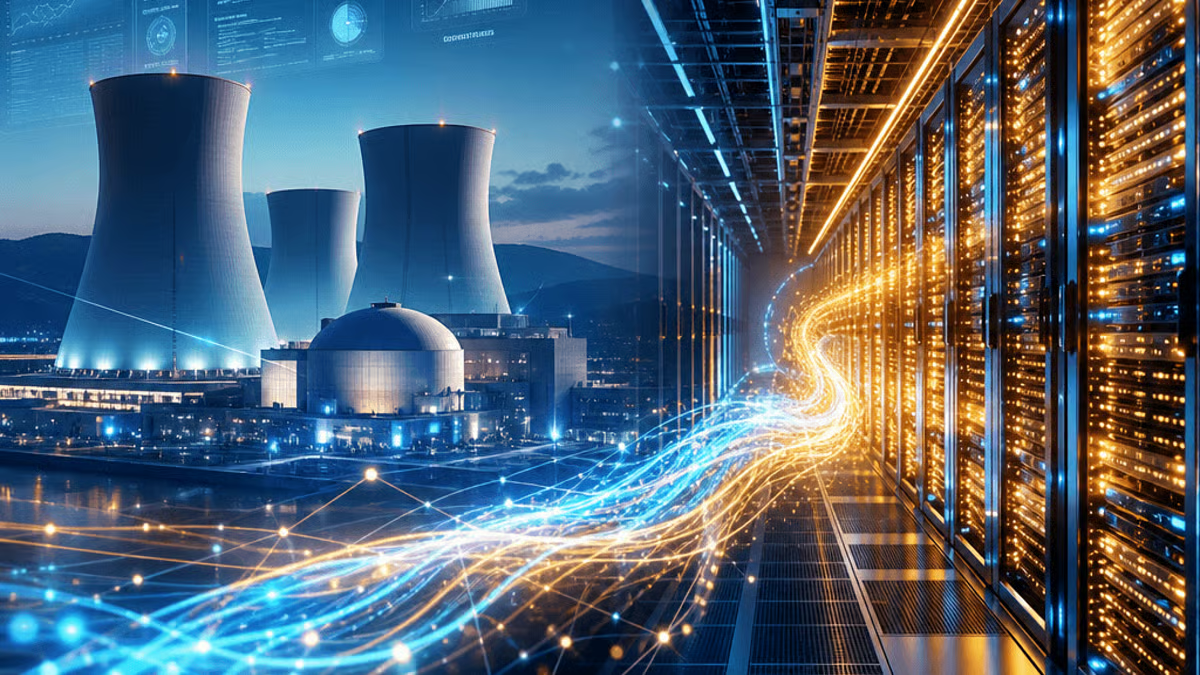
Nuclear energy startup Valar Atomics just closed one of the year’s largest funding rounds, pulling in $1 billion at a $6 billion valuation in a deal led by Sequoia Capital partner Shaun Maguire. The timing isn’t coincidental – the round comes just two months after the company signed a strategic development agreement with Nvidia in June, signaling how seriously Big Tech is taking the AI data center power crisis. It’s a bet that nuclear is the answer to AI’s insatiable energy appetite.
Valar Atomics just secured $1 billion in what might be the most telling investment of the AI infrastructure boom. The nuclear energy startup closed the round at a $6 billion valuation, with Sequoia Capital partner Shaun Maguire taking the lead. But the real story here isn’t just the size of the check – it’s what happened two months earlier.
In June, Valar Atomics signed a development agreement with Nvidia, the chipmaker that’s become synonymous with the AI revolution. That partnership essentially validated what energy analysts have been screaming from the rooftops: AI’s exponential growth is hitting a wall, and that wall is made of inadequate power infrastructure. Nvidia’s latest H100 and B100 GPU clusters can consume as much electricity as a small city, and traditional grid capacity simply can’t keep up.
Maguire, known for his contrarian bets on hard tech and deep science, reportedly began pursuing Valar Atomics shortly after the Nvidia deal became public. According to sources familiar with the financing, Sequoia moved fast, recognizing that nuclear partnerships with hyperscalers and AI infrastructure players would become the new moat in energy tech. The firm’s thesis is straightforward: whoever solves the data center power problem wins the next decade of AI.
The billion-dollar injection puts Valar Atomics in rarefied air among nuclear startups. While companies like Oklo and TerraPower have attracted attention and capital, Valar’s combination of strategic partnerships and rapid scaling caught Sequoia’s attention. The startup is reportedly developing advanced small modular reactor technology designed specifically for data center deployment, with faster build times and regulatory pathways than traditional nuclear plants.
Nvidia’s involvement isn’t just symbolic. The June development deal likely includes commitments around power capacity, deployment timelines, and potentially offtake agreements that give Valar Atomics guaranteed demand for its future reactors. For Nvidia, securing dedicated power sources has become as critical as chip production – without reliable energy, even the most advanced AI accelerators are useless.
The urgency is palpable across the industry. Microsoft recently signed a deal to restart Three Mile Island’s reactor to power its AI operations. Google and Amazon have both announced nuclear energy investments to support their cloud and AI infrastructure. The pattern is clear: Big Tech is done waiting for the grid to catch up and is building its own power solutions.
Maguire’s involvement adds credibility beyond just capital. The Sequoia partner has a physics PhD from Caltech and has championed deep tech investments that others dismissed as too ambitious or too slow. His backing signals to the market that Valar Atomics has solved – or is close to solving – the technical and regulatory challenges that have plagued nuclear startups for decades.
The $6 billion valuation reflects not just the company’s technology but the massive addressable market. Data center power demand is projected to triple by 2030, driven almost entirely by AI workloads. Solar and wind can’t provide the baseload, always-on power that AI training and inference require. Natural gas conflicts with corporate climate commitments. Nuclear is increasingly the only option that checks every box: carbon-free, high-density, and reliable.
What remains unclear is Valar Atomics’ timeline to commercial deployment. Even advanced reactor designs face multi-year regulatory reviews, though the company may be pursuing accelerated pathways through the Department of Energy. The Nvidia partnership suggests confidence that reactors could be operational within the timeframe that matters for AI infrastructure planning – likely three to five years.
Other investors in the round haven’t been disclosed, but energy-focused venture firms and strategic corporates likely participated given the deal size. The billion-dollar raise gives Valar Atomics significant runway to navigate regulatory processes, finalize reactor designs, and begin site development for its first commercial installations.
The funding environment for nuclear startups has transformed dramatically. Just five years ago, venture capital avoided nuclear due to regulatory uncertainty and capital intensity. Now, with AI driving unprecedented power demand and climate pressures mounting, nuclear has become one of the hottest sectors in infrastructure investing. Valar Atomics is riding that wave with heavyweight backing and a customer pipeline that starts with the most power-hungry industry on the planet.
Valar Atomics’ billion-dollar raise is about more than nuclear energy – it’s a referendum on AI’s future. The combination of Sequoia’s backing, Nvidia’s strategic partnership, and a $6 billion valuation signals that nuclear infrastructure has moved from controversial to critical in less than two years. As AI models grow larger and data centers multiply, the companies that control reliable, carbon-free power will control the infrastructure layer of the next computing era. Valar Atomics just positioned itself at the center of that transformation, and the industry is watching to see if they can deliver reactors as fast as Nvidia can ship chips.










Leave a Reply