
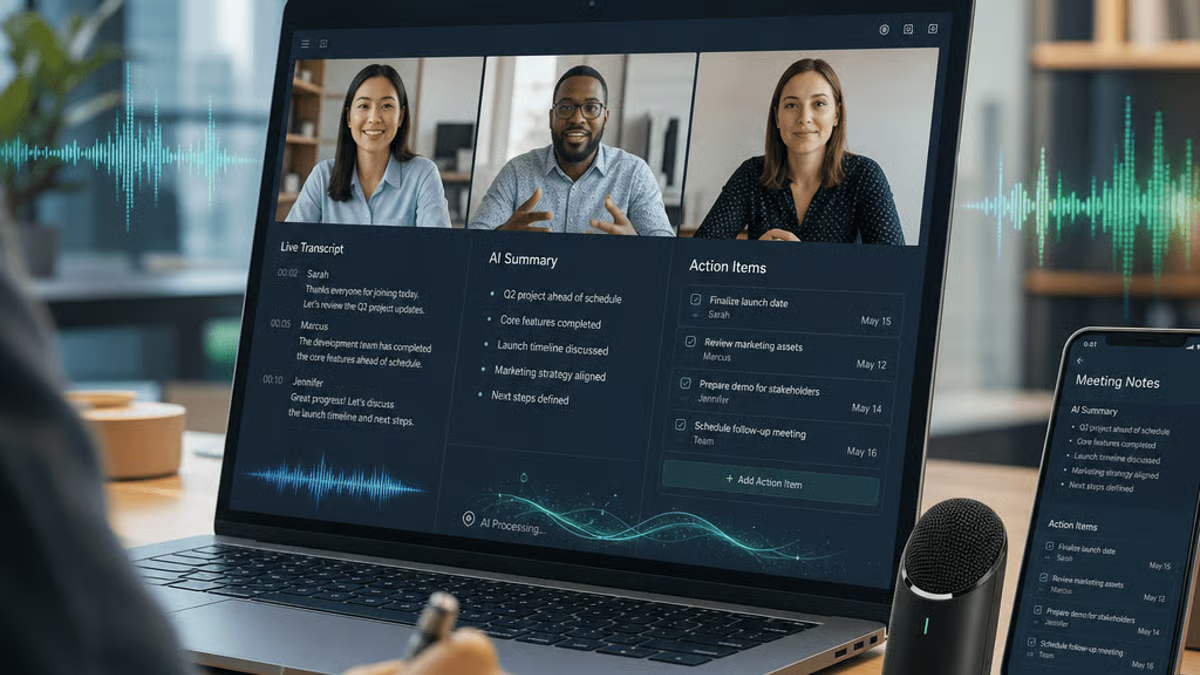
Wispr Flow, the AI-powered voice dictation startup, is preparing to launch a meeting notetaker tool that automatically generates summaries and action items, according to updated terms of service spotted by TechCrunch. The move puts Wispr squarely in competition with established players like Otter.ai, Fireflies, and Granola in the increasingly crowded AI productivity space. For a company that built its reputation on real-time voice-to-text transcription, the pivot to meeting intelligence represents a natural but challenging expansion.
Wispr Flow is about to get a lot more ambitious. The voice dictation startup, which has quietly built a following for its AI-powered speech-to-text tool, just telegraphed its next move through an update to its terms of service. Buried in the new language are references to meeting transcription, automated summaries, and action item extraction – all hallmarks of the booming meeting notetaker category.
The timing is telling. Meeting intelligence tools have exploded in the past two years as remote work normalized having AI bots join Zoom calls. Otter.ai claims millions of users, Fireflies has raised over $19 million, and Granola just emerged from stealth with backing from top-tier VCs. The market’s getting crowded, but it’s also getting lucrative. Companies are willing to pay $20 to $30 per user per month for tools that eliminate note-taking drudgery.
Wispr’s entry makes strategic sense. The company already handles real-time voice transcription – the hardest technical piece of the meeting notetaker puzzle. Extending that capability to capture entire meetings, then layering on AI summarization and task extraction, is a logical product evolution. The terms update spotted by TechCrunch suggests the feature is close to launch, though Wispr hasn’t officially announced timing or pricing.
But this isn’t an easy market to crack. Users have already formed habits around existing tools, and switching costs are higher than they appear. Teams that have built workflows around Otter or Fireflies won’t jump ship without compelling reasons. Wispr will need to differentiate on accuracy, speed, integrations, or price – and probably all four.
The competitive landscape favors incumbents. Otter has enterprise deals with major corporations and integrates directly into Zoom, Microsoft Teams, and Google Meet. Fireflies offers similar breadth plus CRM integrations that automatically log sales calls. Granola is positioning itself as the premium option with superior AI summaries. Where does Wispr fit?
One potential angle is accuracy. Wispr built its reputation on voice dictation that actually works – a surprisingly high bar in a category plagued by transcription errors. If that quality translates to meeting capture, especially in noisy environments or with multiple speakers, it could be a differentiator. Real-time processing speed matters too. Nobody wants to wait 10 minutes after a call ends to get their notes.
The broader trend here is AI tools collapsing into each other. What started as distinct categories – voice dictation, meeting transcription, note-taking apps, task managers – is blurring into an all-in-one productivity stack. Notion added AI writing. Grammarly added tone detection. Now Wispr is adding meeting intelligence. Users benefit from consolidation, but startups face the innovator’s dilemma of expanding beyond their core competency.
Financial pressure might be driving the move. Voice dictation is a tough business to monetize at scale. Subscription prices are low, switching costs are minimal, and users balk at paying for something smartphones do for free. Meeting notetakers command higher prices because they solve a more painful problem – the endless cycle of meetings and follow-ups that drain knowledge worker productivity.
Wispr hasn’t disclosed revenue or funding details recently, but the product expansion suggests either opportunity or necessity. Companies don’t enter crowded markets casually. Either they’ve identified a genuine gap competitors aren’t filling, or they need a new revenue stream to sustain growth. The terms update offers no clues which scenario applies.
What’s clear is the stakes. Meeting intelligence is becoming table stakes for AI productivity companies. Microsoft bundles it into Teams Premium. Google is testing it in Meet. Zoom acquired a transcription startup last year. If Wispr wants to remain relevant as big tech wakes up to this category, it needs to move fast.
The product details matter enormously. Will Wispr’s notetaker work across all meeting platforms or just a few? Does it require installing a bot that joins calls, or does it capture audio locally? How does it handle privacy and data retention? These aren’t just feature questions – they’re make-or-break factors for enterprise adoption. The updated terms mention data processing but don’t specify architecture.
Industry watchers will be looking for pricing signals. Fireflies starts at $10 per month. Otter charges $16.99 for its Pro tier. Granola hasn’t disclosed pricing but is positioning premium. If Wispr undercuts on price while matching on quality, it could grab market share. If it prices at parity, differentiation becomes harder.
Wispr Flow’s impending meeting notetaker launch is a calculated bet on AI productivity consolidation, but it’s entering a market where user loyalty runs deep and feature parity runs high. The company’s voice transcription chops give it a technical foundation, but success will hinge on execution details we haven’t seen yet – integrations, pricing, accuracy under real-world conditions. For now, the terms update is a signal of intent in a category where standing still means falling behind. Whether Wispr can carve out meaningful market share against entrenched competitors and deep-pocketed tech giants remains the open question. The answer will come down to whether users find a compelling reason to switch, and that’s never just about features – it’s about solving problems competitors overlooked.









Leave a Reply