
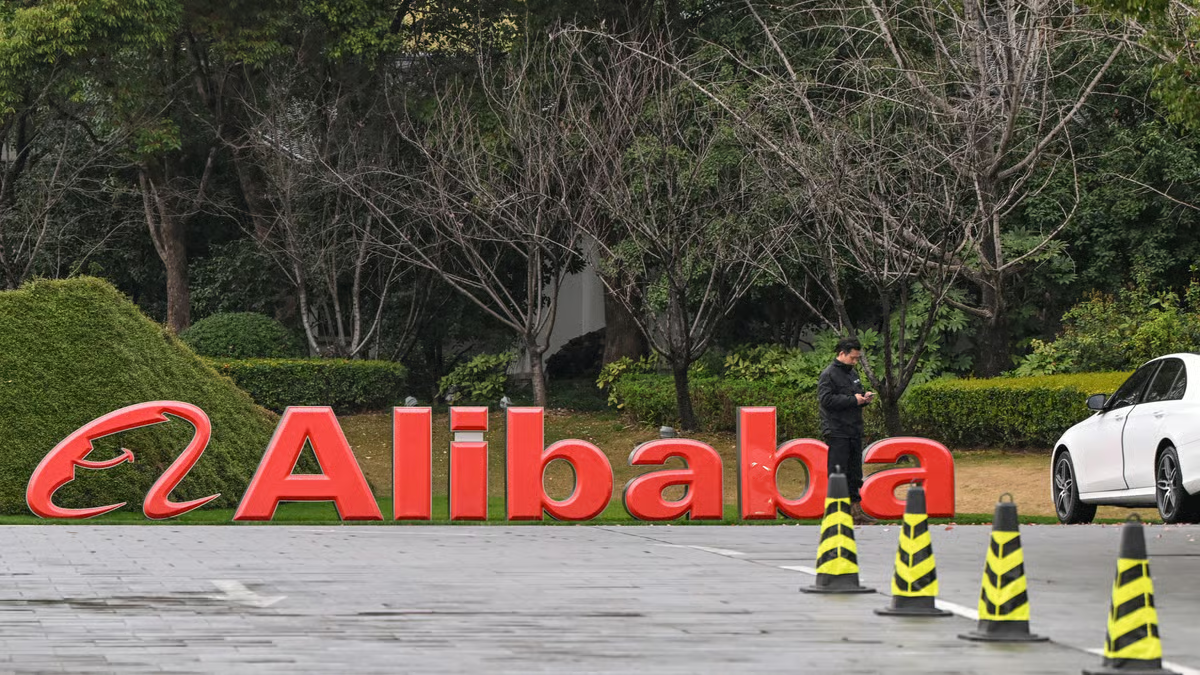
Alibaba just dropped its most powerful AI model yet, and the Chinese tech giant isn’t being shy about the competition it’s targeting. The company released Qwen3.8-Max on Monday, claiming performance that rivals Anthropic’s flagship Fable 5 and OpenAI’s top systems. The move marks another escalation in the US-China AI race, with Beijing-based companies increasingly releasing open-weight models that challenge Silicon Valley’s technical dominance while raising fresh questions about export controls, national security, and the future of AI development.
Alibaba just made its boldest move yet in the global AI arms race. The Chinese e-commerce and cloud giant released Qwen3.8-Max on Monday, billing it as the company’s “most capable AI model to date” with performance metrics that supposedly match the best systems coming out of Anthropic and OpenAI. According to Alibaba’s blog post, the model ranks “second only to Fable 5” – Anthropic’s flagship system that’s been setting benchmarks since its release.
The release wasn’t entirely unexpected. Alibaba previewed the model last month, giving the AI community advance warning that another heavyweight Chinese model was incoming. But the actual launch still sends ripples through an industry already grappling with the implications of China’s rapid AI advancement despite US export restrictions on advanced chips.
What makes this particularly noteworthy is Alibaba’s decision to make Qwen3.8-Max widely available as an open-weight model. Unlike closed systems from OpenAI or Anthropic, developers worldwide can download, modify, and deploy Alibaba’s technology. It’s a strategic choice that mirrors China’s broader approach to AI development – if you can’t manufacture the most advanced chips, make your software so accessible that hardware limitations matter less.
The competitive landscape just got more crowded. Alibaba isn’t just competing with American labs anymore. Domestic rival Moonshot AI released its Kimi K3 model recently, and the two Chinese companies are now locked in their own rivalry while simultaneously challenging Western dominance. According to Alibaba’s internal benchmarks, Qwen3.8-Max outperforms Kimi K3 on several key metrics, though independent verification of these claims is still pending.
The technical specs reveal how far Chinese AI has come. While US export controls have limited China’s access to cutting-edge Nvidia chips, companies like Alibaba have gotten remarkably efficient at training large language models on less powerful hardware. The exact training methodology for Qwen3.8-Max remains partly under wraps, but industry observers suspect aggressive optimization techniques and longer training runs on available chip stockpiles.
Silicon Valley is watching nervously. The open release of increasingly capable Chinese models adds to mounting tensions around AI safety, national security, and competitive positioning. Some American researchers argue that open-weight releases democratize AI and accelerate global innovation. Others worry about losing the technological edge that’s underpinned US dominance in the sector.
Washington’s response will be telling. The Biden administration’s chip export controls were designed to slow China’s AI progress by limiting access to advanced semiconductors. Alibaba’s release suggests those controls haven’t stopped Chinese labs from developing frontier-class models – they’ve just changed how those models get built. Policymakers now face tough questions about whether tighter restrictions would be effective or simply push Chinese development further underground.
The business implications are significant too. Alibaba’s cloud division has been struggling to compete with AWS and Microsoft Azure globally, but offering state-of-the-art AI models for free could change that calculus. Developers who adopt Qwen3.8-Max might find themselves increasingly tied to Alibaba’s ecosystem of cloud services and tools.
For AI researchers, this marks another data point in the great open versus closed debate. While OpenAI and Anthropic have largely moved toward closed, API-only access for their most powerful models, Chinese companies are betting that open releases will drive faster adoption and ecosystem growth. It’s a fundamentally different strategic approach, and the next few years will reveal which bet pays off.
The release also highlights the global nature of AI competition. Despite geopolitical tensions and export controls, the technology continues to advance on multiple continents simultaneously. Chinese labs are publishing papers, releasing models, and pushing benchmarks forward just as aggressively as their Western counterparts.
Alibaba’s Qwen3.8-Max release represents more than just another AI model launch – it’s a statement about the shifting balance of power in global AI development. As Chinese companies continue releasing capable open-weight models despite US export restrictions, the fundamental assumptions underlying Western AI strategy are being tested. The question isn’t whether China can build frontier AI systems anymore; it’s how quickly they can iterate and whether the open approach will ultimately prove more effective than the closed API model favored by American labs. For developers, businesses, and policymakers worldwide, Qwen3.8-Max is a reminder that the AI race is truly global, and the finish line keeps moving.







Leave a Reply