
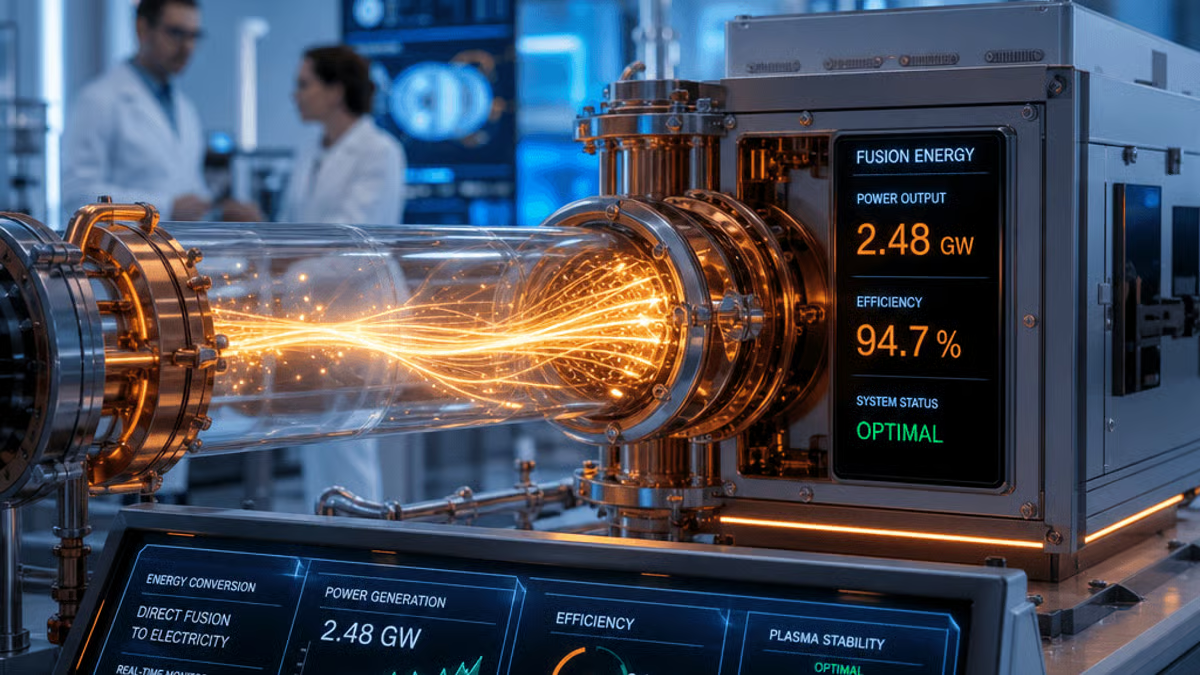
Realta Fusion just rewrote the playbook for fusion energy. The startup demonstrated it can generate electricity directly from a fusion reaction without steam turbines – an apparent industry first that could dramatically simplify the path to commercial fusion power. While most fusion companies focus on achieving net energy gain, Realta’s approach sidesteps the complex thermal conversion systems that have defined power generation for over a century.
Realta Fusion just pulled off something no other fusion company has publicly demonstrated – generating electricity straight from a fusion reaction without routing heat through steam turbines. The announcement, reported by TechCrunch, marks a potentially transformative shift in how fusion energy could reach the grid.
Most fusion efforts follow the same playbook as coal and nuclear fission plants: generate heat, boil water, spin turbines. It’s a 19th-century approach to 21st-century physics. Realta’s direct conversion method bypasses that entire chain, potentially slashing the complexity and cost of future fusion power plants. The company hasn’t disclosed the exact mechanism yet, but direct conversion techniques typically capture charged particles from fusion reactions and convert their kinetic energy straight into electricity.
The timing couldn’t be more critical for the fusion sector. Companies like Commonwealth Fusion Systems, Helion Energy, and TAE Technologies have collectively raised over $6 billion in venture funding, all racing toward the same goal: proving fusion can be a practical energy source. Most are targeting the 2030s for commercial deployment. But they’re all planning to use conventional thermal conversion, which adds hundreds of millions in capital costs and significant efficiency losses.
Realta’s approach could leapfrog that limitation entirely. Direct energy conversion isn’t new – NASA explored it for space applications in the 1960s – but applying it to fusion has remained largely theoretical. The challenge is capturing enough of the reaction’s energy efficiently. Fusion reactions spray energy in multiple forms: neutrons carry about 80% of the energy in deuterium-tritium fusion, while charged particles carry the rest. Neutrons are notoriously difficult to capture directly, which is why most designs dump their energy into a blanket material as heat.
The fusion industry has been on a tear lately. Commonwealth Fusion’s SPARC reactor aims for net energy gain by 2027. Helion signed a power purchase agreement with Microsoft to deliver fusion electricity by 2028. General Fusion is building a demonstration plant in the UK. The sector’s momentum has attracted major tech investors – Sam Altman personally invested $375 million in Helion, while Google and Chevron have backed TAE Technologies.
But technical milestones don’t always translate to commercial success. The fusion sector has been criticized for overpromising and underdelivering. Scientists achieved fusion ignition at the National Ignition Facility in 2022, a genuine breakthrough that made headlines worldwide. Yet converting that lab success into a power plant remains a massive engineering challenge. Direct conversion addresses one piece of that puzzle – the efficiency losses in thermal conversion typically waste 60-65% of the heat energy.
Realta hasn’t disclosed how much power its demonstration generated or what efficiency it achieved. Those numbers matter enormously. If the system only captures a small fraction of the fusion energy, it’s a physics demonstration rather than a path to commercialization. The company also hasn’t revealed its fusion approach – whether it’s using magnetic confinement, inertial confinement, or one of the alternative schemes like field-reversed configuration or spheromak.
What’s clear is that eliminating turbines could dramatically reshape fusion economics. Turbine systems require extensive balance-of-plant infrastructure: heat exchangers, cooling systems, generators, condensers. That’s why nuclear plants cost $6-9 billion to build. A direct conversion fusion plant could potentially shrink the facility footprint and capital costs by 30-40%, making it competitive with renewable energy plus storage.
The breakthrough also highlights how competitive the fusion race has become. Companies are exploring radically different approaches, betting billions that their particular physics approach will win. Commonwealth is using high-temperature superconducting magnets to create compact tokamaks. Helion is pursuing pulsed non-ignition fusion specifically designed for direct conversion. TAE is trying to fuse hydrogen and boron, which produces no neutrons but requires much higher temperatures.
Realta’s emergence adds another contender to this increasingly crowded field. The company has operated relatively quietly compared to fusion’s higher-profile startups – it’s not clear how much funding they’ve raised or who’s backing them. That stealth approach mirrors how some AI labs operated before their breakthroughs forced them into the spotlight.
The fusion sector needs more than demonstrations at this point. It needs a clear path to a plant that can feed power to the grid at a price utilities will pay. Direct conversion helps with that equation, but plenty of challenges remain: materials that can withstand neutron bombardment, tritium fuel breeding, regulatory approval, supply chain development. Every fusion company is solving a different piece of this puzzle, and it’s not yet clear which combination of approaches will actually work at commercial scale.
Realta Fusion’s demonstration answers one of fusion energy’s toughest questions – how do you capture the power efficiently – but it raises plenty more. The company will need to prove this works at scale, disclose efficiency numbers, and show it can be manufactured cost-effectively. Still, eliminating steam turbines is exactly the kind of architectural innovation fusion needs if it’s going to compete with plummeting renewable costs. The race to commercial fusion just got more interesting, and the approach that seemed most radical might end up being the most practical. Watch for Realta to disclose more technical details and funding news as it moves from demonstration to development.











Leave a Reply