
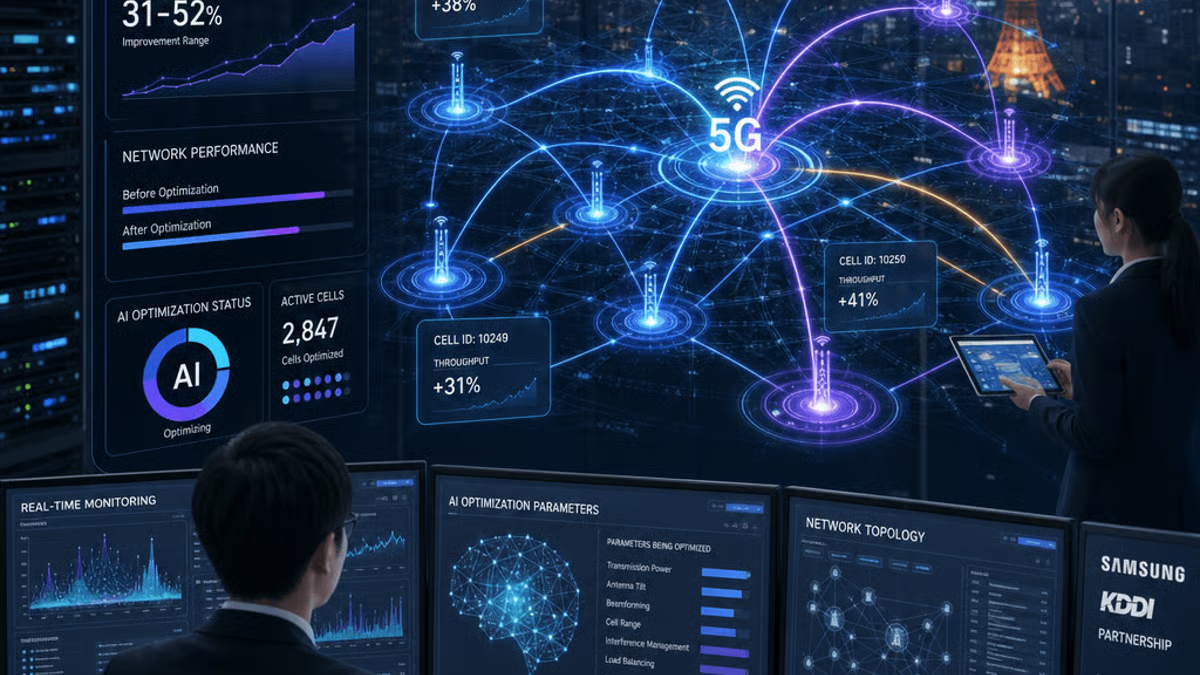
Samsung just proved AI can optimize commercial 5G networks better than humans. The company’s RAN Speed Optimizer boosted downlink throughput by up to 52% on KDDI‘s live network across Tokyo, marking a shift from manual network tuning to AI-driven, cell-by-cell optimization. The months-long trial on hundreds of cells shows telecom infrastructure is ready for autonomous operation.
Samsung just cracked a problem that’s plagued telecom operators for years – how to optimize thousands of network cells without armies of engineers tweaking parameters manually. The company’s AI-powered RAN Speed Optimizer delivered a 31% average boost in 5G downlink throughput during a live trial on KDDI‘s commercial network in Japan, with peak gains hitting 52% in dense urban areas around Tokyo.
The trial, which ran from late 2025 through early 2026, covered hundreds of cells spanning urban, suburban and rural terrain across the greater Tokyo region. Samsung leveraged 100 MHz of 3.7 GHz TDD spectrum to train its AI models on real-world traffic patterns and network conditions. During peak usage hours, when networks typically strain under load, the RSO’s cell-by-cell optimization delivered the most dramatic improvements.
What makes this different from previous optimization attempts is the granularity. Traditional network tuning applies the same parameter settings across clusters of cells, assuming similar conditions. Samsung’s AI throws that approach out. The RSO analyzes environmental data for each individual cell – traffic patterns, interference levels, user density – and tailors optimization parameters specifically for that site. It’s the difference between buying off-the-rack suits and getting everything custom-tailored.
“Combining KDDI’s accumulated expertise in network innovation and Samsung’s technical leadership, this field trial proves that individual tuning for cells – a long-standing industry challenge – has now become a reality through the integration of AI,” Kazuhiro Furuhata, Chief Network Officer at KDDI, said in the announcement. The admission reveals just how manual and labor-intensive network optimization has been until now.
The RSO sits inside Samsung’s CognitiV Network Operations Suite, a collection of AI-powered automation tools the company’s been developing since 2024. The suite uses AI-based prediction models to analyze site data automatically and recommend optimized parameters. For operators like KDDI, that means networks that adjust themselves to changing conditions without constant human oversight.
The business case is straightforward. Telecom operators spend significant resources on network optimization teams that manually tune parameters based on performance reports and user complaints. Samsung’s approach flips that model – the AI monitors performance continuously and makes micro-adjustments in near real-time. Operators cut operational costs while end users get faster speeds whether they’re streaming video, gaming or video calling.
“Samsung continues to help operators like KDDI build intelligent and efficient networks by weaving in AI-powered innovation,” June Moon, Executive Vice President and Head of R&D for Networks Business at Samsung Electronics, told Samsung Newsroom. “Since 2024, we have been actively testing and training our AI-powered RSO technology in the field and we have demonstrated breakthrough progress in its capabilities.”
The trial’s timing matters. As operators globally deploy 5G standalone networks and prepare for 6G, network complexity is exploding. The number of parameters that need optimization is growing exponentially, making manual tuning increasingly impractical. AI-native network operations aren’t just a nice-to-have anymore – they’re becoming essential for managing modern telecom infrastructure at scale.
KDDI’s existing virtualized network infrastructure gave Samsung an ideal testbed. The operator’s already moved significant portions of its network to software-based systems, which makes integrating AI optimization tools more straightforward than on legacy hardware-based networks. That foundation is exactly what’s needed for the industry’s push toward fully autonomous network operations.
The two companies aren’t stopping here. According to the announcement, Samsung and KDDI plan to expand testing of AI-based optimization across broader commercial deployments. The success in Tokyo provides a blueprint for rolling out similar systems across KDDI’s entire Japanese network and potentially to other operators in Samsung’s customer base.
For the broader telecom industry, this trial represents validation that AI can handle the complexity of live commercial networks. It’s one thing to show AI optimization works in lab conditions or controlled trials. Proving it on a commercial network serving actual customers during peak traffic hours is different. The 52% throughput gains in dense urban areas – typically the most challenging environments to optimize – show the technology is ready for prime time.
Samsung’s successful deployment of AI-driven network optimization on KDDI’s commercial 5G infrastructure marks a turning point for telecom operations. The shift from manual, cluster-level tuning to autonomous, cell-by-cell optimization promises to reduce operational costs for carriers while delivering measurably better performance for end users. As networks grow more complex with 5G expansion and eventual 6G rollouts, AI-native operations move from experimental to essential. Watch for other major carriers to fast-track similar AI optimization pilots – the 31-52% throughput improvements are too significant to ignore.







Leave a Reply