
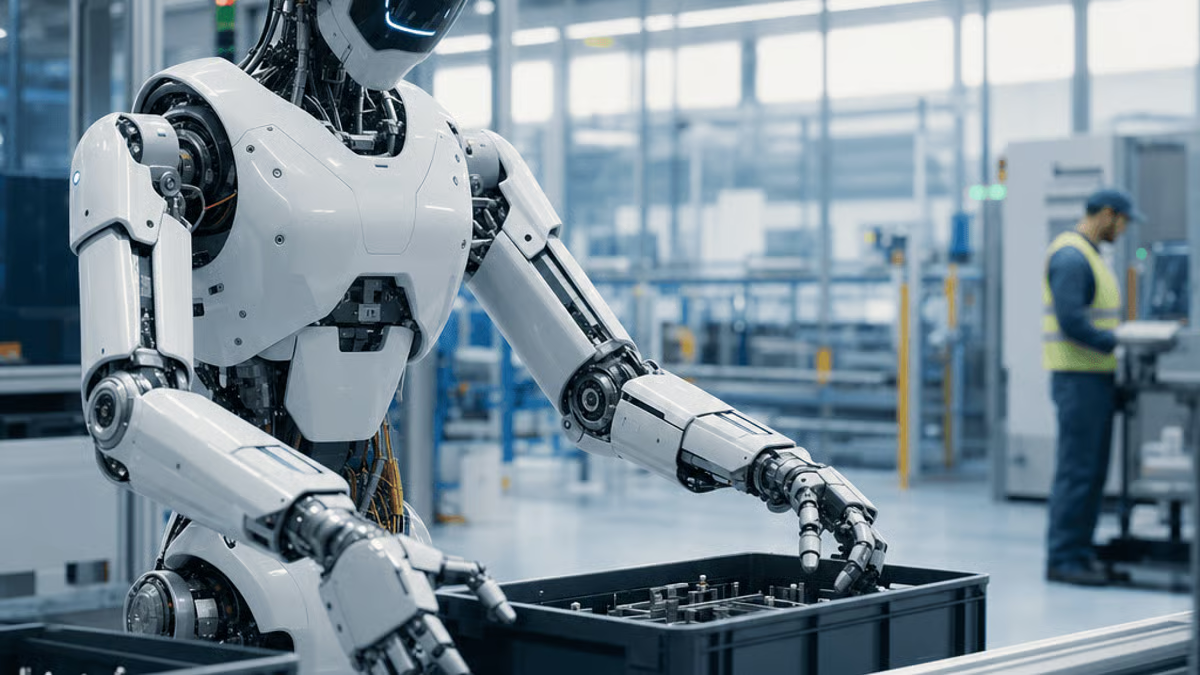
China’s humanoid robotics market just got a major vote of confidence from Wall Street. Morgan Stanley sharply doubled its shipment forecast for the sector, citing faster-than-expected commercial deployment in real-world scenarios. The revision signals that AI-powered humanoid robots are moving beyond pilot programs into actual enterprise adoption, marking a potential inflection point for the industry as Chinese manufacturers race to capitalize on automation demand.
Morgan Stanley just rewrote its outlook for China’s humanoid robotics sector, and the revision tells a bigger story about where AI-powered automation is headed. The investment bank doubled its shipment forecast for Chinese humanoid robots, according to a report via CNBC, marking one of the most aggressive Wall Street upgrades in the emerging robotics category.
What’s driving the sudden optimism? Real-world deployment. Morgan Stanley analysts cite accelerating commercial adoption in actual production environments, not just controlled pilot programs. That’s a critical distinction. For years, humanoid robots have lived in the realm of flashy demos and laboratory testing. But the investment bank’s revised numbers suggest Chinese manufacturers are now pushing these machines into factories, warehouses, and service settings at a pace that caught forecasters off guard.
The timing isn’t coincidental. China has been pouring resources into robotics and AI infrastructure, treating humanoid automation as a strategic priority. Companies like Xiaomi and startups like Unitree Robotics have been showcasing increasingly capable bipedal robots that combine computer vision, large language models, and advanced motor control. The technology stack behind these machines mirrors developments happening in the West, but China’s manufacturing ecosystem and government support are creating a different commercialization trajectory.
Morgan Stanley’s forecast doubling reflects what analysts are seeing on the ground – purchase orders converting from intent to reality. While the bank hasn’t disclosed specific shipment numbers in the available reporting, the magnitude of the revision points to a market that’s expanding faster than traditional industrial robotics adoption curves would predict. That’s significant because it suggests customers are finding immediate ROI justifications, not speculative future value.
The broader implications ripple across the AI hardware landscape. Humanoid robots represent one of the most complex integration challenges in robotics – combining locomotion, manipulation, perception, and real-time decision-making in a form factor that can navigate human-designed spaces. If China’s achieving commercial scale ahead of forecasts, it validates both the underlying AI models powering these systems and the manufacturing supply chains producing them at competitive price points.
Competitive dynamics are already shifting. Western robotics firms like Boston Dynamics and Figure AI are pursuing similar enterprise deployment strategies, but China’s ability to iterate rapidly and manufacture at scale creates pricing pressure. Morgan Stanley’s upgrade essentially acknowledges that Chinese players aren’t just catching up – they’re potentially setting the deployment pace for the entire industry.
What this means for investors watching the AI space is that robotics hardware is moving from R&D expense to revenue category faster than consensus models anticipated. The thesis that general-purpose humanoid robots would remain perpetually five years away from commercialization is getting stress-tested in Chinese factories right now. If these deployments prove sustainable, expect more Wall Street revisions beyond Morgan Stanley’s.
The forecast also highlights a geographic divergence in AI adoption patterns. While US tech giants focus on large language models and cloud AI services, China’s betting heavily on embodied AI – robots that interact physically with the world. Morgan Stanley’s numbers suggest that bet is starting to pay off in measurable shipment volumes, not just research papers.
For enterprises evaluating automation strategies, the accelerated China timeline offers a preview of what’s possible when regulatory environments, manufacturing capability, and market demand align. The question isn’t whether humanoid robots will reach commercial viability anymore – it’s how quickly the rest of the world can match China’s deployment pace.
Morgan Stanley’s forecast revision isn’t just about bigger numbers – it’s a signal that the humanoid robotics market is hitting commercial inflection faster than Wall Street expected. China’s combination of aggressive AI investment, manufacturing scale, and real-world deployment appetite is creating a proof point for the entire industry. If these shipment forecasts hold, we’re watching the early stages of embodied AI moving from expensive experiments to defensible business models. The next twelve months will reveal whether this acceleration sustains or hits the typical adoption curve obstacles that have slowed previous robotics waves.










Leave a Reply