

MoEngage, the San Francisco and Bangalore-based customer engagement platform, just made a bold bet that the future of marketing isn’t just about AI—it’s about giving every single customer their own AI agent. The company announced an all-cash acquisition of Aampe, a startup that’s pioneered technology for assigning individual AI agents to customers at scale. The deal, disclosed by TechCrunch, signals a major shift in how enterprises think about personalization, moving from broad segments to millions of autonomous agents making real-time decisions.
MoEngage is making a calculated bet that marketing’s next evolution isn’t about better dashboards or smarter campaigns—it’s about deploying millions of AI agents that act like personal assistants for every customer. The company’s all-cash acquisition of Aampe, announced Tuesday, gives it access to technology that fundamentally reimagines how brands interact with users at scale.
Instead of marketers manually creating customer segments and journey flows, Aampe’s platform spins up individual AI agents for each user. These agents continuously learn preferences, predict behavior, and autonomously decide when and how to engage—whether that’s pushing a notification, sending an email, or staying silent. It’s a radical departure from the rules-based automation that’s dominated marketing technology for the past decade.
The acquisition comes as MoEngage, which has raised over $180 million from investors including Steadview Capital and Eight Roads Ventures, faces intensifying competition in the customer engagement space. Traditional players like Braze and Iterable are racing to integrate AI capabilities, while newer entrants pitch AI-first architectures. By absorbing Aampe’s technology, MoEngage is betting it can leapfrog competitors stuck retrofitting AI into legacy platforms.
“We’re moving from an era of segmentation to an era of individualization,” the companies indicated in materials reviewed by TechCrunch. The distinction matters. Traditional marketing automation groups customers into segments—maybe thousands of them for sophisticated brands—and treats everyone in a segment the same way. Aampe’s approach creates as many “segments” as there are customers, with each AI agent operating independently.
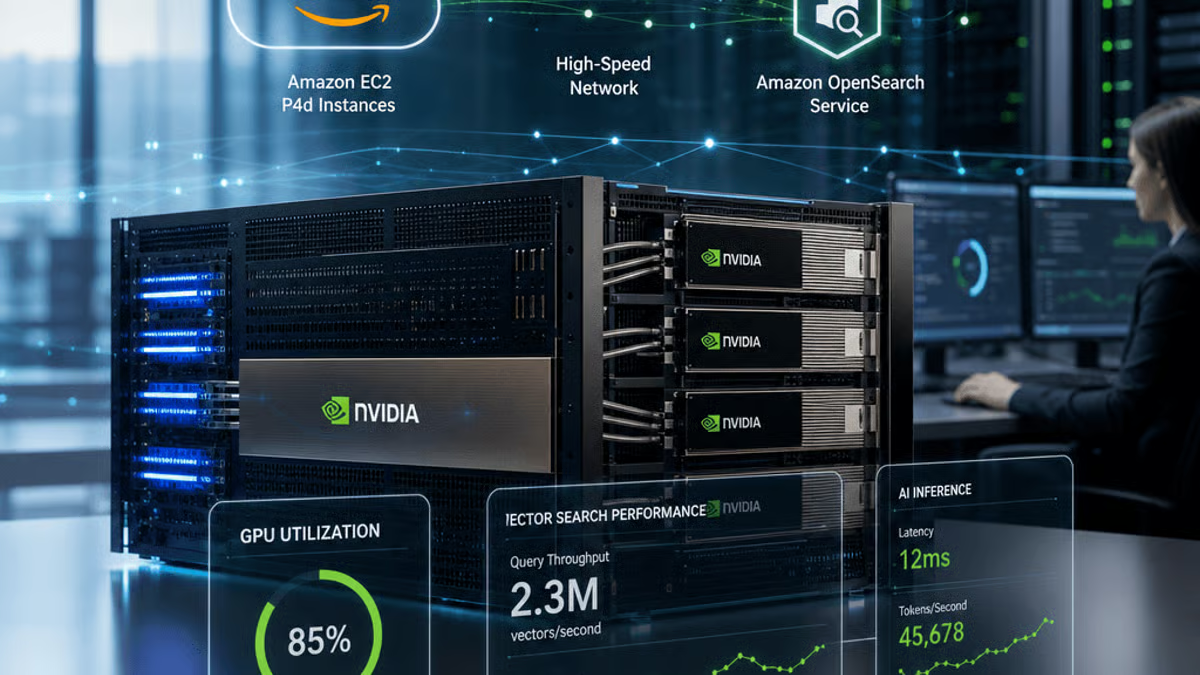
The technical challenge is immense. Running millions of AI agents requires infrastructure that can handle massive parallel processing, real-time decision-making, and continuous learning loops. Each agent needs to maintain state, track interactions across channels, and adapt to changing behavior without human intervention. It’s the kind of problem that only became solvable recently with advances in large language models and cheap cloud compute.
For MoEngage, the deal accelerates its AI strategy at a critical moment. The company serves over 1,200 brands including Samsung, Flipkart, and Ola, processing billions of customer interactions monthly. Integrating Aampe’s agentic AI layer could transform MoEngage from a messaging platform into something more like a personalization operating system.
The acquisition also reflects broader trends reshaping enterprise software. Agentic AI—systems where autonomous agents complete tasks with minimal human oversight—is emerging as the next battleground after generative AI. While tools like ChatGPT grabbed headlines for generating content, the real enterprise value may lie in agents that take actions. Marketing, with its clear metrics and tolerance for experimentation, offers an ideal testing ground.
Financial terms weren’t disclosed, but all-cash deals in the current environment suggest MoEngage sees urgent strategic value. Venture-backed companies have pulled back from expensive acquisitions as exit timelines stretch. An all-cash transaction implies MoEngage believes Aampe’s technology is critical to maintaining competitive position, not just a nice-to-have feature.
The deal also highlights India’s growing influence in global enterprise software. MoEngage, co-founded by Raviteja Dodda and Yashwanth Kumar in 2014, has built a major MarTech player from Bangalore while competing against well-funded Silicon Valley rivals. The company represents a wave of Indian B2B startups achieving global scale in categories once dominated by American firms.
For customers, the promise is marketing that feels less like marketing. Instead of everyone getting the same promotional email at 10am on Tuesday, each person gets communications timed to their habits, phrased in their preferred style, promoting products they actually care about. The AI agent learns whether you prefer morning or evening messages, long explanations or brief updates, discounts or early access.
But the approach raises questions. How much autonomy should brands give AI agents? What happens when millions of agents make suboptimal decisions? How do marketers maintain brand voice when each agent operates independently? And do customers actually want this level of personalization, or does it cross into surveillance?
MoEngage will need to answer those questions while integrating Aampe’s team and technology. The hardest part of any acquisition isn’t signing papers—it’s merging codebases, aligning product roadmaps, and retaining key talent. Many promising MarTech acquisitions have stumbled during integration, leaving customers with half-baked features and confused strategies.
The broader market is watching closely. If MoEngage successfully deploys agentic AI at scale, it could force competitors to follow or risk obsolescence. Marketing leaders are already asking vendors about AI capabilities, and “we have an AI agent for every customer” is a compelling pitch compared to “we added some AI features.”
MoEngage’s acquisition of Aampe represents more than a typical MarTech consolidation play—it’s a bet that marketing automation’s next chapter will be written by autonomous AI agents, not human-designed workflows. If the integration succeeds, MoEngage positions itself at the forefront of agentic AI in enterprise software, potentially redefining what personalization means when every customer gets their own AI assistant. But the hard work starts now: merging technologies, proving ROI at scale, and convincing enterprises to trust millions of AI agents with their customer relationships. For the broader MarTech industry, it’s a signal that incremental AI features may not be enough—the market is moving toward fundamentally different architectures where AI doesn’t just assist marketers, it becomes the marketer.





Leave a Reply