
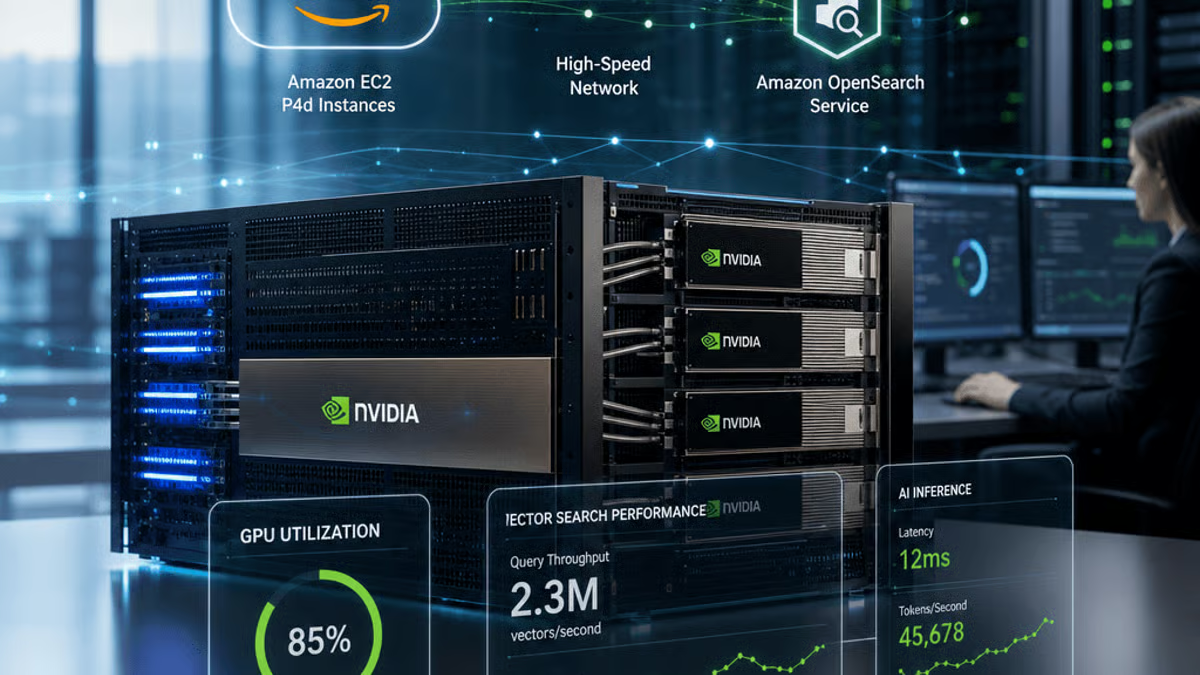
Nvidia and Amazon Web Services just announced a deepened partnership aimed at solving one of enterprise AI’s biggest headaches: actually deploying intelligent systems at scale. The collaboration brings Nvidia’s AI infrastructure directly into AWS’s Amazon EC2 and OpenSearch services, targeting the low-latency inference, vector search capabilities, and GPU price-performance that companies need to move beyond pilots into production. For enterprises struggling with operational complexity as they scale AI workloads, this integration could reshape how cloud-based AI deployment works.
Nvidia and Amazon Web Services are betting that the next phase of AI won’t be won by who has the flashiest models, but by who can actually get them running in production without breaking the bank or the ops team. Their expanded partnership, announced today through Nvidia’s official blog, brings Nvidia’s GPU infrastructure and AI optimization tools directly into AWS’s core services.
The collaboration targets what’s become a persistent pain point for enterprises: the gap between impressive AI demos and systems that actually work at scale. Building production AI requires juggling low-latency inference for real-time applications, vector search capabilities for retrieval-augmented generation, and GPU resources that deliver performance without astronomical cloud bills. Most companies hit a wall when trying to scale beyond initial pilots.
Nvidia’s infrastructure is now optimized specifically for Amazon EC2 instances and Amazon OpenSearch, AWS’s search and analytics service that’s become critical for AI applications using vector databases. The integration means companies can tap into Nvidia’s GPU acceleration and AI software stack without having to architect custom solutions or manage the underlying complexity themselves.
For Amazon, this deepens an already substantial partnership with the chip giant. AWS has been racing against Microsoft Azure and Google Cloud to become the go-to platform for enterprise AI workloads. Each cloud provider is fighting to offer not just raw compute, but complete AI infrastructure that handles everything from training to inference to the retrieval systems that power modern LLM applications.
The vector search angle is particularly telling. As companies build AI applications using retrieval-augmented generation – where models pull relevant information from databases before generating responses – fast vector search has become essential. Amazon OpenSearch with Nvidia acceleration could give AWS an edge in this increasingly competitive space, especially for enterprises dealing with massive knowledge bases.
GPU price-performance is the other critical piece. Training giant AI models gets the headlines, but inference – actually running those models to serve users – is where costs pile up in production. Nvidia’s specialized inference optimizations on EC2 could help companies manage those costs as they scale from hundreds to millions of queries.
What’s notable is how this partnership reflects the broader infrastructure wars playing out in AI. Nvidia has dominated AI chips, but the company knows its future depends on being deeply embedded in the cloud platforms where enterprises actually deploy AI. Meanwhile, AWS needs Nvidia’s performance and ecosystem to compete against Microsoft’s OpenAI partnership and Google’s homegrown TPU infrastructure.
The timing matters too. We’re entering a phase where enterprises are moving past the “let’s try ChatGPT” stage into serious production deployments. That’s where operational complexity becomes the real bottleneck – not model capabilities, but the unsexy infrastructure work of keeping AI systems running reliably at scale without teams of specialists.
For developers and platform teams, this integration could mean fewer moving pieces to manage. Instead of stitching together Nvidia drivers, AWS services, vector databases, and optimization frameworks, they get a more integrated stack. Whether that actually delivers on the promise of simplified operations remains to be seen, but the direction is clear.
The partnership also signals where the AI market is headed: toward vertical integration of the stack. The winning platforms won’t just offer access to GPUs or database services separately – they’ll provide optimized end-to-end infrastructure where all the pieces work together. That’s the play here, and it puts pressure on competitors to either build similar integrations or risk being seen as too complex for enterprises with limited AI expertise.
Neither company disclosed specific performance benchmarks or pricing details in the announcement, which suggests this is still early in the rollout. But the strategic intent is unmistakable: own the enterprise AI infrastructure layer before someone else does.
This Nvidia-AWS partnership is less about technological breakthroughs and more about removing friction from enterprise AI deployment. As companies move from experimentation to production, the winners will be platforms that make the operational complexity disappear. Nvidia gets deeper cloud integration, AWS gets performance advantages, and enterprises get a more manageable path to scaling AI. The real test will be whether this actually simplifies deployment enough to accelerate enterprise adoption – or if it’s just another layer in an already complex stack. Watch for performance benchmarks and customer case studies in the coming months to see if this partnership delivers on its promise.










Leave a Reply