
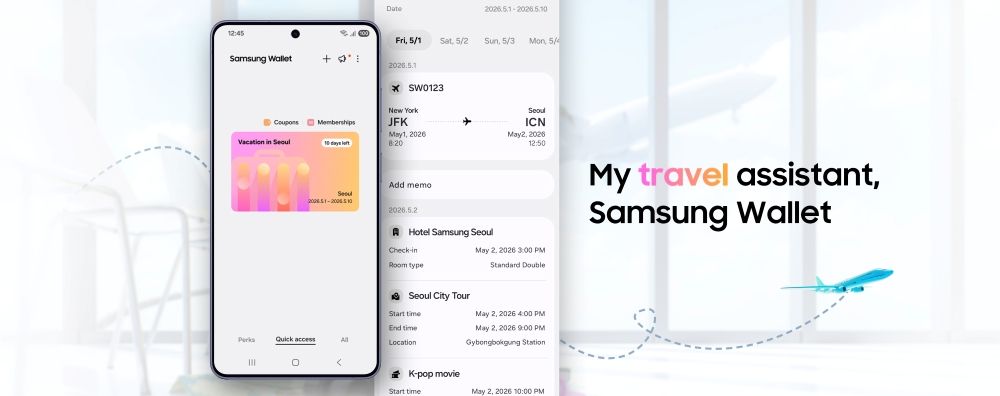
Samsung is making a play for travelers’ home screens. The company just rolled out Trips, a new Samsung Wallet feature that automatically organizes flights, hotel bookings, rental cars, and event tickets into unified travel timelines. Launching this month in Korea, the U.S., and the U.K., the feature aims to eliminate the chaos of juggling confirmation emails and scattered apps – putting Samsung in direct competition with Google’s travel tools and Apple’s Wallet integrations.
Samsung is taking on the travel coordination chaos that plagues every smartphone user. The company just announced Trips, a new feature inside Samsung Wallet that automatically pulls together flight confirmations, hotel reservations, and event tickets into a single, chronological timeline. It’s Samsung’s answer to a problem Google and Apple have been chipping away at for years – but with a twist that leans hard on automation.
The feature launches in April 2026 across Korea, the United States, and the United Kingdom on compatible Galaxy phones running Samsung Wallet version 5.9.32 or higher in Korea, 6.4.97 in the U.S., or 6.4.98 in the U.K. That means millions of Galaxy users will soon find their travel plans organizing themselves without lifting a finger.
“Travel plans are often scattered across confirmations, apps and messages, and that creates friction at the exact moments people need clarity,” Woncheol Chai, EVP and Head of Digital Wallet Team at Samsung’s Mobile eXperience Business, told Samsung Newsroom. “By bringing Trips to Samsung Wallet, we’re giving Galaxy users a single place to keep their trip details organized and stay one step ahead as their plans unfold.”
Here’s how it works. When you add eligible items to Samsung Wallet – boarding passes, hotel confirmations, rental car receipts – Trips automatically groups them based on timing and location. The system creates a trip timeline that stitches together your entire journey, from the moment you book a flight to when you check into a theme park three days later. It’s not just flights and hotels, either. The feature handles bus and train tickets, excursions, sporting events, and even lets you manually add itinerary items with attached memos for things like restaurant reservations or meeting notes.
This puts Samsung in direct competition with Google‘s travel features, which already pull flight and hotel data from Gmail, and Apple‘s Wallet, which surfaces boarding passes and event tickets automatically. But Samsung’s angle is consolidation – instead of relying on scattered notifications or digging through email threads, Trips promises a single view that updates as your plans change.
The timing is strategic. Mobile wallets have evolved from simple payment tools into lifestyle hubs. Apple has been steadily expanding Wallet to include state IDs, car keys, and hotel room access. Google Pay morphed into Google Wallet with similar ambitions. Samsung’s pushing hard to keep pace, and travel is a high-frequency use case that keeps users engaged with the app.
Security is table stakes here. Samsung’s baking in Knox protection – the company’s defense-grade security platform – with encryption and biometric authentication to lock down sensitive data like passport numbers and credit card details. Only the device owner can access stored information, which matters when you’re carrying boarding passes and hotel confirmations across international borders.
But the real test will be adoption and accuracy. Automatic grouping only works if Samsung’s algorithms correctly identify what belongs in a trip and what doesn’t. Misfire on a business traveler’s overlapping itineraries, and the feature becomes noise instead of signal. Samsung’s also entering a market where Google already has deep integration with Gmail and Calendar, and Apple controls the entire hardware-software stack on iOS.
The company’s betting that Galaxy users want a dedicated travel layer inside Wallet, rather than relying on third-party apps like TripIt or Kayak. It’s a reasonable wager – reducing app clutter is a constant user demand, and Samsung Wallet already sits on millions of home screens as the default payment tool.
Samsung’s hinting this is just the start. The company plans to expand Samsung Wallet with new features and partner integrations over time, suggesting future tie-ins with airlines, hotel chains, or travel booking platforms. That could mean real-time flight updates, gate change notifications, or even loyalty program integration – features that would make Trips less of a static organizer and more of an active travel assistant.
For now, the feature launches in three markets with relatively straightforward functionality. But if Samsung can nail the execution and prove Trips reduces travel friction, expect rapid expansion to more regions and deeper integrations with the travel ecosystem. The question is whether users will trust Samsung Wallet as their travel command center – or keep defaulting to Google, Apple, and the dozen travel apps already fighting for attention.
Samsung’s Trips feature is a smart consolidation play in a crowded market. By auto-organizing travel details inside Samsung Wallet, the company’s reducing friction for Galaxy users who are tired of hunting through email for boarding passes. But success hinges on execution – the feature needs to group trips accurately, update reliably, and convince users it’s worth abandoning Google or Apple’s existing travel tools. If Samsung nails it and expands partner integrations, Trips could evolve from a convenience feature into a legitimate travel assistant. For now, it’s a solid opening move in the battle to own travelers’ digital workflows.











Leave a Reply