
- ■
Samsung launches Care on Call, showing caregivers’ parents’ activity status before phone calls connect
- ■
SmartThings now deploys Bespoke AI Jet Bot vacuums as roving cameras when elderly users go inactive
- ■
Now Brief AI assistant expands from Galaxy phones to 2024+ TVs and 2021+ Family Hub fridges
- ■
Move positions Samsung against Google Nest and Amazon Alexa in the emerging elder care tech market
Samsung just turned its smart home platform into a remote caregiving command center. The company’s latest SmartThings update introduces Care on Call, a feature that surfaces real-time activity data before you even dial your aging parents, plus robot vacuum patrols that can check on loved ones when motion sensors go quiet. Rolling out alongside the Galaxy S26, the update signals Samsung’s push beyond convenience into healthcare-adjacent territory—a space where Amazon and Google are also circling with their own ambient computing plays.
Samsung is betting that the future of smart homes isn’t just voice commands and thermostat adjustments—it’s making sure your parents are okay when you can’t be there. The company’s SmartThings platform overhaul, announced today, adds a suite of AI-powered elder care features that transform connected appliances into a distributed monitoring network.
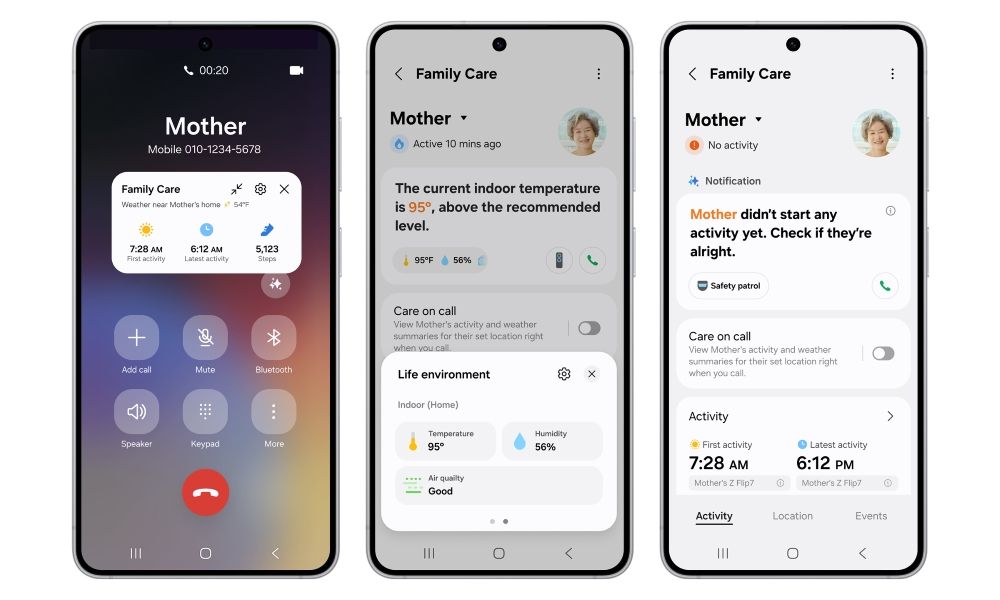
The headline feature is Care on Call, which intercepts your phone calls to aging relatives with a pre-call intelligence briefing. Before the line connects, a pop-up displays when they first moved around the house that day, their most recent detected activity, and local weather conditions. “Samsung’s AI technology goes beyond everyday convenience to help users care for themselves and their families with greater peace of mind,” Jaeyeon Jung, Executive VP and Head of the SmartThings Team, told Samsung Newsroom.
But Samsung’s ambitions go further than contextual phone calls. The updated Family Care service now conscripts the company’s Bespoke AI Jet Bot Steam Ultra robot vacuum into surveillance duty through a feature called Safety Patrol. If SmartThings detects no movement from the care recipient for a specified duration, caregivers get an alert and can remotely pilot the vacuum’s built-in camera through the house. Two-way audio lets them communicate if they spot trouble—say, someone who’s fallen and can’t get up.
It’s a clever repurposing of hardware that already exists in millions of homes, and it underscores how the smart home battleground is shifting from device sales to platform stickiness. Amazon has explored similar territory with Alexa Care Hub, while Google has experimented with Nest’s activity monitoring for elder care scenarios. Samsung’s advantage? It controls the entire stack from phone to fridge to vacuum.
The SmartThings update also enhances environmental monitoring across connected appliances. Air conditioners, purifiers, dehumidifiers and humidifiers now feed continuous temperature, humidity and air quality data into the platform. Unusual patterns—like a heat wave hitting and the AC staying off—trigger immediate caregiver notifications with remote control options.
Care Insight, another upgraded feature, analyzes week-over-week changes in activity levels and device usage patterns, flagging significant deviations that might indicate health changes. It’s basic pattern recognition, but applied to a dataset most families have no systematic way of tracking.
The other major update brings Now Brief—Samsung’s AI briefing service that debuted on Galaxy phones—to TVs and Family Hub refrigerators. Launching alongside the Galaxy S26 series, the expanded Now Brief aggregates Home Security, Family Care, Pet Care, Energy usage, and sleep data into ambient displays that activate automatically when you approach a TV or open the fridge door.
Samsung’s phased rollout targets TVs from 2024 onward and Family Hub fridges from 2021 and later, creating a unified information layer across the home. Walk into your kitchen in the morning and the fridge screen might show that your mom’s first activity was logged at 7:15 AM, your dog was walked for 23 minutes, and your front door was last opened at 6:42 AM when your partner left for work.
The strategy mirrors how Apple has stitched iOS, watchOS, and HomeKit into a persistent context engine, but Samsung’s betting on appliance ubiquity where Apple has wearable dominance. According to industry analysts, the global smart home market is projected to hit $174 billion by 2025, with elder care applications representing one of the fastest-growing segments as Boomer demographics age in place.
What Samsung isn’t addressing yet is the privacy calculus of always-on home monitoring. Care on Call requires Galaxy smartphones running One UI 8.5 or later, and all these features demand SmartThings device registration and service activation. The company notes that remote control capabilities require explicit caregiver permissions, but the architecture still centralizes vast amounts of behavioral data.
Competitors are watching closely. Amazon’s Halo division was shut down last year, but Alexa Together continues as a subscription elder care service. Google has been quieter, focusing Nest on security rather than healthcare, but the company’s recent ambient computing demos suggest it’s building similar capabilities. Meta exited consumer hardware with Portal’s discontinuation, ceding this territory entirely.
For Samsung, the SmartThings update represents a pivot from selling devices to selling peace of mind—a far stickier value proposition. Families already juggling caregiving logistics don’t need another gadget; they need systems that reduce cognitive load. If the platform can deliver on that promise, Samsung’s ecosystem lock-in gets considerably stronger.
The updates begin rolling out with the Galaxy S26 launch, with TV and Family Hub support arriving in phases throughout 2026 depending on region and model. Samsung hasn’t disclosed pricing for premium Family Care features or whether they’ll remain bundled with standard SmartThings accounts.
Samsung’s SmartThings update reveals where the smart home market is actually headed—not toward more connected lightbulbs, but toward platforms that solve real emotional labor. By turning existing hardware into a caregiving mesh network, Samsung’s creating stickiness that transcends brand loyalty. The question isn’t whether families will adopt these tools—the aging demographics guarantee demand—but whether Samsung can navigate the privacy minefield before regulators or competitors force its hand. For now, the company’s got a head start in a race that Amazon and Google are only beginning to run.








Leave a Reply