
- ■
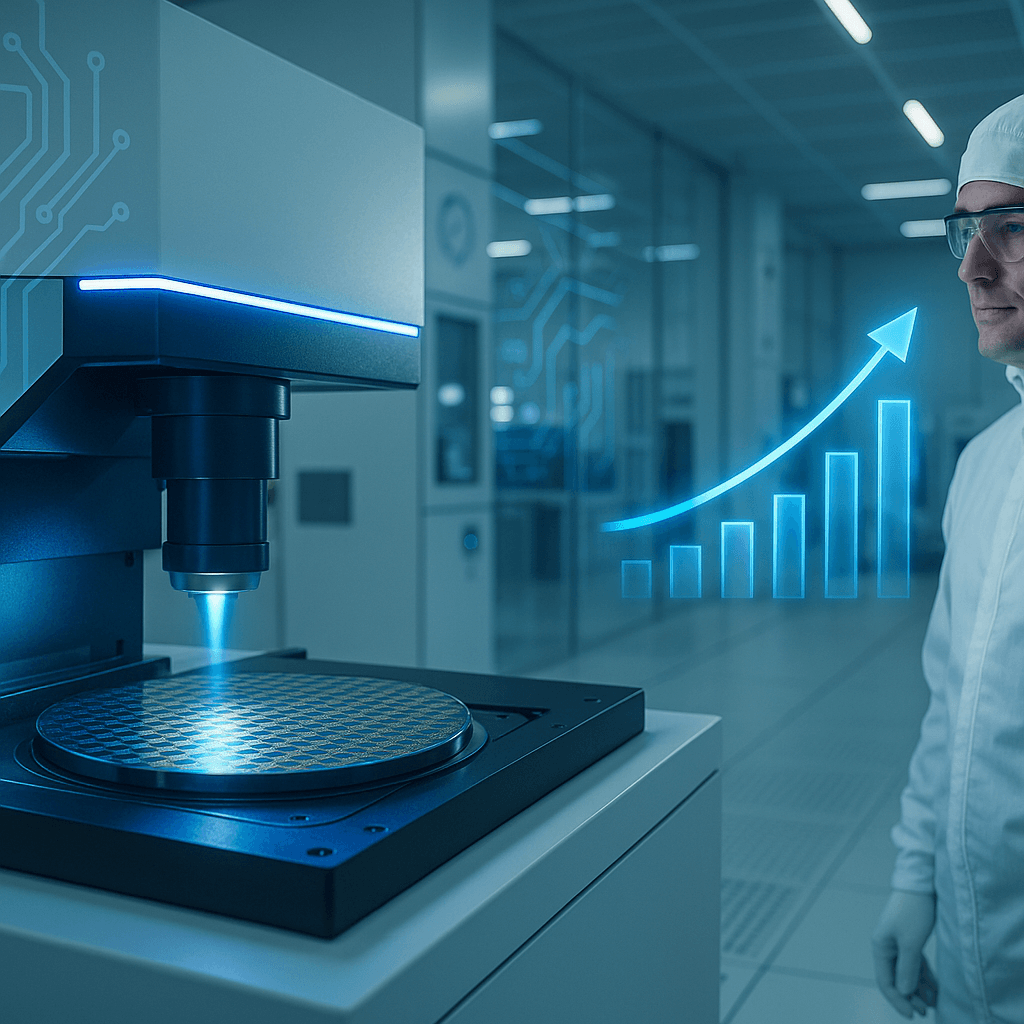
ASML exceeded Q1 2026 revenue and profit expectations, prompting the company to raise full-year sales guidance according to CNBC
- ■
The earnings beat reflects sustained demand for advanced chipmaking equipment as AI infrastructure spending continues to surge
- ■
ASML’s extreme ultraviolet lithography systems are critical bottleneck technology for producing AI chips from Nvidia, AMD, and custom silicon players
- ■
The raised guidance suggests semiconductor manufacturers remain confident in AI-driven chip demand through at least year-end 2026
ASML, the Dutch semiconductor equipment maker that’s become essential to the AI chip boom, beat first-quarter revenue and profit expectations and raised its full-year 2026 sales guidance. The results signal continued strength in semiconductor manufacturing as chipmakers race to meet insatiable demand for AI processors. ASML’s extreme ultraviolet lithography machines remain the only way to produce cutting-edge chips, making the company’s outlook a key barometer for the entire AI infrastructure buildout.
ASML just gave the semiconductor industry its clearest signal yet that the AI chip gold rush shows no signs of slowing. The Dutch equipment manufacturer beat Wall Street’s first-quarter expectations for both revenue and profit, then immediately lifted its sales outlook for the full 2026 fiscal year, according to earnings results reported by CNBC.
The timing couldn’t be more telling. ASML’s performance comes as chipmakers worldwide are locked in a fevered race to expand manufacturing capacity for AI processors. The company’s extreme ultraviolet lithography machines – which use light with wavelengths just 13.5 nanometers to etch impossibly tiny circuit patterns onto silicon wafers – represent the industry’s most critical chokepoint. Without ASML’s EUV systems, companies like Nvidia, AMD, and increasingly Amazon and Meta with their custom chip ambitions simply can’t manufacture the cutting-edge processors powering today’s AI models.
The raised guidance tells a story that goes beyond a single good quarter. When ASML lifts its full-year outlook, it’s essentially saying that semiconductor fabs – the massive manufacturing facilities run by TSMC, Samsung, and Intel – are ordering more equipment than previously anticipated. Those orders translate directly into expanded chip production capacity months down the line.
ASML occupies a unique monopoly position in the semiconductor supply chain. The company is the only manufacturer of EUV lithography systems capable of producing chips at 7-nanometer process nodes and below – the advanced manufacturing techniques required for high-performance AI accelerators. Each EUV machine costs upward of $200 million and takes years to build, with ASML’s backlog stretching well into future quarters.
The first-quarter beat suggests that demand is holding up despite earlier industry concerns about potential AI infrastructure overbuilding. Throughout late 2025, analysts questioned whether the breakneck pace of data center expansion and chip orders could sustain itself. ASML’s results – and more importantly, its confidence in raising guidance – indicate that semiconductor manufacturers aren’t seeing meaningful slowdown signals from their customers.
This matters because ASML sits upstream from the entire AI hardware ecosystem. The company’s order book reflects purchasing decisions made by foundries based on their customers’ long-term capacity needs. When TSMC orders another batch of EUV systems, it’s betting that Nvidia, Apple, Google, and others will continue demanding cutting-edge chips for at least the next 18-24 months – the typical timeline from equipment order to volume production.
The semiconductor equipment sector has become a surprisingly accurate leading indicator for AI infrastructure trends. Unlike chip companies that might hold excess inventory or face quarterly demand fluctuations, equipment makers like ASML see capital expenditure commitments from foundries – investments that only make sense if chipmakers are confident in sustained long-term demand.
ASML’s raised 2026 outlook also provides context for recent moves across the AI chip landscape. Nvidia has maintained aggressive production schedules for its Blackwell architecture. AMD continues pushing its MI300 series accelerators into data centers. Meanwhile, the custom chip movement – with Amazon’s Trainium, Google’s TPUs, and Meta’s AI silicon efforts – adds even more manufacturing capacity requirements to the mix.
The Dutch company’s performance stands in contrast to recent semiconductor market volatility. While chip stocks have experienced periodic corrections on AI demand concerns, ASML’s results suggest the underlying manufacturing infrastructure buildout remains robust. The company essentially enables the entire sector’s production capacity, making its guidance particularly significant for understanding real versus perceived demand trends.
Looking at the broader implications, ASML’s raised outlook supports the thesis that AI infrastructure spending remains in expansion mode rather than consolidation. The multi-year lag between equipment orders and chip production means today’s ASML sales forecast future silicon availability – and by extension, the industry’s collective bet on where AI workloads are headed through 2027 and beyond.
ASML’s first-quarter beat and raised full-year guidance offers something rare in today’s AI market – concrete evidence from the infrastructure layer that demand fundamentals remain strong. As the sole provider of the most advanced chipmaking equipment on the planet, ASML’s outlook reflects billions in capital commitments from foundries betting on sustained AI chip consumption. For anyone trying to separate AI hype from reality, equipment maker results provide harder data points than software company projections. When the companies that enable chip production are raising guidance, it suggests the semiconductor industry’s AI bet still has room to run.










Leave a Reply