
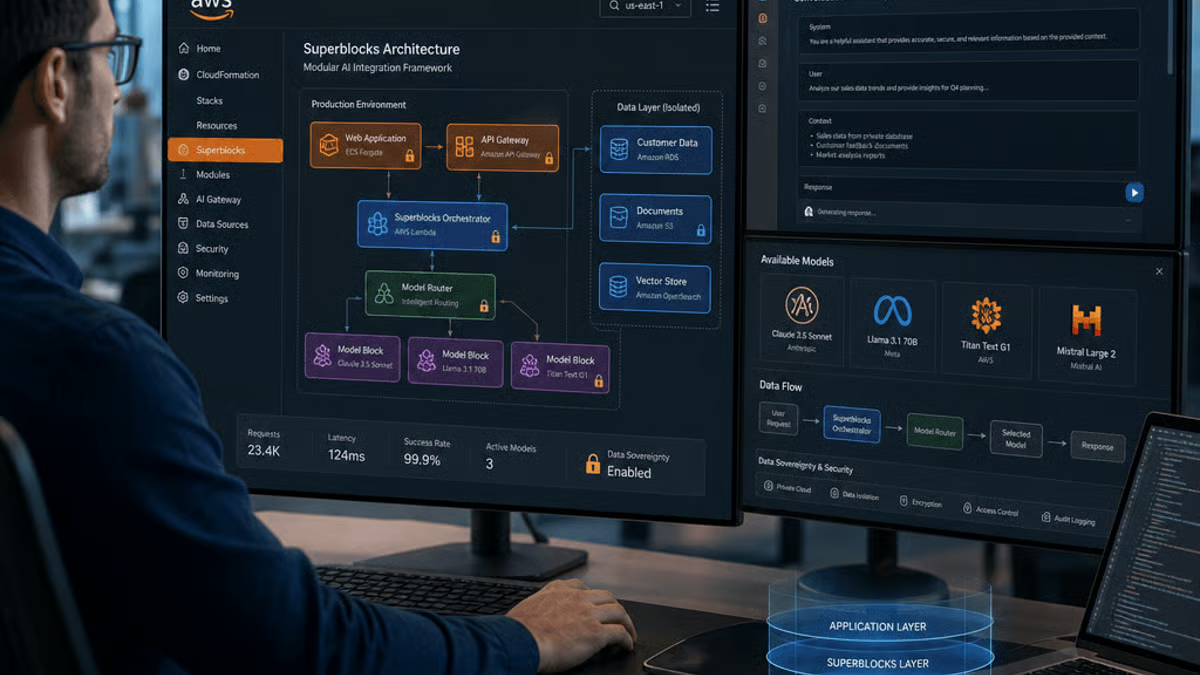
Amazon Web Services just made a quiet but significant move in the enterprise AI space. The cloud giant now allows Superblocks, a vibe-coding platform that lets developers build applications through conversational AI, to be embedded directly into customers’ private cloud environments. The partnership marks a pivotal shift in how enterprises are architecting AI-powered development tools—prioritizing data sovereignty and model flexibility over the tightly coupled platforms that dominated the early AI era.
Amazon Web Services is making a calculated bet on the future of enterprise software development, and it involves letting an AI startup set up shop inside customers’ most sensitive infrastructure.
The cloud behemoth now allows Superblocks, a two-year-old startup building what the industry calls “vibe coding” tools, to be deployed directly within AWS customers’ private cloud environments. It’s a distribution deal that signals something bigger than just another partnership announcement—it’s evidence that the architectural philosophy behind enterprise AI is fundamentally shifting.
Vibe coding, for the uninitiated, refers to conversational development environments where developers describe what they want to build in natural language and AI agents generate the actual code, workflows, and integrations. Think of it as GitHub Copilot on steroids, but for entire application stacks rather than individual functions. Superblocks has been building this capability specifically for internal tools—the dashboards, admin panels, and workflow automation that every company needs but few want to spend engineering resources building from scratch.
What makes this AWS partnership noteworthy isn’t just the distribution muscle Amazon brings. It’s the deployment model. By embedding Superblocks into private clouds rather than offering it as a hosted service, AWS is acknowledging what enterprise customers have been demanding: the ability to use cutting-edge AI development tools without shipping their data to external vendors or getting locked into specific model providers.
This is what industry observers mean when they talk about “decoupling apps from models.” Traditional SaaS platforms bundle the application, the AI models powering it, and the hosting infrastructure into one package. You use Salesforce, you use Salesforce’s AI on Salesforce’s terms. But the new architecture emerging across enterprise AI looks different—modular layers where the application logic, the AI models, and the deployment environment can all be mixed and matched.
Superblocks exemplifies this approach. The platform is model-agnostic, meaning it can work with OpenAI’s GPT models, Anthropic’s Claude, Google’s Gemini, or even customer-hosted open-source models. Companies deploying it in their AWS environments maintain full control over which models process their code, where that processing happens, and who has access to the underlying data.
For AWS, the strategic calculus is clear. As enterprises race to adopt AI-powered development tools, Amazon wants to ensure those workloads run on AWS infrastructure rather than migrating to competitor clouds or SaaS platforms. By validating and distributing tools like Superblocks, AWS positions itself as the secure, flexible foundation for next-generation development—not just a compute provider, but the platform where the future of software gets built.
The timing matters too. Enterprise adoption of AI coding assistants has accelerated dramatically over the past year, but security and compliance teams have pumped the brakes at companies handling sensitive data. Regulated industries like financial services and healthcare want the productivity gains of AI-powered development without exposing proprietary code or customer data to third-party model providers. Private cloud deployment solves that tension.
This pattern is repeating across the AI landscape. Microsoft offers Azure OpenAI Service with similar data isolation guarantees. Google Cloud is pushing Vertex AI as a model-agnostic platform. Even OpenAI has started offering private deployments for enterprise customers willing to pay premium prices. The hyperscalers have recognized that winning the enterprise AI market requires meeting customers where their anxiety lives—in concerns about data residency, model flexibility, and avoiding vendor lock-in.
For startups like Superblocks, partnering with AWS provides instant enterprise credibility and distribution that would take years to build independently. But it also validates vibe coding as a category worth serious infrastructure investment. When hyperscalers start treating your startup’s software as infrastructure-grade tooling worthy of private cloud deployment, you’ve crossed a legitimacy threshold.
The broader implication is that we’re watching the enterprise software stack disaggregate in real-time. The monolithic SaaS platforms that defined the 2010s are giving way to composable architectures where best-of-breed AI applications, swappable model providers, and flexible deployment options become the new normal. Companies want to use the best tools without marrying specific vendors or models that might be obsolete in 18 months.
What remains to be seen is whether this architectural flexibility translates into actual switching behavior or just theoretical optionality that enterprises never exercise. History suggests companies talk about avoiding lock-in more than they actually avoid it. But the pace of model improvement and the proliferation of competitive options might make this cycle different.
The AWS-Superblocks partnership is less about one startup’s distribution win and more about the future architecture of enterprise AI. As companies demand data sovereignty, model flexibility, and escape hatches from vendor lock-in, the tightly integrated platforms that defined early AI adoption are giving way to modular, composable systems. Whether this actually leads to a more competitive, innovative market or just adds complexity without changing switching costs remains the trillion-dollar question. But for now, the hyperscalers are betting that flexibility wins enterprise deals, and they’re building the infrastructure to prove it.










Leave a Reply