
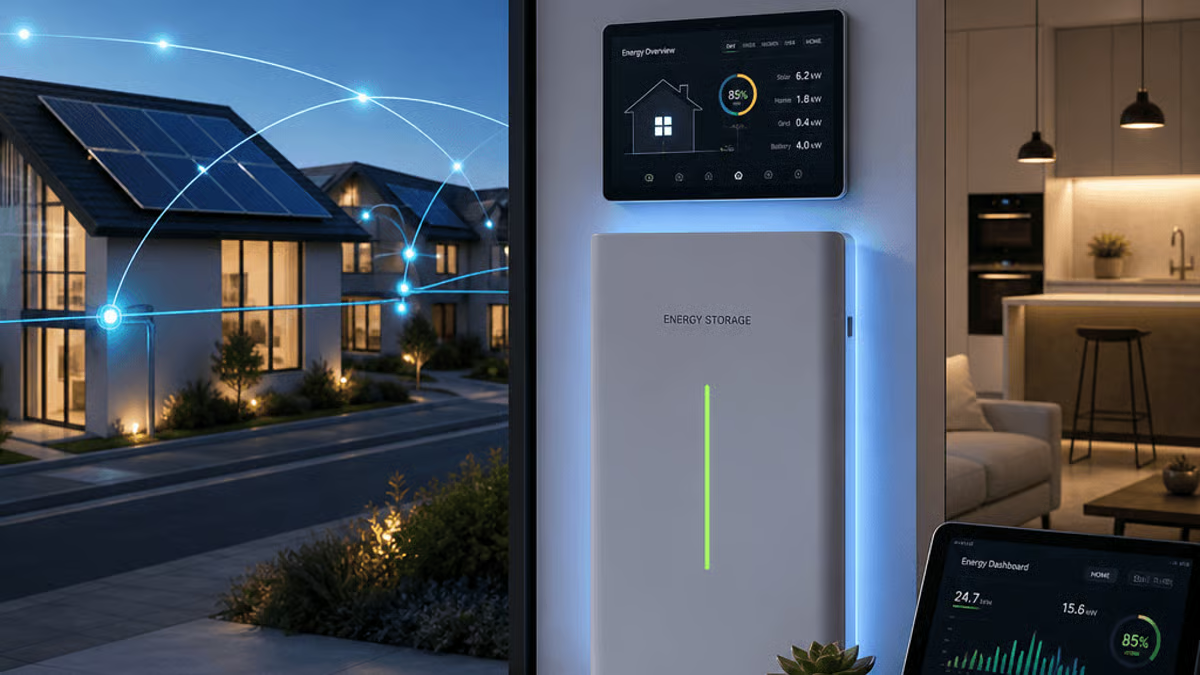
Base Power just closed a staggering $1 billion funding round to ramp up production of home battery systems that double as grid infrastructure. The climate tech startup is betting big that distributed energy storage—thousands of batteries in garages and basements coordinated like a virtual power plant—can solve the grid’s reliability crisis while homeowners get backup power and lower bills. It’s one of the largest climate tech raises this year and signals investor confidence that the future of energy isn’t just about generating clean power, but storing and managing it smartly.
Base Power just pulled off one of the year’s biggest climate tech financing rounds, securing $1 billion to flood the market with home batteries that do double duty as grid assets. The funding arrives as utilities scramble for solutions to an increasingly unstable power grid, and it positions the startup to capitalize on a perfect storm of demand drivers—from extreme weather events knocking out power to the explosive growth of EVs and data centers straining infrastructure.
The company’s pitch is elegantly simple: instead of building massive, centralized battery installations that take years to permit and construct, why not turn every home with solar panels into a tiny node in a distributed energy network? Base Power’s systems store excess solar generation during the day, provide backup power during outages, and—crucially—can be orchestrated en masse to feed electricity back to the grid during peak demand periods when power is most expensive and carbon-intensive.
This “virtual power plant” model has been gaining serious traction. Tesla pioneered the concept with its Powerwall systems in places like California and Australia, proving that aggregated home batteries can respond faster than traditional peaker plants while generating revenue for homeowners. Base Power is betting it can capture market share by undercutting competitors on price while offering superior software that maximizes both grid services revenue and homeowner savings.
The $1 billion round—which the company characterizes as growth capital rather than a traditional Series designation—comes roughly 18 months after Base Power’s last major raise. That cadence suggests the startup has been burning through capital quickly to build out manufacturing capacity, though the company hasn’t disclosed production volumes or unit economics. The massive check also indicates investors believe the residential energy storage market is about to explode beyond the early-adopter phase that’s defined it so far.
Timing matters here. Federal incentives from the Inflation Reduction Act continue to make home batteries financially attractive, covering up to 30% of installation costs. Meanwhile, insurance companies in wildfire-prone regions are increasingly requiring backup power systems as a condition of coverage. And utilities from California to Texas are launching programs that pay homeowners to let them tap stored energy during grid emergencies—effectively turning batteries into income-generating assets.
Base Power faces stiff competition in a suddenly crowded market. Beyond Tesla’s dominant Powerwall, startups like Enphase Energy and established players like LG are all vying for shelf space with installers and mindshare with consumers. The key differentiator increasingly isn’t hardware—most systems use similar lithium-ion battery chemistry—but software intelligence and the ability to stack multiple value streams from grid services, time-of-use arbitrage, and backup power.
The company hasn’t disclosed its investor lineup for this round, though previous backers have included prominent climate-focused VCs and strategic investors from the utility sector. That utility backing is telling—it suggests grid operators see distributed batteries as infrastructure they need rather than a threat to their business model. The shift represents a fundamental rethinking of how power systems should work in an era of renewable energy and extreme weather.
Manufacturing scale is Base Power’s immediate challenge. While the company designs its systems in-house, it relies on contract manufacturers for battery cells and other components—a supply chain that’s been volatile amid trade tensions and raw material price swings. The billion-dollar infusion presumably includes capital for securing long-term supply agreements or even bringing some production in-house to control costs and quality.
The broader market indicators support Base Power’s aggressive expansion. Wood Mackenzie projects residential battery installations in the US will grow 30% annually through 2030, driven by falling costs, policy support, and increasing grid instability. California alone is expected to add over 500,000 home battery systems in the next three years. That creates a massive addressable market, though it also means competition will intensify as every major energy company scrambles for a piece.
What makes this round particularly noteworthy isn’t just the size—though $1 billion is rare air for a hardware startup—but what it signals about investor appetite for climate infrastructure plays. After years of skepticism about capital-intensive climate tech, major investors are clearly willing to write huge checks for companies addressing the unglamorous but critical challenge of grid reliability. Base Power’s ability to raise at this scale suggests the market sees energy storage as moving from science project to essential infrastructure.
The company’s success or failure will likely hinge on execution basics: Can it manufacture reliably at scale? Can its software actually deliver the grid services it promises? And can it navigate the complex web of utility regulations, interconnection standards, and local permitting requirements that vary wildly across markets? Those aren’t sexy questions, but they’re what separates climate tech winners from cautionary tales.
Base Power’s billion-dollar bet represents a broader shift in how we think about energy infrastructure. Instead of the centralized, top-down grid that’s defined electricity for a century, the future increasingly looks distributed, flexible, and resident in millions of homes and businesses. Whether Base Power specifically succeeds or not, the company’s massive raise confirms that the market believes residential batteries are infrastructure, not gadgets. For homeowners, that means backup power and lower bills. For the grid, it means a more resilient system that can handle the renewable transition. And for investors, it means one of the few climate tech categories where the business model is already proven and the market is ready to scale. Now Base Power just has to execute.











Leave a Reply