
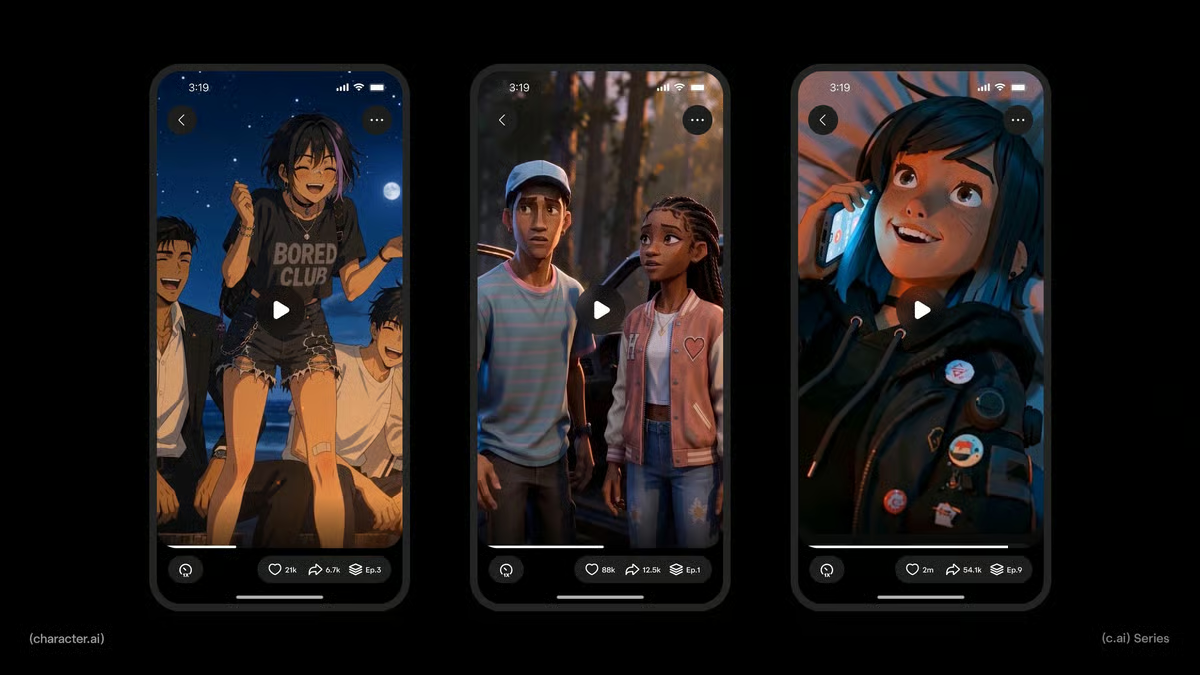
Character.AI is making a play for the booming microdrama market. The company announced today it’s launching c.ai Series, short-form episodic videos that are animated and almost entirely generated by AI. Unlike traditional microdramas with human actors, these vertical videos blend watching with interactive elements – giving users the ability to influence storylines on their phones. It’s a bold pivot for a platform known primarily as an LLM-powered chatbot service, but with microdramas projected to hit $26 billion in the next few years, the timing makes sense.
Character.AI is betting big on AI-generated entertainment. The company just unveiled c.ai Series, a new platform for short-form, animated episodic videos that users can watch and interact with on their phones. It’s the latest sign that AI companies are looking beyond chatbots and productivity tools to stake claims in the entertainment business.
The announcement comes as the microdrama industry is exploding globally. These bite-sized video series, typically featuring dramatic storylines condensed into episodes lasting just a few minutes, are projected to become a $26 billion industry in the next few years according to Variety. But while most microdrama platforms rely on cheaply produced live-action content with human actors, Character.AI is taking a different approach – using generative AI to create animated series from the ground up.
The strategy marks a significant expansion for Character.AI, which has spent the past year pushing beyond its roots as an LLM-powered chatbot platform. The company already offers interactive books, comics, and audio dramas – all designed to showcase how AI can create immersive storytelling experiences. Video was the natural next step, but it’s also the most technically challenging and culturally risky.
What sets c.ai Series apart from traditional microdramas isn’t just the animation. The platform promises interactive elements that let viewers influence storylines, similar to choose-your-own-adventure narratives. This interactivity has been Character.AI’s calling card since launch, with millions of users already chatting with AI characters ranging from historical figures to original fictional personas. Now, those conversations are evolving into visual narratives.
The timing reveals Character.AI’s broader ambitions. While competitors like OpenAI and Anthropic focus on enterprise applications and model capabilities, Character.AI is carving out territory in consumer entertainment. It’s a risky play – AI-generated content still faces skepticism from traditional media audiences, and questions about quality, creativity, and the displacement of human artists remain contentious.
But the economics are compelling. Producing animated microdramas with generative AI could dramatically reduce costs compared to live-action production, even at the low-budget end of the microdrama spectrum. If Character.AI can achieve acceptable quality at scale, it could flood the market with content faster than human creators can compete. That’s exactly what’s making Hollywood nervous about AI’s encroachment into entertainment.
The microdrama boom itself has been driven largely by international markets, particularly in Asia, where platforms serve up addictive short-form dramas optimized for mobile consumption. Services like ReelShort and TikTok have popularized the format in the West, proving there’s appetite for snackable video storytelling. Character.AI is betting it can capture that same audience while adding the unique hook of AI-powered interactivity.
Whether viewers will embrace fully AI-generated entertainment remains an open question. Early experiments with AI animation have produced mixed results, often falling into an uncanny valley that feels neither authentically human nor stylistically distinct. Character.AI will need to prove its technology can deliver compelling stories that keep users coming back, not just technological novelty.
The launch also puts Character.AI in potential competition with traditional streaming services and social media platforms that are all vying for attention in the short-form video space. YouTube Shorts, Instagram Reels, and TikTok already dominate mobile video consumption. Breaking through that noise will require more than just AI-generated content – it’ll need genuine creative hits.
For now, Character.AI is positioning c.ai Series as an extension of its existing entertainment ecosystem rather than a standalone product. Users who already engage with the platform’s chatbots and interactive fiction are the natural early adopters. If the company can convert even a fraction of its existing user base into regular viewers, it could establish a beachhead in the AI entertainment space before larger tech companies fully commit.
Character.AI’s push into AI-generated microdramas represents a calculated bet on where entertainment and AI converge. With a $26 billion market taking shape and production costs potentially slashed by generative technology, the opportunity is real. But success depends on whether audiences will embrace fully AI-created content in an entertainment landscape still dominated by human storytelling. The next few months will reveal whether AI-generated microdramas can compete with traditional content – or if they’ll remain a novelty in the expanding universe of short-form video.









Leave a Reply