
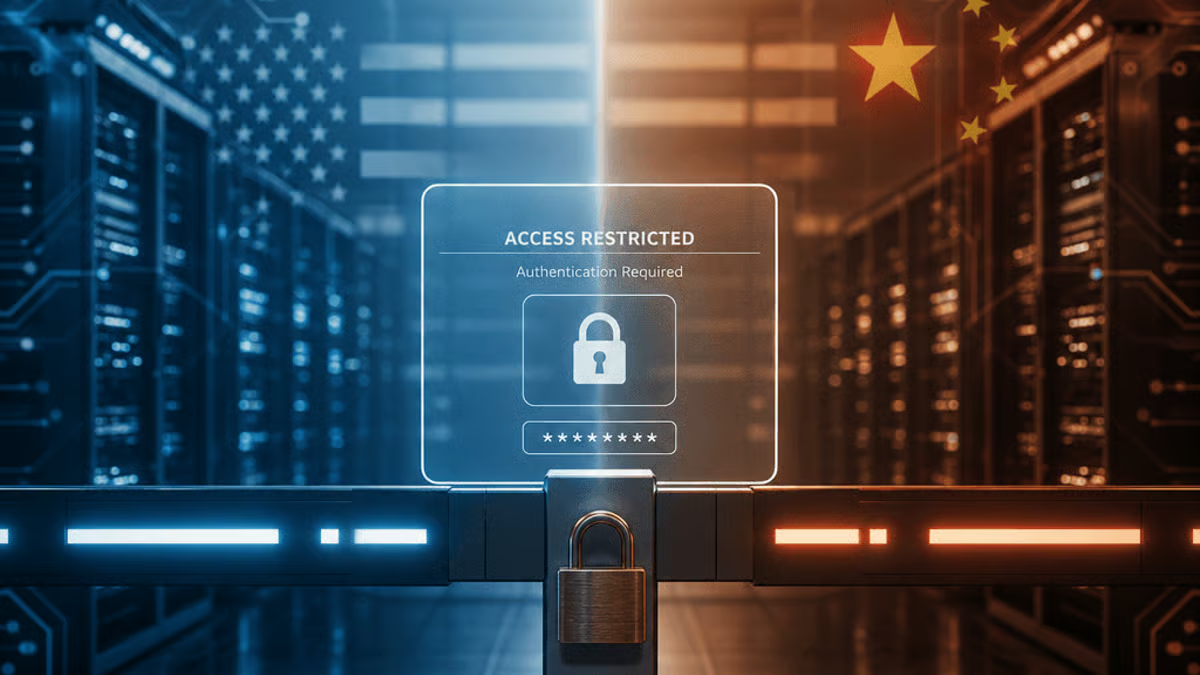
Alibaba just threw down a major red flag in the AI cold war. The Chinese e-commerce giant has officially blacklisted Anthropic’s Claude Code as high-risk software for all employees, citing concerns over what the company calls a ‘distillation attack’ – essentially accusing the US AI startup of using sophisticated techniques to extract and replicate proprietary AI model capabilities. The move marks one of the most direct confrontations yet between China’s tech establishment and American AI firms, and it’s sending shockwaves through an industry already navigating treacherous geopolitical waters.
Alibaba isn’t pulling punches. According to CNBC reporting, the company’s internal security team has classified Claude Code – Anthropic’s AI-powered coding assistant – as high-risk software, effectively prohibiting its use across the organization. The designation puts Claude in the same category as known security threats and unauthorized enterprise tools.
The timing couldn’t be more charged. This comes just months after Anthropic raised over $7 billion in funding with backing from Google and other major tech investors, positioning itself as a key competitor to OpenAI’s ChatGPT. Now the company faces its first major market access challenge from one of the world’s largest tech ecosystems.
But it’s the accusation itself that’s raising eyebrows across the industry. A ‘distillation attack’ is a sophisticated AI technique where a smaller model learns to mimic a larger, proprietary model by studying its outputs – essentially reverse-engineering another company’s AI without direct access to its training data or architecture. It’s like learning someone’s secret recipe by tasting their dish enough times. The practice operates in a legal gray zone and has become increasingly controversial as AI models grow more valuable.
Alibaba hasn’t publicly detailed specific evidence of distillation attempts, but the company’s own AI division – Alibaba Cloud – competes directly with Western AI providers in enterprise markets. The Chinese tech giant has invested billions in developing its own large language models, including Tongyi Qianwen, which powers various business applications across its e-commerce and cloud platforms.
The geopolitical dimension is impossible to ignore. US export controls have already restricted Nvidia’s advanced AI chips from reaching Chinese customers, and the Biden administration has pushed American AI companies to limit technology transfer to China. Now we’re seeing what looks like a countermove – Chinese companies drawing their own boundaries around which Western AI tools their employees can access.
Industry insiders worry this could be just the opening salvo. If other major Chinese tech firms follow Alibaba’s lead and blacklist Anthropic or other US AI providers, it would effectively split the global AI market along geopolitical lines. That’s a nightmare scenario for companies like Microsoft, Google, and OpenAI that have been eyeing China’s massive market potential.
Anthropic hasn’t yet responded to requests for comment on the allegations. The San Francisco-based company has built its reputation on AI safety and responsible development, making these IP theft accusations particularly damaging to its brand positioning. CEO Dario Amodei has previously emphasized the company’s commitment to transparency and ethical AI development.
What makes this situation particularly complex is that model distillation isn’t inherently malicious – it’s actually a common technique used to create smaller, more efficient AI models for deployment. The question is whether it’s being used to inappropriately extract value from competitors’ proprietary systems. Without seeing Alibaba’s evidence, it’s hard to assess the validity of the claims.
The broader context matters too. Chinese regulators have been tightening oversight of AI development, requiring companies to register their models and ensure they align with ‘socialist values.’ Western AI companies operating in or selling to China face increasingly complex compliance requirements. Alibaba’s move could be as much about regulatory positioning as genuine security concerns.
For developers and enterprises caught in the middle, this creates immediate practical headaches. Companies with operations in both the US and China now have to navigate conflicting requirements about which AI tools their teams can use. A developer in Shanghai can’t use the same coding assistant as their colleague in Silicon Valley if that tool is Claude.
The ban also raises questions about due process and transparency in corporate security decisions. Alibaba hasn’t released a public explanation of its evidence or methodology for reaching this conclusion, leaving Anthropic and the wider industry to speculate about what triggered such a dramatic response.
This isn’t just a corporate security decision – it’s a preview of how the AI industry might fracture along geopolitical fault lines. If Alibaba’s move prompts similar actions from Tencent, ByteDance, or other Chinese tech giants, Western AI companies will face a hard choice between accessing the Chinese market and protecting their intellectual property. Meanwhile, Anthropic needs to respond quickly and transparently to these allegations before they calcify into accepted wisdom across Chinese tech circles. The stakes extend far beyond one company or one ban – this could be the moment when the global AI industry splits into incompatible ecosystems, with developers, enterprises, and users forced to choose sides.



Leave a Reply