
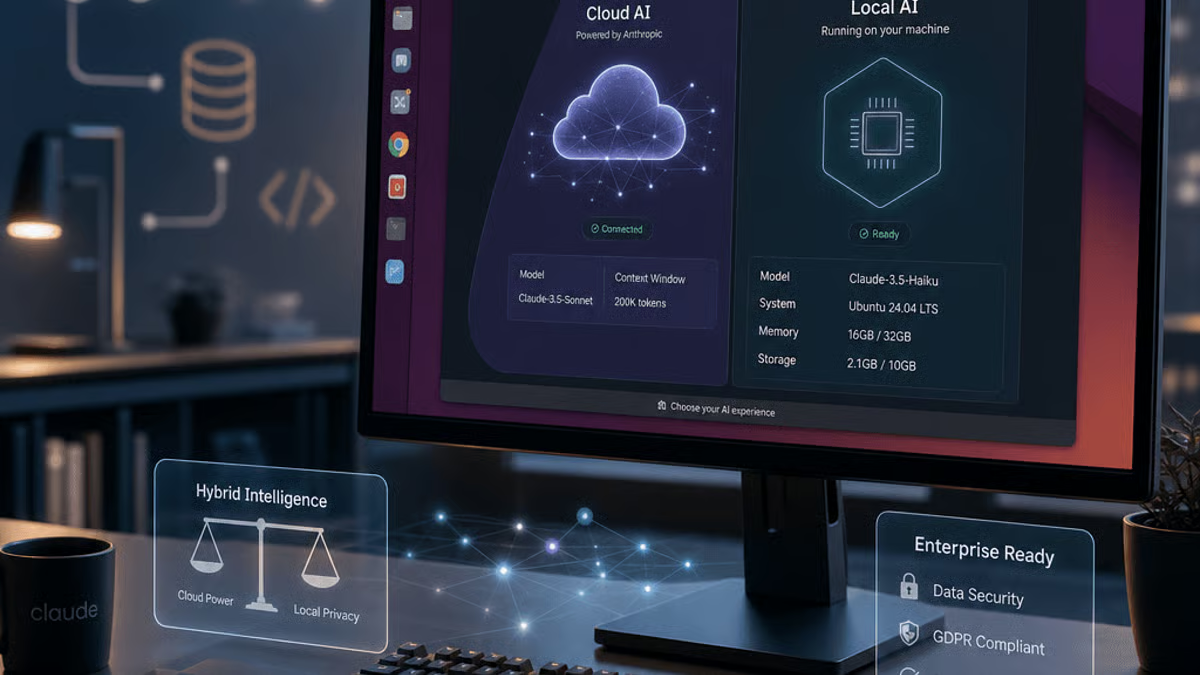
Anthropic just officially launched Claude Desktop for Linux, marking a significant expansion for developers who’ve long waited for native support on the open-source platform. The new desktop app brings Claude’s AI capabilities directly to Linux users, though early hands-on testing from ZDNet reveals that local AI functionality presents notable challenges. The move puts Anthropic in direct competition with other AI desktop tools while addressing a gap in its cross-platform strategy.
Anthropic is making a play for Linux developers. The AI company just released its official Claude Desktop app for Linux, ending months of waiting from the open-source community that’s watched Windows and Mac users get native access first.
The timing matters. As AI coding assistants become standard tools for developers, platform coverage can make or break adoption rates. Microsoft has GitHub Copilot baked into VS Code, while OpenAI has been expanding ChatGPT’s desktop presence. Anthropic was leaving a significant user base on the table by skipping Linux.
According to hands-on testing from ZDNet, the Claude Desktop app delivers solid performance for cloud-based AI interactions. The interface translates well to Linux environments, and the core functionality that’s made Claude popular – nuanced conversation, code generation, and document analysis – works as expected.
But there’s a catch. The review highlights that local AI capabilities, where models run directly on user hardware rather than cloud servers, present notable complications. This matters particularly for enterprise users concerned about data privacy and developers working in air-gapped environments. While the specifics of these challenges weren’t detailed in the available information, local AI performance has been a persistent hurdle across the industry as models grow larger and more resource-intensive.
The Linux launch reflects broader competitive dynamics in the AI tools market. Developer-focused platforms need to support the environments where developers actually work, and Linux remains dominant in server environments, DevOps workflows, and among significant portions of the programming community. Stack Overflow’s annual developer survey consistently shows roughly 25-30% of professional developers use Linux as their primary operating system.
Anthropic has been racing to expand Claude’s reach after raising substantial funding and positioning itself as a safety-focused alternative to OpenAI. The company’s Claude 3.5 Sonnet model has earned strong reviews for coding tasks, making desktop integration particularly strategic. If developers can access Claude directly from their native environment without switching to browsers, that reduces friction in the workflow.
The desktop app strategy also plays into enterprise adoption patterns. Companies evaluating AI tools want solutions that work across their entire tech stack. A Linux gap meant IT departments had to either standardize on different tools for different platforms or skip Claude entirely for teams running open-source systems.
Comparing Claude Desktop to rival apps reveals an increasingly crowded field. Microsoft has the advantage of deep OS integration with Windows. OpenAI has brand recognition and first-mover advantage in consumer AI. Smaller players like Cursor and Codeium are building specialized coding interfaces. Anthropic needs differentiation beyond just model quality – hence the emphasis on cross-platform availability and developer-friendly features.
The local AI limitations flagged in testing point to ongoing technical challenges across the industry. Running large language models locally requires significant compute resources, careful optimization, and often model quantization that can impact quality. Cloud-based AI offers better performance but raises data privacy concerns that matter enormously to enterprise customers and security-conscious developers.
What’s particularly interesting is how this launch fits into Anthropic’s broader enterprise push. The company has been courting business customers with features like longer context windows and enhanced security controls. Supporting Linux is table stakes for that market – you can’t seriously pursue enterprise developers without it.
The review’s mixed assessment on local AI also highlights a fundamental tension in AI tool development. Users want the privacy and control of local models with the performance and capabilities of cloud systems. That’s a hard technical problem that no one has fully solved yet. The companies that figure it out first will have a significant competitive advantage.
Anthropic’s Linux launch for Claude Desktop closes a critical gap in its platform strategy, but the local AI challenges highlighted in early testing reflect broader industry hurdles. For developers working in Linux environments, having native Claude access removes friction and signals Anthropic’s commitment to the platform. But the real test will be whether the company can solve the local AI performance puzzle that’s stumped the entire industry. As enterprises evaluate AI tools, the winners will be those that balance performance, privacy, and platform coverage – and Anthropic just checked one more box on that list.










Leave a Reply