
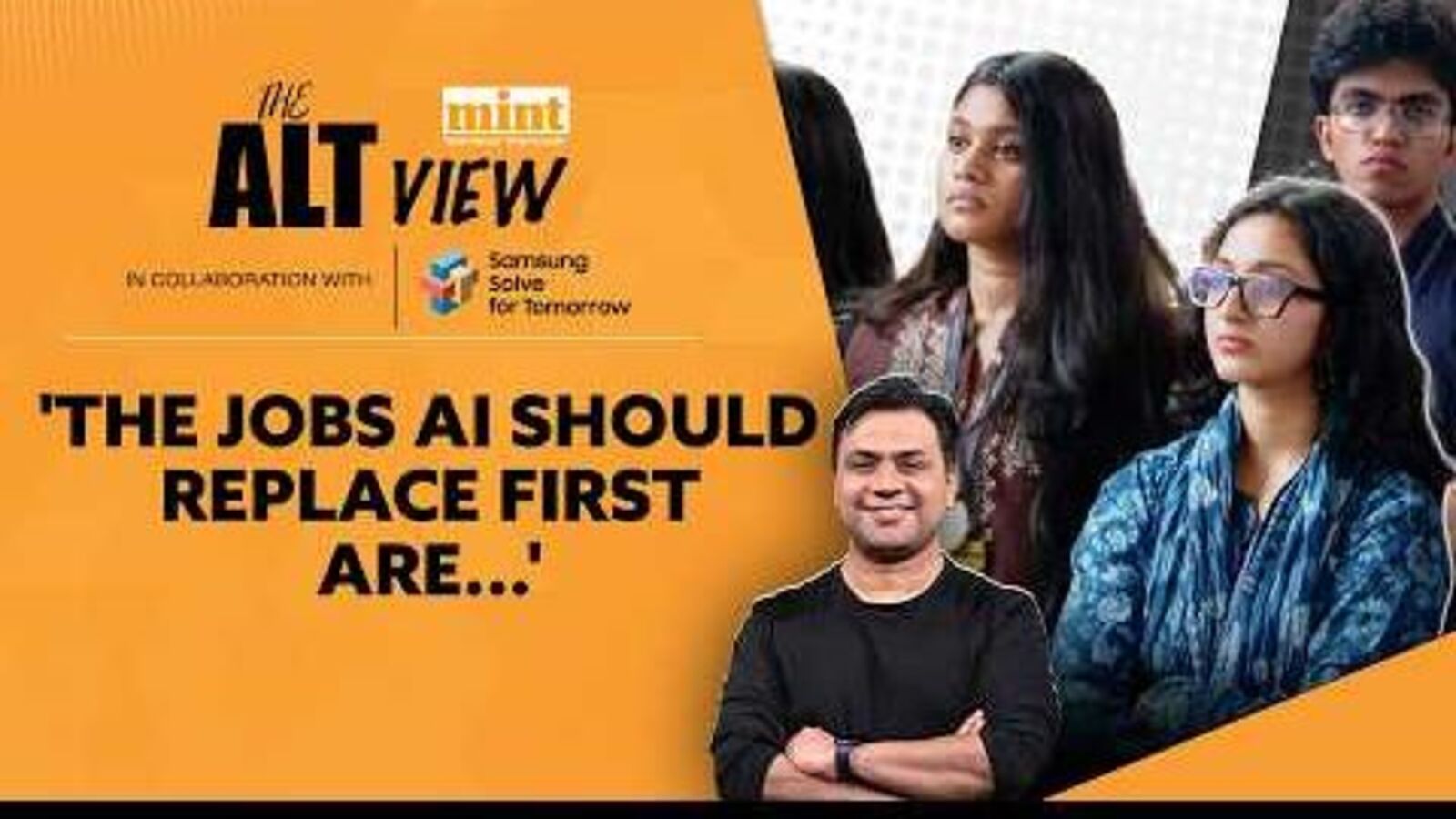
“If you could invent one AI superpower, what would it be?” Abhinav Trivedi, Deputy Editor at Mint and Hindustan Times, asked students at Christ University in Bengaluru. Their answers came fast. One wanted automated translation in any language. Another wanted the ability to scan every database in the world. A third asked for something stranger: the power to read minds. “Knowing people,” she said, “is one of the hardest things there is.”
Two faculty members sat in on the session: Dr Sangeetha R from the School of Business and Management and Dr Bijeesh T V from the Department of AI and Data Science Engineering, an AI educator and practitioner for over a decade.
Where the students think AI should go first
With the icebreaker over, Trivedi steered the discussion to a more practical question: Where could AI make the biggest difference in India?
One student wanted AI models to be properly trained in Indian languages, so people in rural areas could use the technology without needing fluent English. To illustrate the point, the student pointed to the government’s AI Kisan e-Mitra platform, which already accepts voice prompts in Hindi, Tamil, Telugu, and eight other regional languages. Another student highlighted early cancer diagnosis, where AI-assisted screening could detect a disease before it turns serious.
Public safety came up just as fast. “Why can’t AI cameras detect potholes along with the motorcyclists who break traffic rules?” one student asked. Another pointed to India’s overstretched judiciary, suggesting AI could help reduce years of backlog by handling simpler cases.
Then the discussion took a sharper turn. “If AI can replace people who enjoy their jobs, why can’t it replace those doing dangerous and undignified work?” one student asked. She was referring to manual sewage cleaning, a job that continues to cost lives.
When ideas meet evidence
Students supported their ideas with examples of AI already making a difference, while imagining where it could go next. They pointed to Kerala’s AI-assisted disaster systems, such as KaWaCHaM (Kerala Warnings Crisis and Hazard Management system) that was introduced after the 2018 floods, which extended flood warnings from two hours to two days. They also imagined AI improving everyday life, from humanoid companions for people with disabilities to memory devices that could gently remind people living with Alzheimer’s when they forget something.
Why Samsung Solve for Tomorrow was in the room
Trivedi used the session to introduce Samsung Solve for Tomorrow 2026. Samsung Solve for Tomorrow is one of India’s leading innovation programmes, where young changemakers are encouraged to identify pressing societal challenges and transform their ideas into impactful solutions with mentorship, and support.
Applications are open to young innovators aged between 14 to 22 years across four themes for this year: AI Living for India, Health and Education, Sport & Tech, and Environmental Sustainability. Applications remain open until 3 July 2026.
The top 40 teams will each receive ₹20,000 for prototype development, access to state-of-the-art Prototyping Labs at FITT, and an Innovation Bootcamp. They will also get an exclusive opportunity to visit and interact with leaders in Samsung’s R&D centres in Bengaluru, Delhi and Noida, and its South West Asia office in Gurugram, before advancing to the National Pitch Event. Each team member will receive a Samsung Galaxy laptop.
The top 20 teams will each receive ₹1 lakh, perosnalized mentorship from Samsung experts, and a Galaxy Z Flip smartphone for every team member, along with an opportunity to meet investors at the Grand Finale. Four winning teams, one from each theme, will share a cumulative incubation grant of ₹2 crore* and receive incubation support from FITT-IIT Delhi.
The boy who built a voice back
Pranet Khetan was in Class 11 at Shiv Nadar School, Gurugram, when he visited a Delhi care centre on a school trip. Most of the patients there were silent. A caretaker encouraged one to try speaking anyway. Words came out. Nobody in the room could understand them.
Pranet later said that was the moment he decided to build something that could translate what those patients were trying to say. He entered Samsung Solve for Tomorrow alone in 2025 with his project, spending the months that followed recording the voices of patients living with conditions such as dysarthria and building what is believed to be one of the first Hindi-language datasets of its kind.
He built a small, portable device that records a patient’s impaired speech, processes it through a deep-learning model he developed, and plays the words back clearly within seconds. The first version barely worked, with error rates so high that it was unusable. With mentorship from Samsung experts, he refined the technology into ParaSpeak, a device now tested with real patients and supported through incubation at FITT-IIT Delhi. The project went on to become one of four national winners of Samsung Solve for Tomorrow 2025.
Nobody in the Bengaluru classroom built anything that morning. Yet the instinct behind almost every idea, from language models and cancer screening to memory devices, was the same one that had sent a Gurugram schoolboy back to a care centre with a question he could not let go of: AI is most useful not as a replacement for people, but as a tool for solving the problems they have quietly lived with for years.
Samsung Solve for Tomorrow 2026 is now inviting students from southern India to bring their ideas to the Grand Finale in Delhi NCR this October.
Applications for Samsung Solve for Tomorrow 2026 are open at https://www.samsung.com/in/solvefortomorrow/ till the midnight of July 3rd.







Leave a Reply