
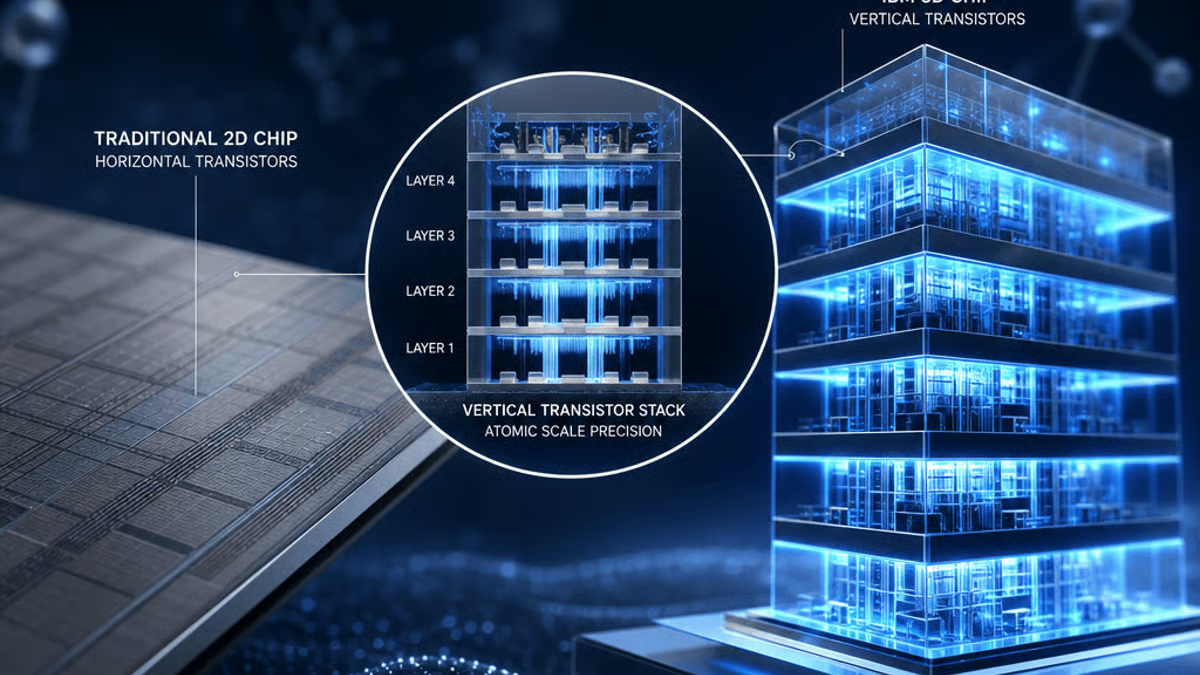
IBM just shattered what many considered the physical limit of semiconductor miniaturization. The company announced it’s created the world’s first known chip technology below 1 nanometer – a ‘block of flats’ vertical design that stacks transistors like apartment buildings instead of spreading them horizontally. While production remains years away, the breakthrough arrives as the industry scrambles for alternatives to traditional scaling, with Intel, TSMC, and Samsung all racing toward 2nm and beyond.
IBM just pulled off what seemed impossible six months ago – building functional chip components smaller than a single nanometer. The company’s research division unveiled the breakthrough Thursday morning, describing a radical ‘block of flats’ architecture that stacks transistors vertically rather than cramming them side-by-side on a flat plane. It’s the semiconductor equivalent of solving urban density by building up instead of out.
The announcement lands at a critical moment for the chip industry. TSMC is burning through billions to reach 2nm production by late 2025, while Intel bet its turnaround strategy on hitting 18A (roughly 1.8nm) next year. Samsung isn’t far behind with its own 2nm roadmap. But IBM’s sub-1nm claim – if it holds up under scrutiny – leapfrogs everyone by at least a full generation.
The physics here get brutal fast. At 1 nanometer, you’re working with structures just a few atoms wide. Quantum tunneling becomes a feature, not a bug. Electrons start ignoring the rules that made traditional transistors work for five decades. IBM’s vertical stacking approach essentially sidesteps these problems by changing the geometry entirely – think building a high-rise where each floor is a separate transistor layer, connected by microscopic elevators instead of sprawling hallways.
What makes this more than a lab curiosity is IBM’s track record. The company pioneered silicon-on-insulator technology in the 1990s, invented copper interconnects, and has been quietly developing quantum computing while competitors chased incremental gains. This isn’t some startup making wild claims – it’s a research organization that’s shipped actual products for decades.
But there’s a massive gap between ‘first known chip tech’ and chips you can actually manufacture. IBM itself cautioned that production remains ‘some time’ away – industry speak for ‘don’t hold your breath.’ The company didn’t share yield rates, power consumption figures, or compatibility with existing manufacturing processes. Those details matter enormously. GlobalFoundries abandoned its own 7nm program in 2018 because the economics didn’t work, even with proven technology.
The competitive implications ripple outward fast. Nvidia currently dominates AI chips using TSMC’s 4nm and 3nm processes. Apple just locked in TSMC’s entire 3nm capacity for its next iPhone generation. If IBM can commercialize sub-1nm chips within five years, it completely redraws the power map – especially for high-performance computing and quantum-classical hybrid systems where IBM already has deployment advantages.
Google and Microsoft are watching closely too. Both companies operate massive data centers where chip efficiency directly impacts operating costs and AI model training speeds. Microsoft’s already partnered with IBM on quantum computing. A sub-1nm breakthrough could accelerate timelines for quantum-advantage computing by years, not months.
The ‘block of flats’ metaphor isn’t just marketing fluff – it describes a fundamental architectural shift. Instead of transistors sprawling across a silicon wafer like suburban houses, IBM’s stacking them vertically like Manhattan real estate. That density unlocks new possibilities for on-chip memory, reduces signal travel distances, and potentially solves heat dissipation challenges that plague current high-performance chips.
What happens next depends on IBM’s ability to industrialize the process. The company hasn’t announced manufacturing partnerships, but TSMC and Samsung both have advanced packaging divisions that could potentially adapt the technology. Intel’s struggling foundry business might see this as a lifeline – or a threat if IBM decides to license the design to competitors.
The timing also intersects with growing concerns about U.S. chip manufacturing sovereignty. IBM’s research happened domestically, not in Taiwan or South Korea. If the technology proves viable, it could shift geopolitical calculations around semiconductor supply chains – especially as tensions around Taiwan Semiconductor continue to simmer.
IBM’s sub-1nm announcement is equal parts breakthrough and provocation. The company proved it’s possible to build chip components smaller than anyone thought feasible with current materials. But the gap between lab demonstration and mass production has killed plenty of promising semiconductor technologies before. What matters now is whether IBM can scale this vertical architecture to manufacturing volumes – and whether competitors can replicate or leapfrog it before it reaches market. For now, the chip industry’s roadmap just got a lot more interesting, and the race to atomic-scale computing shifted into a higher gear.











Leave a Reply