
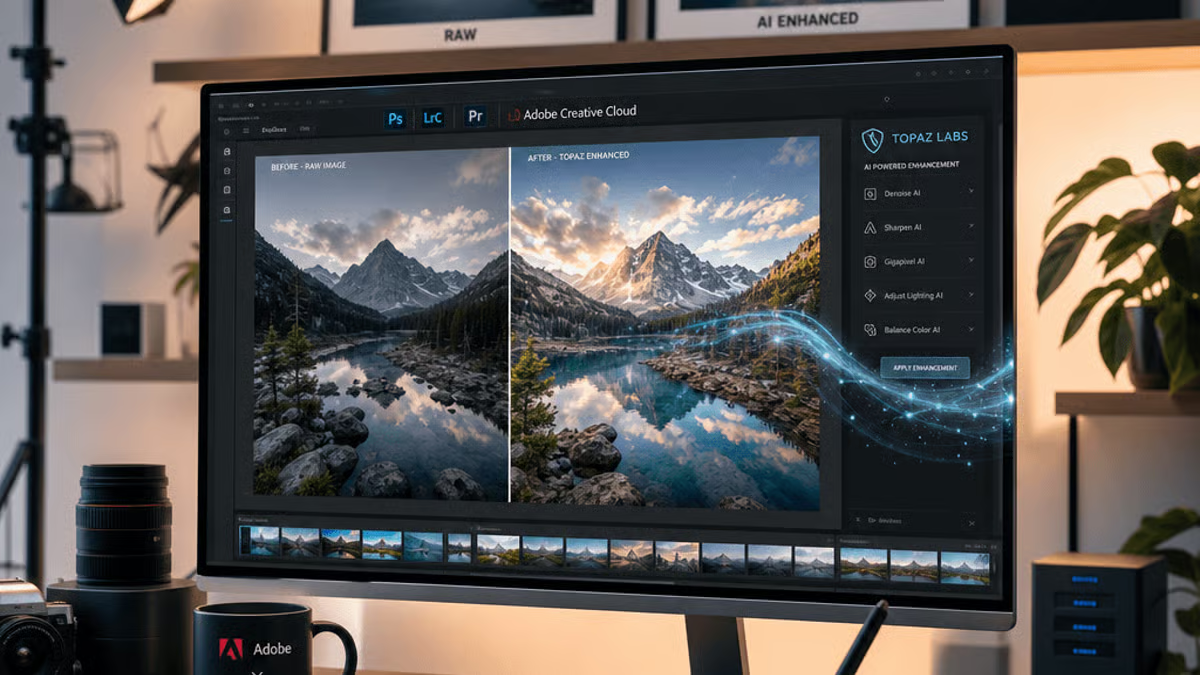
Adobe just made a major play to strengthen its AI arsenal, announcing the acquisition of Topaz Labs, the company behind popular AI-powered image and video enhancement tools. The deal signals Adobe’s aggressive push to embed more advanced AI capabilities directly into Creative Cloud, potentially reshaping how millions of creators approach photo and video editing. Financial terms weren’t disclosed, but the move comes as Adobe faces mounting pressure from nimble AI-native competitors threatening its creative software dominance.
Adobe is bringing one of the creative community’s favorite AI enhancement tools in-house. The company announced it’s acquiring Topaz Labs, a Dallas-based startup that’s built a devoted following among photographers and videographers for its AI-powered upscaling, denoising, and sharpening tools.
The move isn’t exactly surprising. Adobe has been racing to embed AI throughout Creative Cloud as standalone AI tools chip away at its market dominance. Topaz Labs‘ technology – which uses neural networks to enhance image and video quality in ways traditional algorithms can’t match – fits perfectly into that strategy.
What makes this acquisition particularly strategic is Topaz Labs‘ proven track record with professional creators. The company’s suite of desktop apps, including Gigapixel AI for upscaling, Denoise AI, and Video AI, have become essential tools for photographers recovering detail from old photos and videographers upscaling footage to 4K and beyond. Adobe said it plans to integrate these capabilities directly into Photoshop, Lightroom, and Premiere Pro.
The timing reveals Adobe’s competitive anxieties. Upstarts like Runway, Midjourney, and Stability AI have captured creator imagination with AI-first approaches, while Adobe’s own Firefly generative AI has received mixed reviews for output quality. Acquiring Topaz Labs gives Adobe battle-tested AI models and a team that’s been refining enhancement algorithms since 2005.
Financial terms remain undisclosed, but the deal likely values Topaz Labs significantly given its profitable bootstrapped status and loyal user base. The company has operated profitably for years selling perpetual licenses and subscriptions, avoiding the VC funding treadmill that’s consumed many competitors.
For Adobe, the acquisition solves multiple problems at once. It eliminates a potential competitor that could have evolved into a broader creative platform. It brings proven AI enhancement tech that works across photo and video. And it acquires a team with deep expertise in the kind of practical, production-ready AI tools that professionals actually need, not just flashy generative features.
The integration roadmap will be critical. Topaz Labs users have appreciated the company’s focused, standalone apps that do one thing exceptionally well. Adobe’s challenge will be maintaining that quality while weaving the technology into Creative Cloud’s sprawling ecosystem without degrading performance or burying features in complex menus.
For existing Topaz Labs customers, questions remain about whether standalone apps will continue to receive updates or if they’ll be sunset in favor of Creative Cloud integration. Adobe has a mixed track record here – some acquisitions like Figma have maintained independence, while others like Allegorithmic’s Substance tools became deeply integrated.
The deal also highlights the broader consolidation happening in creative AI. As the technology matures, larger platforms are snapping up specialized tools rather than building everything in-house. Adobe has been particularly active, previously acquiring Figma for $20 billion (though that deal faced regulatory scrutiny) and Frame.io for $1.275 billion.
What’s clear is that Adobe isn’t content to let AI-native startups own the future of creative tools. By acquiring Topaz Labs, it’s betting that integrating best-in-class AI enhancement directly into the tools creators already use daily will trump standalone AI apps, no matter how impressive their demos look.
Adobe’s Topaz Labs acquisition is less about eliminating competition and more about survival in an AI-first creative landscape. The deal gives Adobe immediate access to production-ready enhancement AI that professionals trust, filling a critical gap as generative AI grabs headlines but enhancement AI does the daily heavy lifting. For creators, the ultimate question is whether Adobe can preserve what made Topaz special – focused, fast, professional-grade AI tools – while integrating them into Creative Cloud’s ecosystem. If Adobe gets the integration right, this could be the acquisition that keeps Creative Cloud relevant as AI reshapes creative work. If it buries Topaz’s capabilities in bloated menus or compromises performance, it’ll just be another cautionary tale of big tech swallowing innovation.






Leave a Reply