
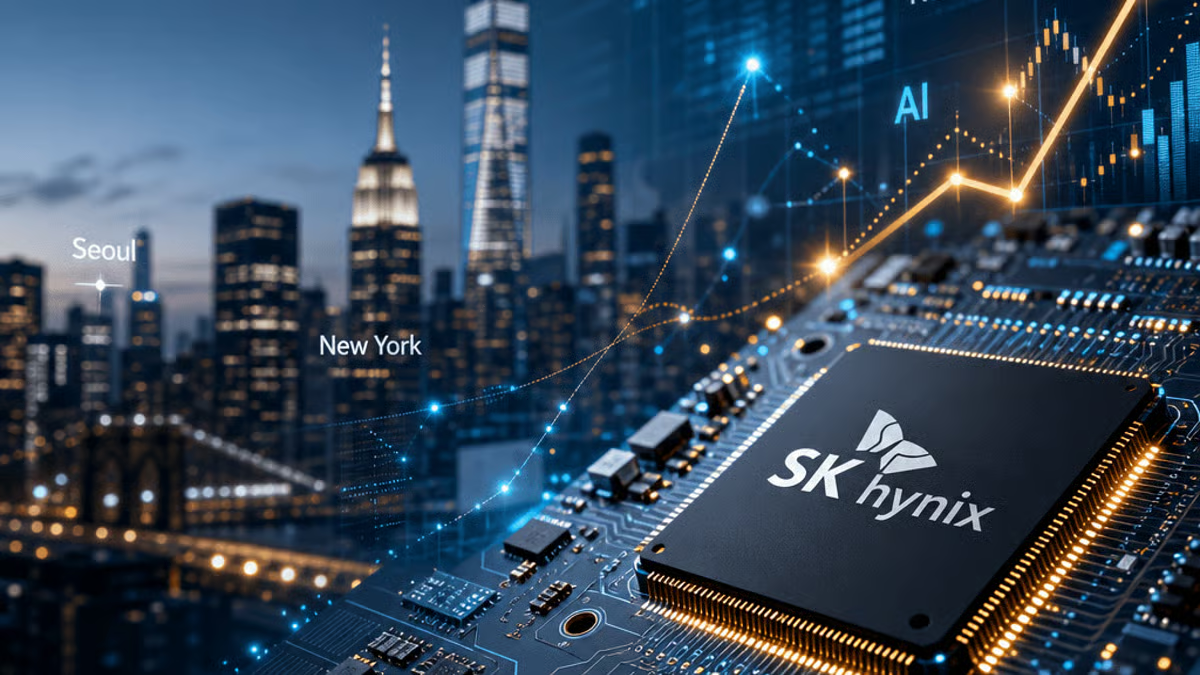
SK Hynix is preparing one of the largest tech capital raises in history, planning to issue 17.79 million new shares on the Nasdaq worth $29.65 billion. The move positions South Korea’s leading memory chipmaker – and the world’s dominant supplier of high-bandwidth memory (HBM) chips powering AI data centers – squarely in the crosshairs of U.S. investors chasing exposure to the AI infrastructure boom. According to CNBC, the share issuance values the offering at 45.45 trillion won, signaling massive ambitions as demand for AI-optimized chips continues to outpace supply.
SK Hynix just threw down the biggest bet in semiconductor history. The South Korean memory giant plans to issue 17.79 million new shares on the Nasdaq, raising a staggering $29.65 billion according to CNBC. That’s 45.45 trillion won for those keeping score at home, and it positions the company at the absolute center of the AI infrastructure gold rush.
The timing couldn’t be more strategic. SK Hynix dominates the high-bandwidth memory market, the specialized chips that sit right next to GPUs in AI data centers and enable the lightning-fast data transfer that large language models demand. While competitors scramble to ramp production, SK Hynix already supplies the majority of HBM chips going into Nvidia’s H100 and H200 accelerators, the workhorses powering everything from ChatGPT to enterprise AI deployments.
This isn’t just another equity raise – it’s a signal that the memory market has fundamentally shifted. Traditional DRAM and NAND flash sustained SK Hynix for decades, but HBM represents an entirely different ballgame with profit margins that would make any CFO salivate. The capital injection will likely fund aggressive fab expansion and next-generation HBM development, keeping SK Hynix ahead of Samsung and Micron in the race to feed AI’s insatiable appetite for bandwidth.
The Nasdaq listing also marks a strategic pivot toward U.S. capital markets. While SK Hynix trades on Korea’s KOSPI exchange, tapping American investors through an ADR program opens access to the deep pools of capital chasing AI exposure. U.S. tech investors have poured billions into Nvidia and hyperscalers, but direct plays on the memory supply chain remain scarce. SK Hynix is betting that appetite extends beyond GPU makers to the entire AI infrastructure stack.
Market dynamics favor the move. Global semiconductor capital expenditures hit record levels as governments from Washington to Brussels pour subsidies into domestic chip production. SK Hynix benefits from South Korea’s advanced manufacturing ecosystem while gaining access to U.S. research partnerships and customer relationships. The company’s HBM roadmap extends through HBM4 and beyond, with each generation requiring massive R&D investment and cleanroom capacity that this capital raise will help finance.
Competitors aren’t standing still. Samsung recently announced plans to triple HBM production capacity, while Micron targets qualification wins with major cloud providers. But SK Hynix’s first-mover advantage in volume HBM production gives it leverage that’s hard to replicate. The company shipped HBM chips for AI accelerators before competitors had working samples, locking in supply agreements that extend years into the future.
The $29.65 billion figure puts this offering in rarefied air. For context, that’s larger than most tech IPOs of the past decade and rivals the capital raises of major infrastructure plays. It signals that SK Hynix views the AI memory market not as a cyclical opportunity but as a structural shift in computing architecture. Data centers are being rebuilt around AI workloads, and every rack of GPUs needs HBM chips that SK Hynix manufactures better than anyone else.
Investor appetite will be the real test. U.S. markets have shown willingness to fund semiconductor expansion, but at valuations that reflect both the opportunity and the risks. Memory markets have historically been cyclical and brutal, with oversupply crashes wiping out profits as quickly as shortages create them. SK Hynix argues that AI memory is different – stickier demand, higher barriers to entry, and customers willing to pay premiums for guaranteed supply. The market will decide if that thesis justifies a $29 billion check.
What happens next could reshape the global memory industry. If the offering succeeds, expect competitors to follow suit with their own capital market plays. If it struggles, it might signal that investors see AI infrastructure spending approaching a peak. Either way, SK Hynix is making a statement that the future of computing runs on high-bandwidth memory, and they’re raising the cash to own that future outright.
SK Hynix’s $29.65 billion Nasdaq play is a watershed moment for the semiconductor industry and AI infrastructure investing. The company isn’t just raising capital – it’s positioning itself as the essential supplier in the AI era, where memory bandwidth matters as much as compute power. U.S. investors finally get direct exposure to the HBM supply chain that enables every major AI breakthrough, while SK Hynix gains the war chest to outspend rivals and lock in dominance. If the offering succeeds at this scale, it validates the thesis that AI infrastructure spending has staying power beyond the hype cycle. And it puts every other memory maker on notice that the race for HBM supremacy will be won by whoever can raise and deploy capital the fastest.






Leave a Reply