

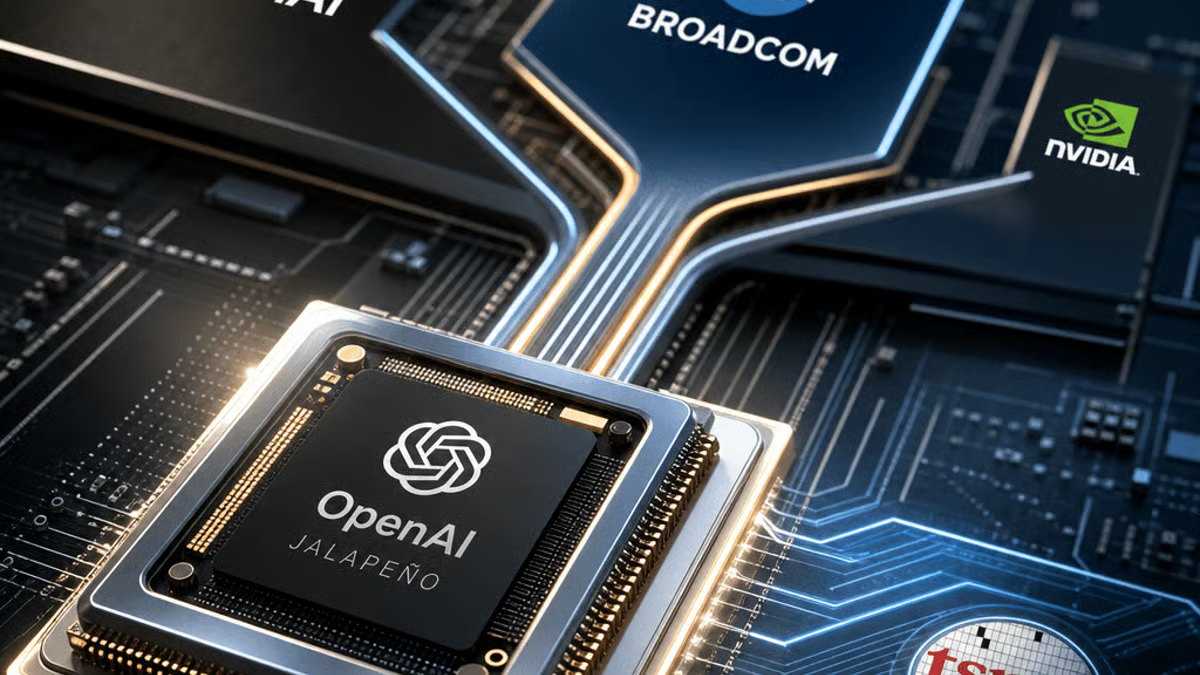
OpenAI just unveiled Jalapeño, its first custom AI chip developed with semiconductor giant Broadcom, marking a decisive break from its dependence on Nvidia hardware. The chip, announced eight months after the partnership went public, represents OpenAI’s most aggressive move yet to control its entire technology stack – from models to the silicon running them. For an industry where compute costs can make or break AI economics, this changes everything.
OpenAI isn’t waiting around for the next generation of Nvidia chips anymore. The AI powerhouse just pulled back the curtain on Jalapeño, a custom AI chip designed in collaboration with Broadcom, representing the company’s first major step toward owning its hardware destiny.
The timing couldn’t be more strategic. Eight months ago, when OpenAI and Broadcom first announced their chip partnership, the AI industry was grappling with severe GPU shortages and skyrocketing inference costs. Now, with Jalapeño’s reveal, OpenAI signals it’s ready to architect solutions tailored specifically for its massive-scale language models rather than relying on general-purpose accelerators.
This marks a fundamental shift in how leading AI companies think about their infrastructure. While OpenAI has spent billions renting Nvidia GPUs through cloud providers like Microsoft Azure, custom silicon promises dramatically better performance-per-watt for specific workloads. The potential savings run into hundreds of millions annually when you’re serving hundreds of millions of ChatGPT users.
Broadcom brings serious credentials to the table. The semiconductor veteran has designed custom chips for Google‘s TPUs and helps Meta build its training accelerators. That expertise now flows directly into OpenAI’s vertical integration strategy – what the company calls building “the full stack.”
The competitive implications ripple across the AI landscape. Google has run on custom TPUs for years. Amazon developed its Trainium and Inferentia chips. Meta announced its own silicon roadmap. Now OpenAI joins the club, leaving Nvidia facing a future where its biggest customers increasingly build in-house alternatives.
But custom chips aren’t just about breaking free from Nvidia. They’re about optimization. Jalapeño likely targets inference workloads – the actual serving of responses to user queries – rather than the training runs that create models in the first place. Inference represents the bulk of ongoing operational costs, making it the smartest place to deploy custom silicon first.
The broader trend reveals AI leaders betting their futures on hardware differentiation. As model architectures converge and training techniques proliferate through research papers, the real competitive moats might emerge at the silicon level. Whoever runs models most efficiently at scale wins the economics game, and generic chips leave money on the table.
OpenAI‘s move also reduces strategic vulnerability. Relying entirely on Nvidia means supply constraints, allocation battles, and pricing pressure beyond your control. Custom chips manufactured through partners like Broadcom and fabricated at TSMC create alternative supply chains and negotiating leverage.
What remains unclear is Jalapeño’s production timeline and performance specifications. Custom chip development typically spans 18-24 months from design to manufacturing. If OpenAI and Broadcom started work before last year’s announcement, initial production runs could arrive within months. Performance benchmarks against Nvidia‘s H100 and upcoming B100 chips will determine whether this gamble pays off.
The financial stakes are massive. OpenAI reportedly spends over $700,000 daily just to operate ChatGPT, with compute costs representing the lion’s share. Even a 30% efficiency gain from custom silicon translates to hundreds of millions saved annually – money that funds more research, faster product iteration, and better margins.
Industry watchers should note this validates the thesis that AI’s next phase hinges on infrastructure innovation as much as algorithmic breakthroughs. The era of buying off-the-shelf GPUs and scaling up is giving way to purpose-built systems optimized for specific model architectures and deployment patterns.
OpenAI’s Jalapeño chip represents more than just another custom silicon project – it’s a declaration that the company plans to control every layer of its technology stack. As AI costs spiral and competition intensifies, vertical integration becomes survival strategy. The partnership with Broadcom gives OpenAI semiconductor expertise without building fabrication facilities, while custom chips promise the performance-per-dollar edge needed to serve billions of inference requests profitably. Nvidia still dominates AI training, but the inference market just got a lot more competitive. Watch for other AI leaders to accelerate their own chip programs as the race to optimize AI economics reshapes the entire semiconductor landscape.









Leave a Reply