
I want to start by writing to you the way I’d want to be written to if I were sitting in your seat.
You opened a Coinbase account, possibly for the first time, because something about $EAT made sense to you. The mission. The transparency. The idea that an asset class you’d never owned could fund hunger relief at scale without you having to remember to write a check. You put real money in. Maybe $300, maybe $30,000. Maybe more. You weren’t here for a 10x. You were here because the cause resonated, and you understood you’d take some volatility along the way.
Then yesterday, you watched your position drop forty percent.
I’m Aaron Rafferty, one of the founders of WYDE. This is a letter to you specifically. I’m not going to use crypto culture vocabulary, and I’m not going to talk down to you about volatility being normal in this asset class. You already know that intellectually. Seeing it in your own account is a different feeling, and I want to address what happened, what it means, and what the next twelve weeks are going to look like.
What happened to $EAT on April 28-29, 2026?
On April 28, $EAT listed on BitMart. That was the first of ten exchange listings scheduled across April through July as part of our Impact Summer World Tour.
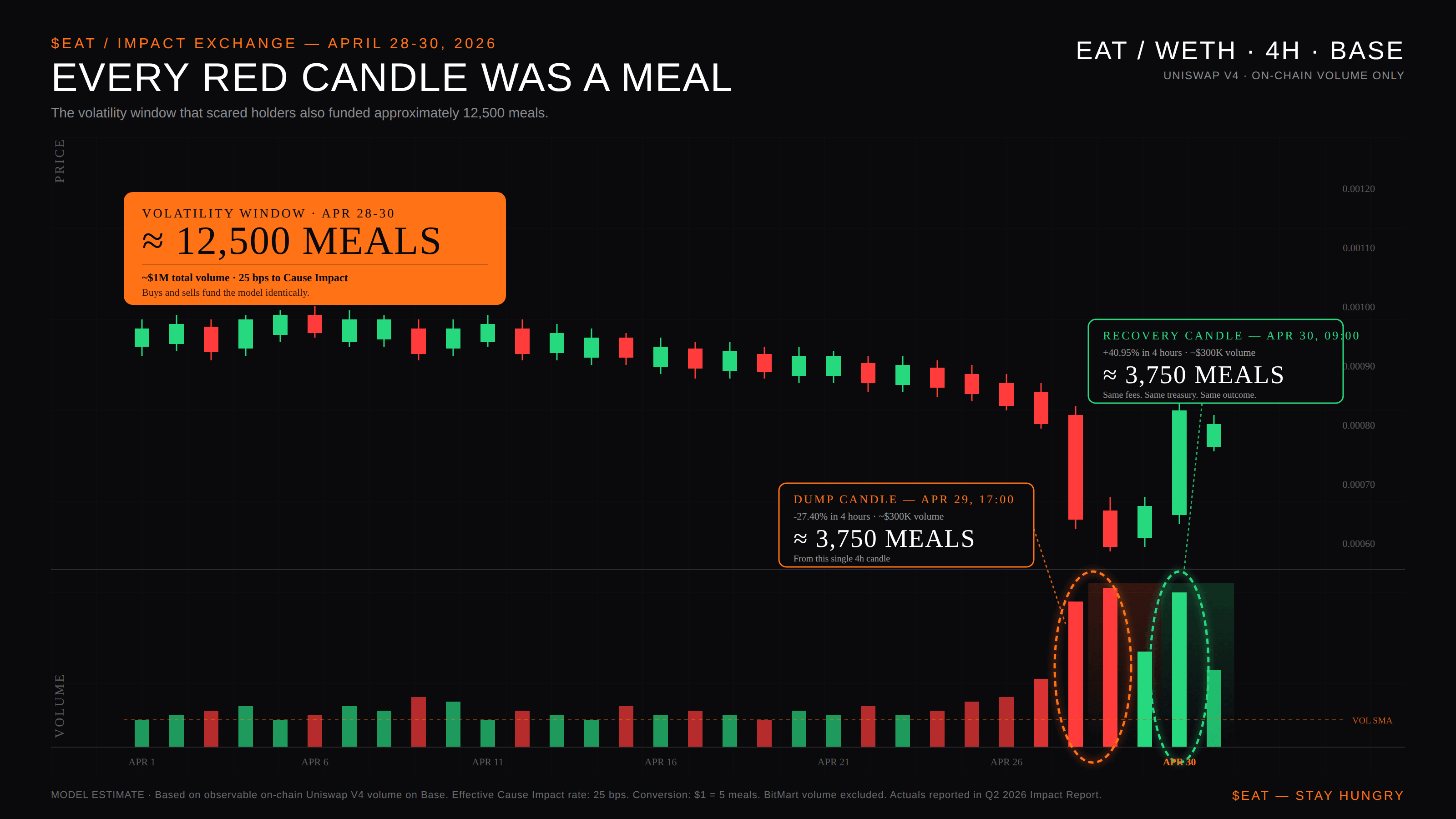
The listing brought new attention, new participants, and a wave of trading activity on both BitMart and on the WYDE Impact Exchange (Uniswap V4 on the Base network, which is where the underlying token trades). Three specific 4-hour windows did most of the work:
| Time (UTC-7) | Move | What happened |
|---|---|---|
| Apr 29, 09:00 | -6.07% | Decline begins. First wave of profit-taking from early holders. |
| Apr 29, 17:00 | -27.40% | The major dump candle. Price fell from ~$0.00085 to ~$0.00060 in four hours. |
| Apr 30, 09:00 | +40.95% | Snap-back recovery. Price returned to ~$0.00085 in a single 4-hour window. |
By the morning of April 30, the price had recovered most of the move. In dollar terms, the WYDE Impact Exchange processed roughly $1 million in trading volume across the volatility window, about 4x the typical pace.
Why did the $EAT price drop forty percent after the BitMart listing?
I’ll give you the real answer instead of a comforting one.
When a token moves from a quiet pocket of the market into a louder one (like a new exchange listing), three things tend to happen at once. New traders enter and bring volatility because they’re sizing positions for the first time. Early holders who’ve been waiting four-plus months for liquidity finally see enough volume to take profit. Short-term traders try to front-run both groups.
That combination produced the chart you saw. Specifically, several large sell orders from launch-week holders met thinner-than-expected order books at the listing moment, and the price moved more than it would have for a deeper-liquidity asset.
If you’re used to evaluating equities, the cleanest mental model is this: $EAT is an early-stage asset with a small float and a market cap in the eight-figure range. A single $30,000 sell order moves the price more than the same order would move a mid-cap stock. The order book deepens as additional exchanges come online. We have nine more listings scheduled between now and July 28, and each one adds capacity.
The other piece of context you should have: the largest individual sell during the window was around $30,000. That single trade is what kicked off the cascade. I’ll come back to a different sell of $16,000 in a moment because there’s a story inside it that explains the model better than any chart could.
How does the WYDE Impact Exchange turn trading volume into meals?
Every trade on the WYDE Impact Exchange generates a dynamic fee. That fee is split four ways, equal quarters:
- 25% to Cause Impact (the treasury that funds hunger relief grants)
- 25% to community participation rewards
- 25% to WYDE operations
- 25% to platform infrastructure
The Cause Impact treasury flows to WYDE Association, our Wyoming nonprofit (501(c)(4) social welfare organization). WYDE Association administers a grant program to verified hunger relief partners. Our standard impact conversion is $1 = 5 meals, which is deliberately conservative against industry benchmarks of $1 = 10 meals.
In effective basis points, the model routes approximately 25 bps of every traded dollar into the Cause Impact treasury at our current fee level.
The mechanism is direction-blind. A $30,000 sell and a $30,000 buy generate the same fee, route the same percentage to Cause Impact, and produce the same number of meals. This is a meaningful break from how most assets work, and it’s the reason the volatility you saw last week is not the problem you might think it is.
How many meals did the April 2026 $EAT drawdown fund?
Here’s the math, using the 25 bps effective Cause Impact rate and the $1 = 5 meals standard:
| Trade or window | Volume | To Cause Impact | Meals (model) |
|---|---|---|---|
| The major dump candle (Apr 29, 17:00, -27.4%) | ~$300K | ~$750 | ~3,750 |
| The major recovery candle (Apr 30, 09:00, +40.95%) | ~$300K | ~$750 | ~3,750 |
| The remaining bars across the volatility cluster | ~$400K | ~$1,000 | ~5,000 |
| Total volatility window (Apr 28-30) | ~$1M | ~$2,500 | ~12,500 |
So the drawdown that scared you funded approximately 12,500 meals from on-chain trading activity during the window. That’s a model estimate based on observable Uniswap V4 volume; BitMart volume is not currently routed through the WYDE on-chain fee infrastructure and is excluded. Actual grant amounts will be reported in our Q2 2026 Impact Report, where we historically round down.
For reference, here are a few specific trades and what each one represents in meals:
- The largest single sell during the window (~$30,000): about 375 meals
- The single ~$24,500 buy that snapped the price back: about 306 meals
- The $16,000 trade that started at a $500 buy within the first week of launch 200 meals
Should I sell my $EAT?
I can’t tell you that, and I won’t pretend to.
What I can tell you is what you’re holding. You’re holding a position in early-stage impact infrastructure that converts trading volume, in any direction, into permanent hunger relief funding. The asset is volatile. The mission is not. Those are two different things, and conflating them is the most common mistake I see new holders make.
If you bought because of the mission and your time horizon is longer than a few months, this week was noise. The structural story is on track and accelerating. The remaining nine exchange listings will add liquidity. The Feed the Children grant relationship is active. The meals counter is moving the only direction it can move.
If you bought because you needed the price to only go up, this asset class will keep teaching you difficult lessons regardless of what we do at WYDE. I’d rather you be honest with yourself about which one you are than have me reassure you out of a decision you’ll second-guess later.
You bought infrastructure, not a ticker symbol. The right financial comparison isn’t a stock. It’s closer to owning a position in a young exchange. What matters for an exchange isn’t its share price on a given day. It’s throughput. Throughput this week was up 4x. That’s the metric you should be checking, not the candle.
What does the next twelve weeks look like for $EAT?
Honestly? It’s going to look like the this week, repeated, several times.
Nine more exchange listings between now and July 28. Each one will bring a wave of new attention. Some of those waves will look like up moves. Some will look like down moves. All of them will look like volume on the chart. All of them will fund meals.
If a forty percent candle felt scary, the right preparation isn’t avoidance. It’s calibration. The volume bars under the price line are the actual scoreboard for what we’re building. The price line is downstream of them, and downstream of any single week’s flow.
We were not built to be a number-go-up project. We were built to convert market activity into hunger relief at scale. This week the mechanism worked exactly as designed. The next twelve weeks will be more of the same, with each listing deepening liquidity and each cycle of attention generating fees that route to the meals counter. We call this model contributory consumption: everyday financial behavior producing charitable impact by design, not by donation.
What this means for your $EAT position
Your downside in this asset class is real. So is the upside. Neither is the point. The point is that you put capital into a system that turns financial activity into food on tables, and the system worked the way it was supposed to work this week.
You’re not a bag holder. You’re a participant in infrastructure that, in seventy-two hours of volatility you could have lived without, funded approximately 12,500 meals.
The chart you watched had two colors. The chart underneath it has one color, and one direction.
That’s the chart that matters.
Aaron Rafferty is a co-founder of WYDE. Meal estimates in this piece are model figures based on observable on-chain trading volume on the WYDE Impact Exchange (Uniswap V4 on Base) and the WYDE conservative impact standard of $1 = 5 meals. The model uses an effective Cause Impact fee rate of 25 basis points. BitMart trading volume is not currently routed through the WYDE on-chain fee infrastructure and is excluded from these calculations. Actual grant amounts and meal totals will be reported in the Q2 2026 Impact Report.










Leave a Reply