
- ■
CNBC conducts first hands-on test of xAI’s Grok chatbot integrated with Tesla’s Full Self-Driving system in real NYC traffic conditions
- ■
Integration demonstrates AI assistant capabilities in autonomous vehicles, showing both practical utility and potential safety concerns
- ■
Test comes as Tesla pushes deeper into AI-powered features while xAI expands Grok beyond standalone chatbot into vehicle systems
- ■
Results offer early glimpse at challenges automakers face deploying conversational AI in high-stakes driving environments
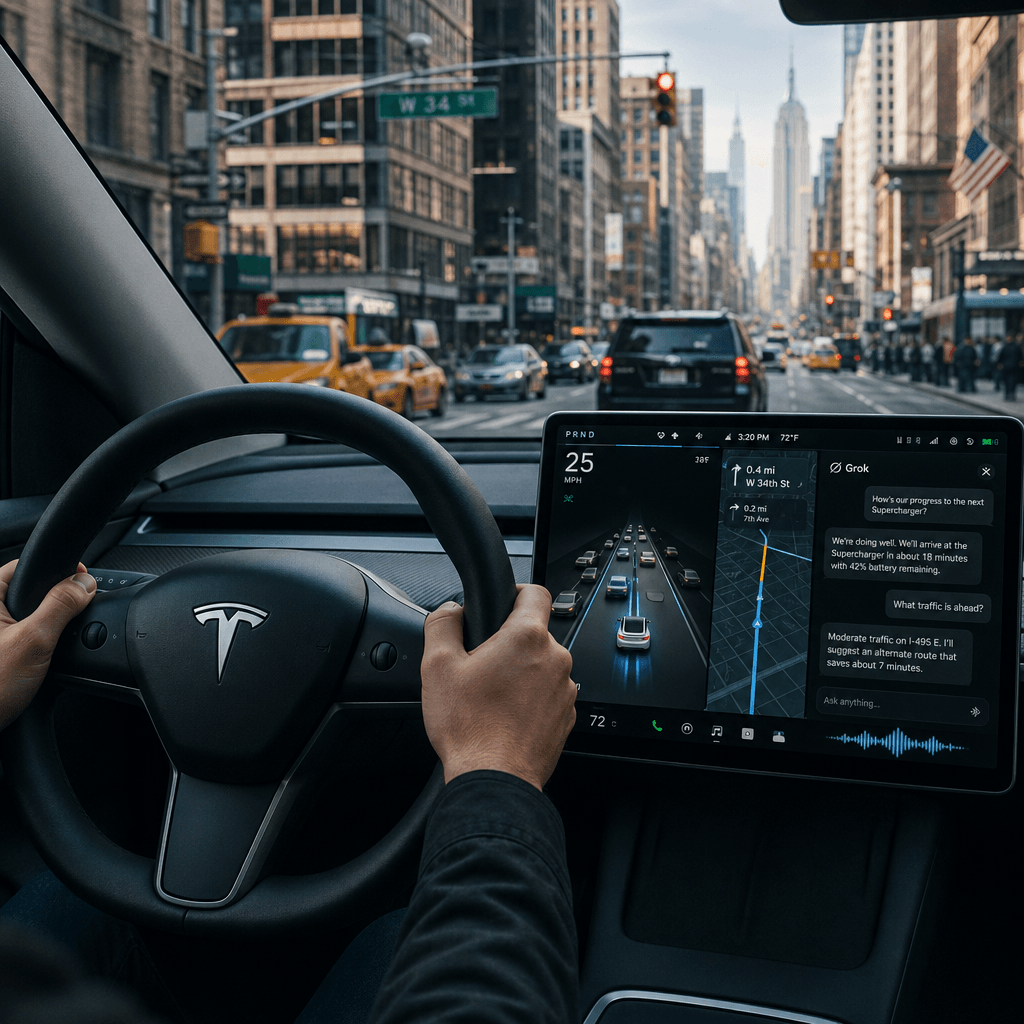
The future of in-car AI just got its first real-world stress test on Manhattan’s chaotic streets. CNBC rode along with a Tesla Model Y owner to see how xAI’s Grok chatbot performs when integrated with Full Self-Driving (Supervised) – and the results reveal both the promise and peril of putting conversational AI behind the wheel. As automakers race to embed AI assistants into vehicles, this hands-on test exposes what happens when chatbots meet actual traffic.
Tesla owners in New York City just became beta testers for the next evolution of in-car AI. CNBC took a ride with a Model Y driver to evaluate how xAI’s Grok chatbot performs when woven into the fabric of Tesla’s Full Self-Driving system – and the experience reveals we’re entering uncharted territory.
The integration marks a significant shift for xAI, Elon Musk’s AI startup that’s been racing to catch up with OpenAI and Google in the chatbot wars. Rather than competing purely on conversational ability, Grok’s now embedded in one of the most demanding environments imaginable: autonomous vehicles navigating Manhattan’s gridlock, double-parked delivery trucks, and jaywalking pedestrians.
During the test drive, the Model Y owner demonstrated how Grok responds to voice commands while the vehicle operates in FSD mode. The AI handled routine queries about nearby charging stations and restaurant recommendations without breaking stride. But the real test came when the driver asked Grok to explain why the car made certain driving decisions – a feature that could prove crucial as regulators scrutinize autonomous systems.
Tesla’s Full Self-Driving (Supervised) remains a Level 2 driver assistance system, requiring constant human attention despite its name. Adding a chatbot into this equation creates new layers of complexity. Can drivers safely split attention between monitoring the road, supervising the AI, and conversing with Grok? The CNBC test surfaced these exact concerns when the vehicle navigated a tight intersection while the driver queried the chatbot.
The timing couldn’t be more strategic for both companies. Tesla has been pushing to prove its AI capabilities extend beyond just autonomous driving hardware into sophisticated software experiences. Meanwhile, xAI needs real-world deployment scenarios to train Grok on contextual, high-stakes decision-making – and there’s nothing quite like rush-hour traffic to stress-test an AI system.
What sets this integration apart from existing in-car assistants like Apple’s Siri or Google Assistant is Grok’s ability to tap into real-time driving data. The chatbot can theoretically explain why the FSD system chose one route over another, or clarify sensor readings that influenced braking decisions. This transparency could address one of autonomous driving’s biggest challenges: the black box problem that makes it difficult to understand why self-driving systems behave as they do.
But the NYC test also exposed limitations. When pressed for navigation alternatives during heavy traffic, Grok occasionally provided suggestions that contradicted the FSD system’s routing choices, creating confusion about which AI to trust. The driver noted moments of cognitive overload – exactly the scenario safety advocates warn about when mixing conversational AI with semi-autonomous driving.
The automotive industry’s watching this experiment closely. Mercedes-Benz recently integrated Microsoft’s AI into its MBUX system, while General Motors partnered with Google for in-vehicle intelligence. Tesla’s approach with Grok represents a more deeply integrated model where the chatbot doesn’t just handle infotainment but potentially explains autonomous driving behavior.
Safety researchers remain cautious. The National Highway Traffic Safety Administration hasn’t issued specific guidance on AI chatbots in vehicles operating autonomous features, leaving manufacturers to self-regulate. The CNBC test revealed this regulatory gap – at one point, the driver engaged in an extended conversation with Grok about stock prices while the car navigated a construction zone, a scenario that would alarm safety experts.
For xAI, the Tesla integration offers invaluable training data. Every query about “why did we brake there” or “what does the car see” feeds Grok examples of high-context, real-world AI interaction. This positions xAI differently than OpenAI’s ChatGPT or Google’s Gemini, which largely operate in text-based or controlled environments.
The technology also hints at future possibilities – imagine an AI that not only drives but explains its reasoning in real-time, educates passengers about road conditions, or even argues with you about the best route home. The NYC test showed glimpses of this future when Grok successfully explained why the FSD system yielded to an unmarked police car, demonstrating sensor fusion insights.
Yet the experience also underscored how far we are from seamless AI integration. Voice recognition struggled with sirens and street noise. Response latency occasionally created awkward pauses during time-sensitive queries. And the system lacked intuitive ways to prioritize driving commands over casual conversation – a potentially dangerous gap.
As Tesla expands FSD access and xAI refines Grok’s capabilities, these NYC streets are becoming the proving ground for a fundamental question: can AI assistants make autonomous driving safer through transparency and explanation, or do they add one more dangerous distraction to an already complex system?
The Manhattan streets just became ground zero for the next phase of automotive AI. This CNBC test reveals that integrating chatbots like Grok with autonomous driving systems offers genuine utility – transparent explanations of driving decisions could finally crack the black box problem plaguing self-driving tech. But it also exposes new risks around driver distraction and conflicting AI guidance. As Tesla and xAI refine this integration, the question isn’t whether AI assistants belong in cars, but how to deploy them without turning vehicles into rolling distraction factories. Regulators, meanwhile, face an urgent challenge: writing rules for technology that’s already on the road, learning from every conversation between human drivers and their AI co-pilots.




Leave a Reply