
- ■
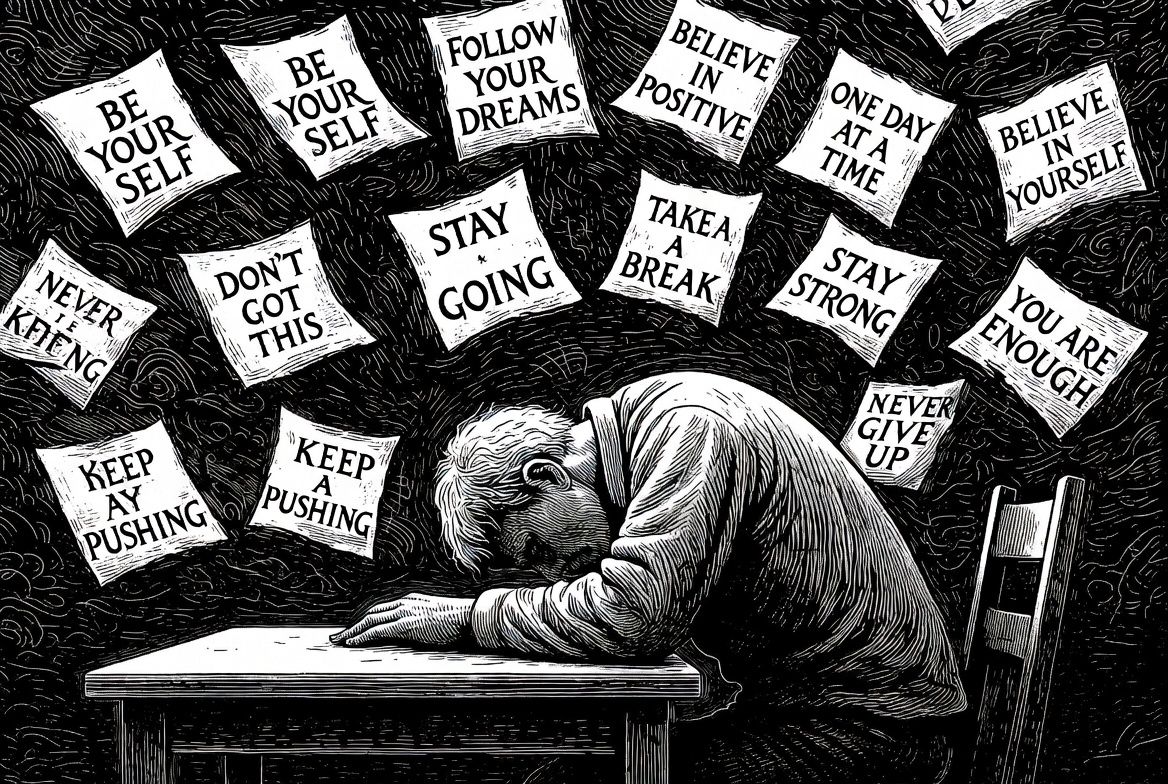
Advice often fails not because it is wrong, but because the person receiving it lacks the capacity to act on it—capacity meaning time, money, energy, attention, and emotional stability. When these resources are depleted, even simple guidance becomes structurally difficult to implement.
- ■
Behavioral science models like the Fogg Behavior Model and research on scarcity show that behavior requires both motivation and ability. Under conditions like depression or financial stress, cognitive bandwidth shrinks and energy drops, making strategy-level advice ineffective without addressing underlying constraints.
- ■
Effective advice focuses on the infrastructure layer: reducing friction, simplifying actions, automating beneficial behaviors, and tailoring solutions to a person’s real circumstances rather than offering universal prescriptions that ignore differences in capacity.
Good advice only works when the person hearing it has the spare capacity to act on it. Capacity means time, energy, money, attention, emotional stability. When those resources are already depleted, advice that looks simple from the outside becomes structurally impossible from the inside. The paradox appears everywhere: people struggling with depression are told to exercise and eat better; people living paycheck to paycheck are told to save and invest. The advice itself is often sound. What’s missing is the infrastructure required to carry it out.
Behavioral science describes this constraint clearly. According to the Fogg Behavior Model, behavior occurs only when three elements converge at the same moment: motivation, ability, and a prompt. Advice usually targets motivation or serves as a prompt. Ability, however, is the piece most likely to be missing. If an action demands too much time, effort, or psychological energy, motivation alone rarely pushes it across the line into real behavior.
The Advice Paradox
Depression illustrates the problem starkly. Clinical depression does not simply lower mood; it disrupts motivation, energy, and the sense that effort will produce results. Fatigue, withdrawal, and sleep disturbances reinforce each other until everyday actions feel heavy. Exercise does help alleviate depressive symptoms over time, but the condition that makes exercise beneficial also makes beginning it unusually difficult. Many people in depression also develop patterns similar to Learned Helplessness, where repeated setbacks create the expectation that nothing they do will change their situation. Advice like “just start exercising” then collides with a system that currently cannot generate the energy or belief required to begin.
A similar pattern appears in financial advice directed at people facing chronic scarcity. Suggestions like “invest 20 percent of your income” assume disposable income and mental space for long-term planning. Research on scarcity, especially work by Sendhil Mullainathan and Eldar Shafir, describes how financial pressure narrows attention around immediate needs. Rent, groceries, and urgent bills dominate the mental landscape. They call this the Scarcity Mindset, where limited resources impose a “bandwidth tax” on cognition. The brain that could plan for retirement under stable conditions is now busy firefighting short-term crises.
Once you see this structure, the advice paradox becomes clearer. Advice typically operates at the strategy layer. It tells you what to do: exercise more, save money, network, study. Capacity sits underneath at the infrastructure layer: stable sleep, spare time, disposable income, mental bandwidth, supportive relationships. When that infrastructure collapses under stress, illness, or scarcity, strategy-level guidance loses traction.
This also explains why advice tends to work best for people who already have slack in their lives. Someone with financial stability, emotional support, and manageable obligations can translate a small tip into meaningful action. Advice functions as a nudge. For someone operating at the edge of exhaustion or survival, the same suggestion becomes another demand.
The Right Approach to Advise
Modern behavior-change research quietly supports this interpretation. Frameworks built around the Fogg Behavior Model emphasize lowering the difficulty of actions rather than increasing motivational pressure. Instead of pushing people toward ambitious goals, the model encourages shrinking behaviors until they fit comfortably within existing ability. The philosophy behind “tiny habits” grows directly from this principle: if motivation fluctuates and capacity is limited, the behavior itself must become easier.
Another line of research addresses a different failure point. Even when people possess adequate motivation and ability, vague goals often stall because the brain still has to decide when and how to act. Work by Peter Gollwitzer on Implementation Intentions shows that turning intentions into precise “if-then” plans increases follow-through. A plan like “exercise more” becomes “if it’s 7 p.m. on weekdays, I walk for ten minutes.” These scripts reduce the decision-making burden in the moment. Even capable people benefit because the plan removes friction from execution.
From inside a constrained situation, generic advice can feel strangely invalidating. Someone hearing it may interpret the message as a misdiagnosis. The suggestion assumes their problem is lack of knowledge or discipline, while their actual barrier may be exhaustion, financial instability, or emotional overload. Advice that ignores those constraints can also sound like a moral judgment: if the solution is simple and you are not implementing it, the implication is that you must not care enough.
Research on scarcity and depression suggests the opposite interpretation. What appears from the outside as laziness or irrational decision-making often reflects constrained bandwidth and depleted energy. The individual is responding to the environment available to them. Advice that ignores those conditions does not simply fail. It can amplify shame and reduce the sense of agency required for change.
Addressing the “Infrastructure Layer”
Helpful advice in difficult circumstances therefore looks very different from the standard list of life hacks. The first step is addressing the infrastructure layer rather than jumping straight to strategy. In depression, that might involve stabilizing sleep patterns, increasing exposure to daylight, or beginning with extremely small activities that restore a sense of movement. In financial scarcity, it might mean simplifying administrative processes, reducing bureaucratic complexity, or designing systems where beneficial actions happen automatically.
Another shift involves radical simplification. When capacity is low, actions must shrink until they clear the behavioral threshold described by the Fogg Behavior Model. “Go to the gym three times a week” becomes “put on running shoes.” The goal is to restart the engine of action without overwhelming the system.
Concrete planning also helps. Translating goals into Implementation Intentions removes moment-to-moment decision-making and turns abstract ambitions into executable routines. A savings goal becomes “when my paycheck arrives on the 28th, five percent automatically moves to another account.” A health goal becomes “after dinner I walk around the block once.”
These strategies reveal something important about advice itself. Sentences rarely change behavior on their own. What changes behavior are structures that reduce friction: automatic systems, environmental cues, social accountability, and tools that compress decision-making. Advice becomes effective when it arrives attached to scaffolding that fits the person’s current bandwidth.
Why Influencer Advise Always Fails
The same logic helps explain why influencer advice often feels persuasive yet proves difficult to apply. The relationship between audiences and creators is usually parasocial, a term introduced by Donald Horton and Richard Wohl to describe one-sided relationships with media figures. Influencers share personal routines and intimate stories, which creates the feeling of familiarity. Yet they have no access to the specific constraints shaping the lives of millions of followers.
Because of this, most influencer advice operates at the broadcast level. Suggestions like “cold-email ten people every day” or “invest twenty percent of your income” are not tailored to any particular person’s financial situation, caregiving responsibilities, or psychological state. The advice is optimized for scale and engagement rather than precision. What worked for one individual becomes packaged as a universal playbook.
Psychology calls the mismatch between universal prescriptions and diverse outcomes effect heterogeneity. The same intervention can help some people, do nothing for others, and even harm a few depending on context. When someone publishes “five rules that changed my life,” the hidden assumption is that everyone reading shares roughly the same conditions under which those rules worked.
Online communities amplify the same dynamic. Large groups discussing health, productivity, or personal finance often distribute a single set of best practices across thousands of members whose lives differ dramatically. Research on digital behavior-change interventions suggests that meaningful transformation usually requires attention to individual context: the person’s motivations, constraints, social environment, and emotional state. Generic broadcasts rarely supply that level of alignment.
Seen through this lens, the disappointment many people feel after consuming endless productivity or self-improvement content becomes understandable. The frameworks themselves may be reasonable. The missing step is adaptation. Advice must be fitted to the soil in which it is planted: available time, financial stability, cultural expectations, psychological traits.
That fitting process typically requires a relationship with someone who actually understands those conditions. A friend, therapist, coach, or mentor can observe trade-offs and help reshape broad principles into something workable. They can adjust the scale of the task, identify hidden constraints, and design steps that fit within real capacity.
Once advice is treated this way, the ecosystem surrounding it becomes easier to interpret. Influencers and large communities provide raw material: stories, ideas, and examples of what worked somewhere else. Genuine advice begins when those ideas are translated into actions that respect the limits and realities of a specific life.











Leave a Reply