
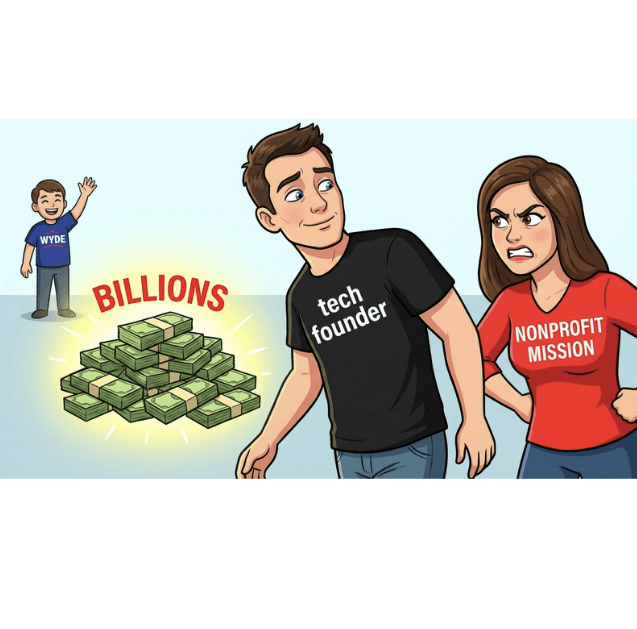
What if there was a way to scale a nonprofit without betraying it?
PUBLISHED: Fri, Jan 16, 2026, 11:59 PM UTC | UPDATED: Sat, Jan 17, 2026, 2:59 AM UTC

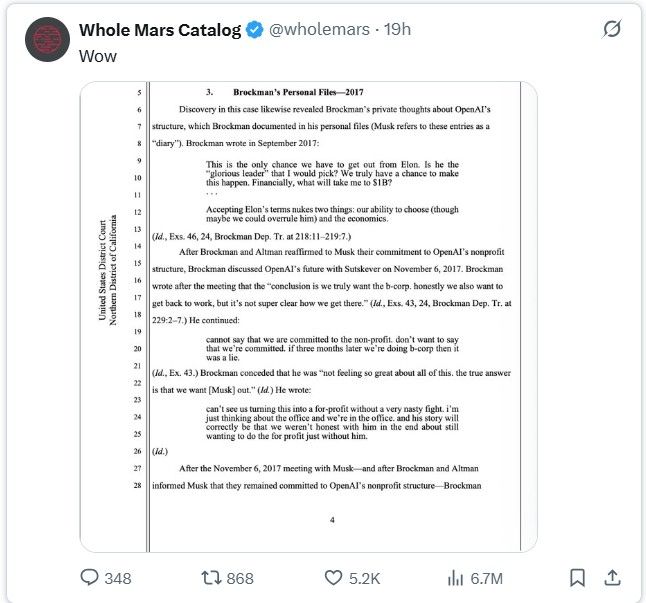
Greg Brockman wrote “it was a lie” in his private diary.
November 2017. He was talking about OpenAI’s nonprofit promise. The commitment that convinced Elon Musk to donate $38 million.
Yesterday, a federal judge ruled this fraud case is going to trial.
But here’s what nobody is asking: What if there was a way to scale a nonprofit without betraying it?
I’ve spent the last year building exactly that. And I’m watching the OpenAI disaster unfold while we quietly prove a different model works.
5,000+ meals funded. Zero donation campaigns. Just trading activity.
Let me show you what’s actually possible.
The $38 Million Betrayal
You’ve probably seen the headlines. Musk vs. Altman. Billions at stake. Trial set for April.
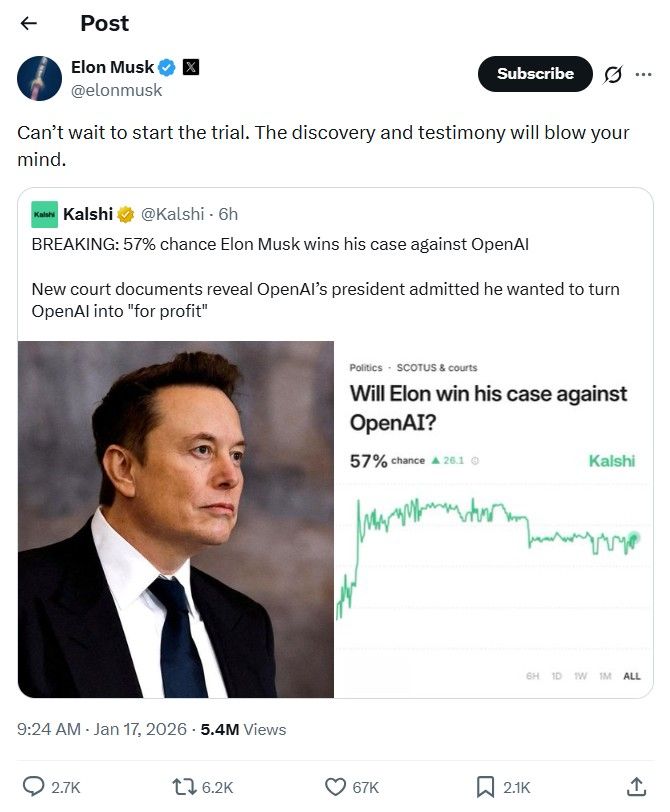
Here’s the short version:
-
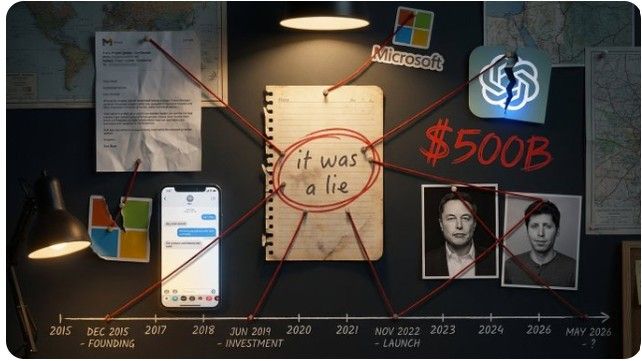
2015: Musk donates $38M to OpenAI, a nonprofit promising to develop AI for humanity’s benefit
-
2017: Brockman writes “it was a lie” in his diary about the nonprofit commitment
-
2019: OpenAI creates a for-profit subsidiary and takes $1B from Microsoft
-
2025: That subsidiary is now worth $500 billion
-
Today: The nonprofit Musk funded controls less than a third of the company
The mission didn’t evolve. It got abandoned.
The Tech Buzz covered the full detail here.
Ilya Sutskever, OpenAI’s former Chief Scientist, wrote to Sam Altman: “We don’t understand your cost function. Is AGI truly your primary motivation?”
When your own Chief Scientist questions whether you care about the mission, something is fundamentally broken.
Why This Keeps Happening
OpenAI isn’t unique. This pattern repeats everywhere.
Traditional nonprofits face an impossible choice:
-
Stay small and principled — limited impact, constant fundraising stress
-
Grow and drift — take corporate money, watch the mission fade
There’s no middle path. The structure forces the choice.
Nonprofits run on donations. Donations require fundraising. Fundraising takes time, energy, and creates dependency on big donors.
When those donors have expectations (like, say, remaining a nonprofit), leadership faces pressure. The bigger the ambition, the bigger the pressure.
Musk saw this coming. In January 2018, he emailed Altman warning that “OpenAI is on a path of certain failure relative to Google.”
His solution? Merge OpenAI into Tesla.
The board said no. Musk resigned.
His diagnosis was right. His prescription was wrong.
The problem wasn’t who controlled OpenAI. The problem was how nonprofits raise money.
What If Funding Was Automatic?
This is the question that launched WYDE.
What if market activity generated nonprofit funding without anyone “donating” in the traditional sense?
In 2024, Wyoming made this legally possible.
They created something called a DUNA: Decentralized Unincorporated Nonprofit Association.
Before this law, combining “nonprofit” and “token governance” was impossible. Nonprofits needed boards and centralized control. Blockchain projects offered decentralized ownership. You couldn’t mix them.
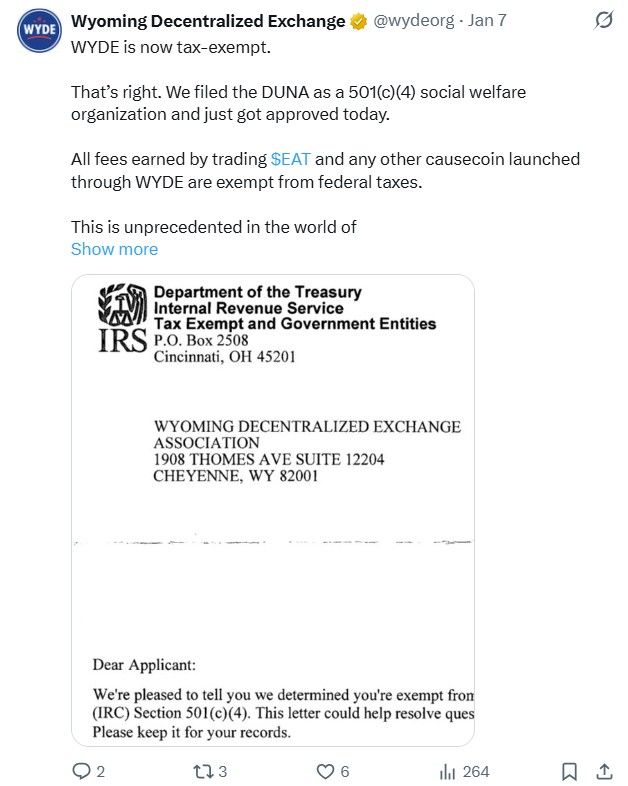
We built WYDE on this framework from day one. And we just achieved 501(c)(4) federal nonprofit status. The fFirst DUNA ever to achieve this milestone.
-
Trading fees flow directly to verified nonprofits
-
Token holders vote on which organizations get funding
-
Everything happens on-chain with full transparency
-
Revenue qualifies for tax-exempt treatment
Every dollar that used to disappear to taxes now goes to the cause.
5,000 Meals. Zero Donations.
Theory means nothing without results.
Our first token, $EAT, launched December 10, 2025.
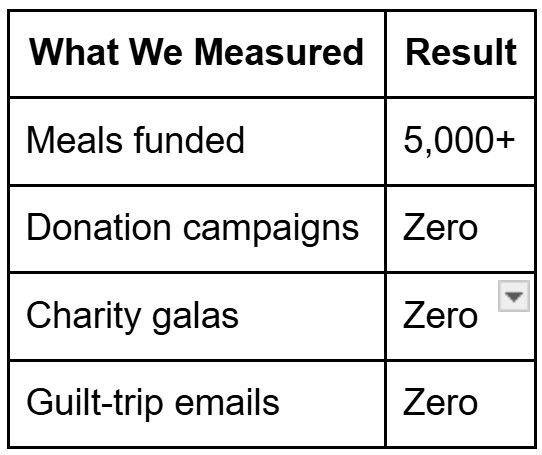
All from normal trading activity.
When you trade $EAT, a fee gets collected. That fee splits four ways:
-
25% to hunger relief partners (verified 501(c)(3) organizations)
-
25% to EAT DUNA (operations and ecosystem growth governed by token holders)
-
25% to WYDE operations (keeping the liquidity and fees growing)
-
25% to protocol costs (technical infrastructure)
The key insight: volatility doesn’t kill the impact.
Whether the market is up 50% or down 50%, the fee percentage stays the same. Trading volume often increases during volatile markets. The model has a natural hedge built in.
What OpenAI Could Have Done Differently
Imagine if this structure existed in 2019.
Instead of creating a for-profit subsidiary and taking $13 billion from Microsoft, OpenAI could have:
-
Launched a governance token — capital raised without selling equity
-
Let trading generate ongoing funding — sustainable without donation cycles
-
Given token holders voting rights — distributed governance, not board politics
-
Written the mission into the legal structure — not just marketing materials
Would they have competed with Google at the same scale? Who knows.
But nobody would be in an Oakland courtroom explaining why the co-founder called the nonprofit promise “a lie.”
The Three Groups This Model Aligns
Traditional nonprofit funding creates tension between donors, organizations, and beneficiaries.
The WYDE model aligns everyone:
You’re a donor? You become a governor. Your contribution gives you voting rights on how funds get deployed. No more wondering if your money actually helped.
You’re a builder (charity)? You get sustainable funding. The token launch creates stakeholders. Trading generates ongoing resources. The mission is built into the legal structure, not dependent on your ability to guilt people into giving.
You’re a trader? You create impact automatically. Buy, sell, hold, speculate. The impact happens in the background regardless of your strategy.
Everyone wins. Nobody has to write “it was a lie” in their diary.
The Counterargument (And Why It Misses the Point)
“But tokens are speculative! Prices swing wildly. You’re adding gambling to charity.”
Fair concern. Here’s why it’s incomplete:
Speculation happens regardless of whether you build infrastructure to channel it. People trade meme coins with zero utility all day long. Trillions of dollars flow through tokens that produce nothing.
The question is whether that trading activity produces anything useful.
With $EAT, it does. 25% of every trade goes to verified hunger relief organizations. That’s automatic, on-chain, and transparent.
The OpenAI case shows what happens when nonprofit missions collide with billion-dollar ambitions under traditional structures.
The mission loses. Every time.
We’re proving a different path exists.
What This Means For You
If you’re building something with a social mission:
You don’t have to choose between scale and integrity. Wyoming’s DUNA framework creates a real alternative. The legal infrastructure exists now.
If you’re a donor frustrated by traditional philanthropy:
Governance tokens give you actual power. Not a thank-you letter. Voting rights over how resources get deployed.
If you’re watching the OpenAI trial wondering if mission-driven tech is even possible:
It is. But it requires legal infrastructure that aligns incentives from day one. Not promises that get abandoned when the money gets big enough.
The Bottom Line
The OpenAI trial will drag on for months. Musk claims fraud. Altman claims business necessity. Microsoft’s lawyers will argue they were just investors.
Whatever the verdict, one thing is already clear:
The old model for scaling nonprofit missions doesn’t work. OpenAI proved that by abandoning theirs.
We’re proving something different.
5,000+ meals funded. First weeks of launch. No donations required.
The question now: How big can this get?
What’s your take? Could nonprofit tokenization solve the funding problem, or am I missing something? Drop your thoughts below.
I’m a co-founder of WYDE and hold $EAT tokens. This creates a conflict of interest. This is NOT financial advice. Token values fluctuate. Always do your own research.



Leave a Reply