

$70 BILLION GONE: Minnesota Lost $9 Billion. California Lost $70 Billion. Your Money Funded It All.
Billionaires Fleeing, Auditors Failing, Is Blockchain the Only Solution?
PUBLISHED: Sat, Jan 3, 2026, 9:25 PM UTC | UPDATED: Sat, Jan 3, 2026, 9:49 PM UTC

$70 BILLION GONE: Minnesota Lost $9 Billion. California Lost $70 Billion. Your Money Funded It All.
Why Billionaires Are Fleeing, Auditors Are Failing, and Blockchain Might Be the Only Solution

That post earned 80,000 likes and 740,000 views in 20 hours. It landed just days after his investigative video exposing Minneapolis daycare centers went viral on YouTube.
Sounds obvious, right? But 8k people shared it because they just watched his video showing empty Minneapolis daycare centers collecting millions to feed kids WHO DON’T EXIST.
That video got 2 million views. President Trump invited Shirley to the White House. The feds froze $185 million in payments.
Minnesota’s $9 billion scandal? That’s the SMALL one. California just got caught losing $70 BILLION.
California’s $70+ Billion Disaster
Minnesota’s $9 Billion Scam

Source: California State Auditor Report 2025-601 (Dec 11, 2025), U.S. Attorney Minnesota (Dec 18, 2025)
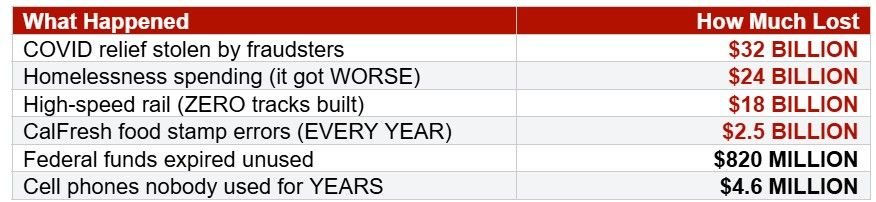
The COVID Money Heist: $32 Billion
The federal government gave California $285 billion for COVID relief. That’s more than Portugal’s entire economy.
What happened? Fraudsters took $32 billion. Just… took it. California’s EDD was so bad at checking claims that scammers filed unemployment using names of prisoners, dead people, and celebrities. Someone filed under Senator Dianne Feinstein’s name. IT WORKED.
Another $820 million? Literally expired before anyone spent it. An immunization grant ran out in June 2025. Nobody noticed.
The Homelessness Black Hole: $24 Billion
California spent $24 billion on homelessness (2019-2025). Result? Homelessness INCREASED.
Best part? They don’t know where the money went because they didn’t have a tracking system. A new law requires data collection. First report? Not due until February 2027.
They spent $24 BILLION (that’s $133,000 per homeless person per year) before building a system to track if it worked.
The Train to Nowhere: $18 Billion
California’s high-speed rail was supposed to connect LA to San Francisco by 2020. It’s 2026. They’ve spent $18 billion. Tracks connecting major cities? ZERO.
Congressman Kevin Kiley: “We are very close to Silicon Valley, and yet the government can’t figure out how to make basic technology perform.”
First Assistant U.S. Attorney Joe Thompson called it “fraud tourism.” Two guys from Philadelphia HEARD Minnesota’s programs were easy to scam. So they:
-
Flew to Minnesota
-
Set up fake companies
-
Flew back to Philadelphia
-
Submitted millions in fake claims FROM HOME
-
Collected $3.5 million
Thompson: Minnesota has become “a magnet for fraud” with a literal “fraud tourism industry.”
While California loses billions, the people who could pay for it are packing their bags.
-
December 31, 2025: Peter Thiel’s firm opened a Miami office. He’s lived there since 2020.
-
December 2025: Google co-founder Larry Page filed three new companies in Florida.
Why? California wants a 5% tax on billionaires. Their response: See ya.
Chamath Palihapitiya: “That one bill has changed California’s trajectory by $100-200 billion over the next 5-10 years.”
Palmer Luckey (Anduril): “This would force founders to sell huge chunks of companies to pay for fraud, waste and political favors.”
Bill Ackman: “California is on a path to self-destruction.”
They’re fleeing because they’ve watched billions in fraud and now the state wants more.
“Public blockchains are more transparent than any legacy financial system ever built.”
He emphasized that this transition could deliver
“significant benefits in both transparency and risk management.”
SEC Chair Paul Atkins, December 15, 2025
Every fraud happened because nobody could verify anything in real time. On blockchain: every transaction is permanent, public, and unchangeable. No human gatekeepers to bribe, pressure, or sue.
The technology exists to prevent these frauds before they scale to billions of dollars. We just haven’t used it for charitable funding. Until now.
Crypto exchanges processed $80 TRILLION in trading volume last year.
All U.S. charitable giving in 2024? $592.5 billion.
If 1% of crypto trading went to charity: $800 BILLION. More than all American charity. Combined.
On December 10, 2025, the first causecoin launched on Wyoming Decentralized Exchange (WYDE): $EAT, on Coinbase’s Base network. How it works:
-
You buy or sell $EAT
-
Every trade has a ~1% fee
-
25% goes AUTOMATICALLY to verified 501(c)(3) hunger charities
-
No donation button. No fundraiser. Just trading.
In three weeks: 3,500+ meals funded. Every transaction traceable on-chain.
GOVERNMENT: Pay taxes, money disappears, auditor says billions missing, nobody fired.
BLOCKCHAIN: Trade, smart contract sends to charity, every transaction visible, trace every penny.
Our aim with WYDE is three-fold:
-
Bring more funding to the nonprofit sector. Traditional charitable giving reached $592.5 billion in 2024, but most nonprofits spend 40% of their time fundraising. Causecoins generate funding automatically from trading activity that’s already happening.
-
Increase transparency in nonprofit funding. Every dollar spent on impact will be accounted for. You can look up every trade on a block explorer like Basescan. The funding flows are visible to anyone who wants to verify them.
-
Increase efficiency of impact outcomes. By operating on a public ledger, we introduce accountability where token holders own the impact outcomes and have a say in which organizations receive funding.
Critics raise legitimate concerns. Crypto markets are volatile. Token prices can crash, reducing the dollar value of charitable funding. Bad actors could create fake “cause” tokens that claim charitable purposes but divert funds. And blockchain transparency cuts both ways: if government regulators treat every wallet as a surveillance target, the technology could become what Atkins called “the most powerful financial surveillance architecture ever invented.”
These concerns are real. They’re also addressable.
On volatility: Causecoins don’t depend on token price appreciation. They generate funding from trading fees regardless of whether the token goes up or down. A $100 trade at $0.001 per token generates the same fees as a $100 trade at $1.00 per token.
On scams: The DUNA framework provides legal legitimacy that fly-by-night projects can’t match. Real legal entity. Real tax compliance. Real accountability.
On surveillance: The goal is transparency for charitable flows, not surveillance of individual users. You should be able to verify that money reached Feeding America without necessarily knowing which specific trader generated each fee.
The Minnesota scandal shows what happens without transparency. The risk of too much transparency seems manageable by comparison.
Causecoins and impact markets have the potential to eliminate the fraud and corruption we see in our current systems. DOGE is highlighting the problem with NGOs. Nick Shirley exposed daycare fraud in Minnesota. California is next on the chopping block. The solutions are being built right now.
The question isn’t whether technology can prevent fraud. We know it can. The question is whether we’ll use it.
Disclosure
This is my opinion based on analysis of current events and industry developments. This is NOT financial advice. I am a co-founder of WYDE and hold $EAT tokens, which creates a potential conflict of interest. Token values fluctuate based on market conditions. Charitable impact depends on trading volume, nonprofit execution, and governance decisions. Past performance does not guarantee future results. Always conduct your own research (DYOR) and consult a qualified financial advisor before making investment decisions. Never invest more than you can afford to lose.
NOT FINANCIAL ADVICE. Opinion based on public audits. Crypto is risky. Author holds $EAT. DYOR. Don’t invest money you can’t lose.
Related Resources
About the Author
Aaron Rafferty is a behavioral scientist and founding member of WYDE the world’s first Impact Exchange. He bought $EAT in the public fair launch like everyone else. His research background includes NIH-funded work on human health outcomes, digital therapeutics, health access, decision-making and human behavior. He now applies that expertise to building technology backed businesses and market infrastructure that channels trading activity into verified charitable impact. Aaron is based in Irvine, California.
Connect: X: @aaronjrafferty | WYDE: @wydeorg | Website: wyde.org | Farcaster: @ajr










Leave a Reply