
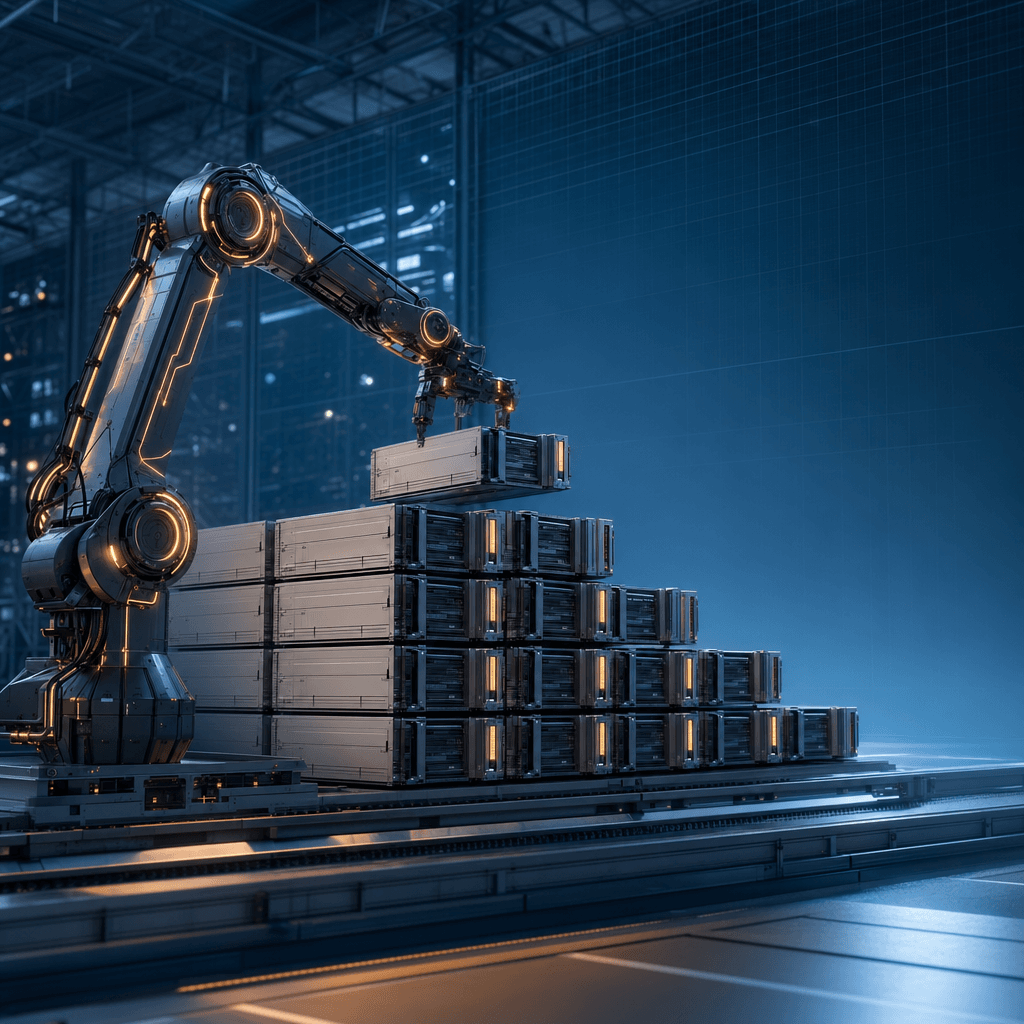
SoftBank is launching a robotics company designed to automate data center construction, and it’s already eyeing a staggering $100 billion IPO valuation. The move represents a bold bet that the AI infrastructure boom requires not just more facilities, but an entirely new approach to building them. In a market where data center demand is outpacing construction capacity, SoftBank sees automation as the solution to what could become AI’s biggest bottleneck.
SoftBank just made its most ambitious infrastructure play yet. The Japanese conglomerate is spinning up a robotics company dedicated to building data centers with autonomous systems, and it’s already planning an eye-watering $100 billion initial public offering.
The announcement comes as the AI industry faces a looming infrastructure crisis. Hyperscalers like Microsoft, Google, and Amazon are spending record sums on data center capacity, but traditional construction methods can’t keep pace with demand. Building a major data center currently takes 18-24 months using conventional approaches, creating a structural bottleneck that threatens to slow AI development.
SoftBank’s solution leverages robotics and automation to compress timelines and reduce costs. While specific technical details remain under wraps, the company is betting that autonomous construction systems can fundamentally transform how these critical facilities get built. The approach mirrors what’s happening in manufacturing, where robots have already revolutionized production speed and precision.
The $100 billion IPO target is particularly striking. That valuation would place the venture among the most valuable infrastructure companies globally before it’s constructed a single facility. It reflects both the scale of the data center opportunity and SoftBank CEO Masayoshi Son’s characteristically bold vision. Son has been increasingly vocal about AI infrastructure as the next major investment wave, following his firm’s earlier bets on companies like Nvidia and Arm.
Timing matters here. Data center construction costs have been climbing as demand surges. Amazon Web Services alone is projected to spend over $100 billion on infrastructure in 2026, while Meta and Google have announced similarly massive capital expenditure programs. The bottleneck isn’t capital – it’s the physical ability to build fast enough.
SoftBank’s robotics venture enters a market where automation in construction has lagged far behind other industries. While factories use robots extensively, job sites remain heavily reliant on human labor and traditional methods. Data centers, with their repetitive modular designs and standardized components, present an ideal testbed for construction automation.
The company faces significant challenges, though. Construction robotics startups have struggled to scale in the past, hampered by the complexity of real-world building environments and regulatory hurdles. Data centers also require extreme precision – any errors in cooling systems, power distribution, or server rack installation can prove catastrophically expensive.
But SoftBank brings unique advantages. The company’s existing investments span robotics, AI, and cloud infrastructure, creating potential synergies. Its Vision Fund has backed construction tech startups and autonomous systems companies, giving it access to technology and talent. And SoftBank’s relationships with major tech companies could provide early customers for the new venture.
The $100 billion valuation target suggests SoftBank expects this company to capture significant market share quickly. Global data center construction spending is projected to exceed $300 billion annually by 2028, driven by AI workload growth. If the robotics venture can demonstrate faster, cheaper builds, it could command premium valuations from an industry desperate for capacity.
Investors will be watching several key metrics as this develops. Construction speed improvements over traditional methods will be critical – a 30-50% timeline reduction could justify aggressive valuations. Cost savings matter too, particularly if automation can reduce the $10-15 million per megawatt price tag for hyperscale facilities. And the company will need to show it can scale beyond initial pilot projects.
The announcement also reflects broader trends in AI infrastructure. As computing demands grow exponentially, every part of the supply chain is getting rethought. Nvidia’s chip dominance, new cooling technologies, and now construction automation all represent efforts to remove bottlenecks that could constrain AI progress.
For SoftBank, this venture fits a pattern of moonshot bets on transformative technologies. The company’s track record is mixed – massive wins with Alibaba and early AI investments, but also high-profile failures like WeWork. A $100 billion robotics IPO would vindicate Son’s vision that AI infrastructure represents a multi-trillion dollar opportunity.
SoftBank’s robotics gambit represents more than just another construction tech play. It’s a bet that the AI revolution will be constrained not by algorithms or capital, but by our ability to build the physical infrastructure fast enough. A $100 billion valuation before breaking ground suggests the market agrees the prize is enormous. Whether SoftBank can execute on this vision will help determine if AI development hits a brick wall or continues its exponential trajectory. For an industry pouring hundreds of billions into compute capacity, the stakes couldn’t be higher.







Leave a Reply