
- ■
- ■
Previously called “vibe working,” Agent Mode directly manipulates Office canvases rather than just answering questions
- ■
The launch intensifies competition with Google’s Workspace Intelligence as tech giants race to dominate enterprise productivity AI
- ■
Early foundation models weren’t powerful enough for this – Microsoft admits Copilot “missed the mark” on direct action until now
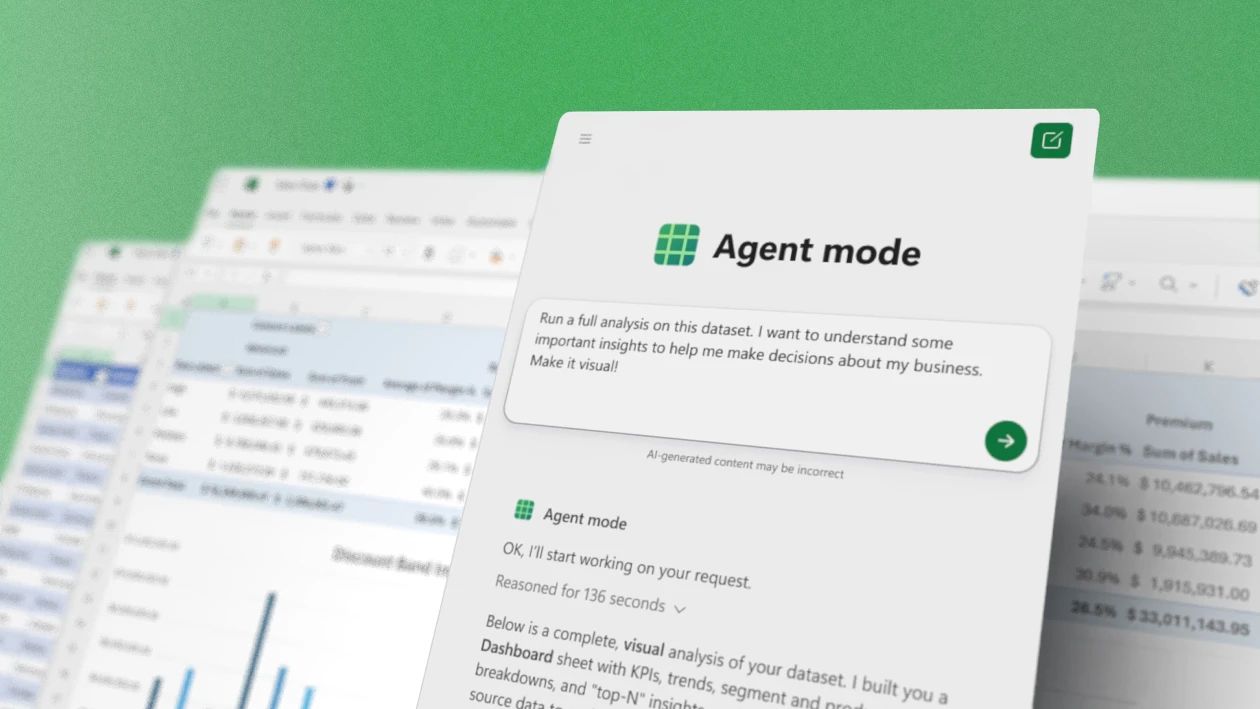
Microsoft just turned Office into an AI playground. The company’s launching Agent Mode across Word, Excel, and PowerPoint this week, marking a major shift from passive AI assistance to autonomous productivity tools. Dubbed “vibe working” internally, the feature transforms Copilot from a chatbot into an AI that can actually edit documents, manipulate spreadsheets, and build presentations on command – putting Microsoft head-to-head with Google’s Workspace Intelligence in the battle for enterprise AI dominance.
Microsoft is rolling out what could be its biggest Office upgrade in years. Agent Mode, the company’s answer to autonomous AI assistants, hits Word, Excel, and PowerPoint this week after months of testing. It’s a frank admission that the first wave of Copilot wasn’t quite ready for prime time.
“When we first shipped Copilot, foundation models were not powerful enough to use Copilot to command the applications,” Sumit Chauhan, corporate vice president of Microsoft’s Office Product Group, told Microsoft’s blog. “This meant Copilot was a passive partner in documents: it could answer questions but missed the mark when it was asked to take action on the canvas directly.”
That changes now. Agent Mode represents a fundamental shift in how AI interacts with productivity software. Instead of generating text in a sidebar that users copy-paste, the new system directly edits documents, reformats spreadsheets, and redesigns presentations. Microsoft’s been calling it “vibe working” internally – a term that captures the hands-off approach to document creation the company’s betting on.
The timing isn’t coincidental. Google recently launched Workspace Intelligence with similar autonomous capabilities across Docs, Sheets, and Slides. The enterprise productivity market, worth billions in annual subscriptions, is rapidly becoming an AI arms race. Both companies are pushing the same pitch: let AI handle the grunt work while employees focus on strategy and creativity.
But there’s a crucial difference in approach. Microsoft’s leveraging its partnership with Anthropic, integrating Claude models alongside its own AI infrastructure. Previous reports from The Verge indicated Microsoft was testing Anthropic’s models specifically for Office Agent Mode, suggesting the company’s hedging its bets on foundation model providers.
The technical leap required for Agent Mode reveals how far AI’s come in just two years. Early large language models could generate convincing text but struggled with the structured, multi-step reasoning needed to edit complex documents. They’d hallucinate formatting, break formulas in Excel, or create presentation layouts that made no visual sense. Getting AI to understand the canvas as a manipulable workspace, not just a text generation target, required fundamental advances in model architecture and training.
For Microsoft’s enterprise customers – the ones paying $30 per user monthly for Copilot – Agent Mode might finally justify the investment. Early Copilot adoption was slower than Microsoft hoped, with companies questioning whether chatbot-style assistance warranted the premium. Autonomous editing capabilities could change that calculus, especially if Agent Mode delivers on promises to draft reports, analyze datasets, and create presentations with minimal human intervention.
The competitive pressure’s intense. Google is aggressively pricing Workspace Intelligence to steal enterprise accounts, while startups like Notion and Coda are building AI-native productivity tools from scratch. Microsoft’s betting its massive Office installed base gives it an edge – if it can prove the AI actually works at scale.
There are obvious risks. Autonomous AI editing raises questions about version control, audit trails, and who’s responsible when Agent Mode makes mistakes. Microsoft hasn’t detailed how Agent Mode handles errors or whether there are guardrails preventing AI from making catastrophic edits to critical business documents. Enterprise IT departments will want answers before blessing widespread rollout.
The launch also signals Microsoft’s confidence in current foundation models. By admitting earlier versions “missed the mark,” Chauhan’s essentially saying the company held back features until the technology caught up to the vision. That’s a different strategy than competitors who shipped AI features early and iterated publicly.
What’s clear is that passive AI assistance is already obsolete in Microsoft’s view. The company’s pushing toward a future where users describe what they want and AI handles execution. “Vibe working” might sound like corporate buzzword bingo, but it captures a genuine shift – from AI as tool to AI as colleague that directly manipulates your workspace.
Microsoft’s Agent Mode launch marks the moment AI productivity tools graduate from assistants to autonomous agents. The company’s candid admission that earlier Copilot versions weren’t technically capable of direct manipulation shows how rapidly foundation models have evolved. As Microsoft and Google battle for enterprise dominance, the real test won’t be whose AI generates better text – it’ll be whose AI employees actually trust to edit their documents unsupervised. Agent Mode’s success depends on whether “vibe working” translates to actual productivity gains or just becomes another expensive enterprise AI experiment that over-promised and under-delivered.








Leave a Reply