
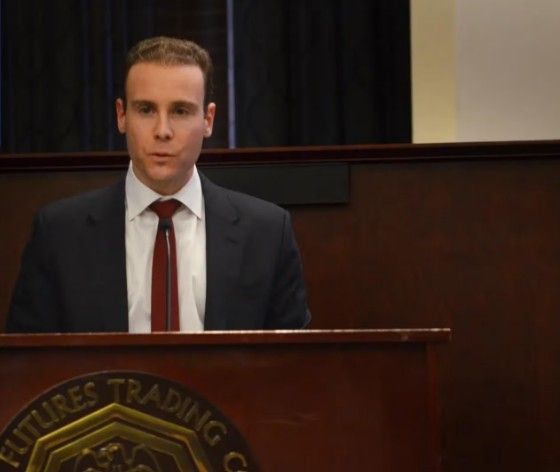
CFTC adds a who’s-who of the companies the agency is about to oversee
PUBLISHED: Fri, Feb 13, 2026, 2:02 AM UTC | UPDATED: Fri, Feb 13, 2026, 4:54 AM UTC

Chairman Selig’s new Innovation Advisory Committee reads like a who’s-who of the companies the agency is about to oversee — and he’s the only commissioner in the building.
The people most likely to be regulated by the CFTC’s expanding crypto authority are now formally advising the agency on how that regulation should work. Today, Chairman Michael Selig announced the 35-member Innovation Advisory Committee, and the roster tells you everything you need to know about where American derivatives regulation is headed: Coinbase CEO Brian Armstrong, Ripple CEO Brad Garlinghouse, Robinhood CEO Vlad Tenev, Uniswap Labs CEO Hayden Adams, and Polymarket CEO Shayne Coplan all have seats at the table. So do the CEOs of Kalshi, Kraken, Gemini, Crypto.com, Solana Labs, Chainlink Labs, Grayscale, and Blockchain.com.
This isn’t a listening tour. It’s a policy architecture session — and the architects are the same firms that stand to gain the most from the rules it produces.
What the CFTC Actually Announced
The IAC replaces the old Technology Advisory Committee and absorbs many of the charter members from former Acting Chair Caroline Pham’s CEO Innovation Council, which she stood up in late 2025 before Selig took the chair on December 22. The committee’s mandate, per the CFTC’s release, is to advise on “how breakthrough innovations, such as artificial intelligence and blockchain technologies, are transforming markets.” Selig framed it as essential to building “clear rules of the road for the Golden Age of American Financial Markets.”
The 35 members break into three rough camps. Traditional exchange and clearing executives — Terry Duffy at CME Group, Adena Friedman at Nasdaq, Jeff Sprecher at Intercontinental Exchange, Craig Donohue at Cboe Global Markets, Frank LaSalla at DTCC — represent the incumbents. Crypto-native firms — Armstrong, Garlinghouse, Tenev, Adams, Tyler Winklevoss at Gemini, Arjun Sethi at Kraken, Kris Marszalek at Crypto.com, Peter Smith at Blockchain.com, Nathan McCauley at Anchorage Digital, Peter Mintzberg at Grayscale — represent the industry that’s about to fall squarely under the CFTC’s jurisdiction once market structure legislation passes. And prediction market operators — Coplan at Polymarket, Tarek Mansour at Kalshi, Christian Genetski at FanDuel, Jason Robins at DraftKings — represent the sector where the CFTC is actively deciding what counts as a regulated derivative and what counts as a sports bet.
Two academics round out the list: Professor Harry Crane and Professor Carla Reyes. Two out of 35. The committee also includes a16z Crypto’s Chris Dixon, Framework Ventures’ Vance Spencer, and Paradigm’s Alana Palmedo from the investment side, plus industry group heads Walt Lukken at FIA and Scott O’Malia at ISDA.
Why the Composition Matters More Than the Committee
Advisory committees at federal agencies are common. The CFTC has had a Technology Advisory Committee for years. But three things make this one different.
First, Selig is operating alone. All four other CFTC commissioner seats are vacant. Per Bloomberg Law’s reporting, that means these advisers have a direct line to the sole decision-maker at an agency that’s about to absorb major new regulatory authority over digital assets. There’s no Democratic commissioner to push for consumer protection voices. There’s no second Republican to offer a competing industry vision. Selig is the CFTC, and this committee is his chosen sounding board.
Second, the companies on this list have active business before the agency. Polymarket received CFTC approval to operate in the U.S. Kalshi is currently fighting a state-level injunction in Massachusetts over whether its sports prediction market constitutes illegal gambling — a fight that hinges on whether the CFTC’s exclusive jurisdiction over event contracts preempts state gaming law. Coinbase, Kraken, and Robinhood are all positioning for the digital asset market structure legislation moving through Congress, which would place crypto spot markets under CFTC oversight. These aren’t disinterested experts. They’re regulated entities and applicants.
Third, the timing aligns with a regulatory agenda that’s already tilting toward industry. On January 29, Selig directed CFTC staff to withdraw the Biden-era proposed rule that would have prohibited political and sports-related event contracts. He also pulled a 2025 staff advisory that had cautioned exchanges about offering sports-related contracts. And he ordered staff to begin drafting a new event contracts rule — one that will establish “clear, workable standards” for prediction markets, per his remarks at the joint SEC-CFTC “Project Crypto” summit with SEC Chair Paul Atkins. The people who will profit most from permissive event contract rules — Coplan, Mansour, Genetski, Robins — are now advising on what those rules should look like.
The Regulatory Context Is Moving Fast
The IAC announcement doesn’t exist in a vacuum. Congress is advancing bipartisan digital asset market structure legislation on two tracks. The House passed the CLARITY Act last summer. The Senate Agriculture Committee — which oversees the CFTC — voted along party lines on January 29 to advance its own version, the Digital Commodity Intermediaries Act. Both bills would formally grant the CFTC authority over digital commodity markets, per the Morrison Foerster analysis of the Project Crypto summit. Senate Agriculture Committee Chairman John Boozman told CNBC he’s working toward a deal this year.
If that legislation passes, the CFTC goes from a relatively small agency overseeing futures and swaps to the primary federal regulator for a large chunk of the crypto market. The companies whose CEOs now sit on the IAC — Coinbase, Kraken, Gemini, Robinhood — would register with the CFTC as digital commodity intermediaries. They would operate under rules the CFTC writes. And they’re now helping the agency think about what those rules should be.
Selig has also launched Project Crypto as a joint SEC-CFTC initiative, aimed at harmonizing oversight so that crypto firms don’t face duplicative registration requirements across both agencies. The initiative’s stated goal — per the joint op-ed Selig and Atkins published — is to ensure that “market participants should not be saddled with duplicative agency registrations and sets of regulations in order to offer economically similar products.” That’s a position the crypto industry has pushed for years. Having industry CEOs advise on how to implement it is, at minimum, efficient. Whether it’s appropriate depends on how much weight you give to the Federal Advisory Committee Act’s requirement for balanced membership.
The Counterargument and Its Limits
Defenders of the committee’s composition — including former CFTC Chairman J. Christopher Giancarlo, per Bloomberg Law — argue that drawing on CEO expertise is standard practice and helps the agency make informed decisions. “He’s taking some of the leading CEOs of companies registered with the CFTC, and he’s able to now draw upon their expertise,” Giancarlo said. The CFTC has historically relied on market participants for technical input on complex products, and the agency’s small size (relative to the SEC) makes outside expertise genuinely useful.
That argument has merit. Derivatives regulation is technically dense. Understanding how perpetual futures settle on-chain, or how a prediction market’s order book functions, requires domain knowledge that career regulators may not have. The traditional exchange executives on the list — Duffy, Friedman, Sprecher — bring decades of experience running regulated markets.
But the balance question is real. Two academics out of 35 members is thin representation for consumer protection, market integrity, or public interest perspectives. Former CFTC Chairman Timothy Massad, who led the agency under Obama, told Bloomberg Law that the committee’s value “really depends on what the chairman wants out of it. It can simply be a way to engage with market participants, give the appearance you’re engaging with market participants, or it could be a vehicle to actually get ideas.” Better Markets, the consumer advocacy group, has already criticized Selig as the “wrong choice” to lead the CFTC, citing his prior work as a crypto industry attorney at Willkie Farr & Gallagher and what they characterized as an anti-enforcement posture during his confirmation hearing.
Selig’s own background adds context. Before joining the SEC and then being nominated to the CFTC, he represented crypto clients at Willkie — a client list that included exchanges, blockchain startups, and crypto investors, per his Office of Government Ethics filings. His one-year recusal period from matters involving former clients has largely expired, given that he’s been in government service for most of 2025. The Intercept reported that the breadth of his prior client relationships presents potential conflict questions, though a White House spokesperson told reporters there are “no conflicts of interest.”
Who Wins and Who Should Be Watching
If you’re building or investing in crypto infrastructure, prediction markets, or DeFi protocols, this committee is a strong signal that the CFTC under Selig will write rules with your input and likely your preferences in mind. The presence of DeFi-native executives like Adams (Uniswap), Nazarov (Chainlink), and Yakovenko (Solana) alongside traditional exchange heads suggests the agency is serious about creating frameworks that accommodate both on-chain and traditional market structures.
If you’re running a prediction market platform, the inclusion of Coplan, Mansour, Genetski, and Robins — four CEOs whose businesses depend directly on how the CFTC defines and regulates event contracts — signals that Selig views these products as legitimate financial instruments, not regulatory gray areas. That’s consistent with his January 29 directive to draft new event contract rules and his withdrawal of the Biden-era prohibition proposal.
If you’re in compliance or legal at a crypto firm, the IAC’s formation — combined with Project Crypto and the advancing congressional legislation — points to a compressed timeline for new registration frameworks, reporting requirements, and market conduct rules. The CFTC is actively building the institutional capacity and industry relationships to regulate digital assets at scale. Firms that engage early with this process will shape the rules. Firms that wait will inherit them.
If you’re a consumer advocate or someone who watched the FTX and Celsius collapses unfold, the composition of this committee should prompt hard questions. The CFTC brought enforcement actions against both firms. The agency’s own former enforcement director, Ian McGinley, emphasized that “for the regulatory system to function, there must be a level playing field.” A 35-member advisory committee dominated by the CEOs of regulated entities — with two academics as the counterweight — is not a level playing field for input. It’s a room full of people with aligned incentives.
The Bottom Line
The CFTC’s Innovation Advisory Committee is the clearest indicator yet of how crypto and prediction market regulation will be built in the U.S. — by the industry, for the industry, with the industry sitting in the room. Selig isn’t hiding this. He’s framing it as a feature, not a bug: the agency needs technical expertise, and who better to provide it than the people building the products?
That logic holds up right until you remember that the people building the products are also the people whose revenue depends on the regulatory o











Leave a Reply