
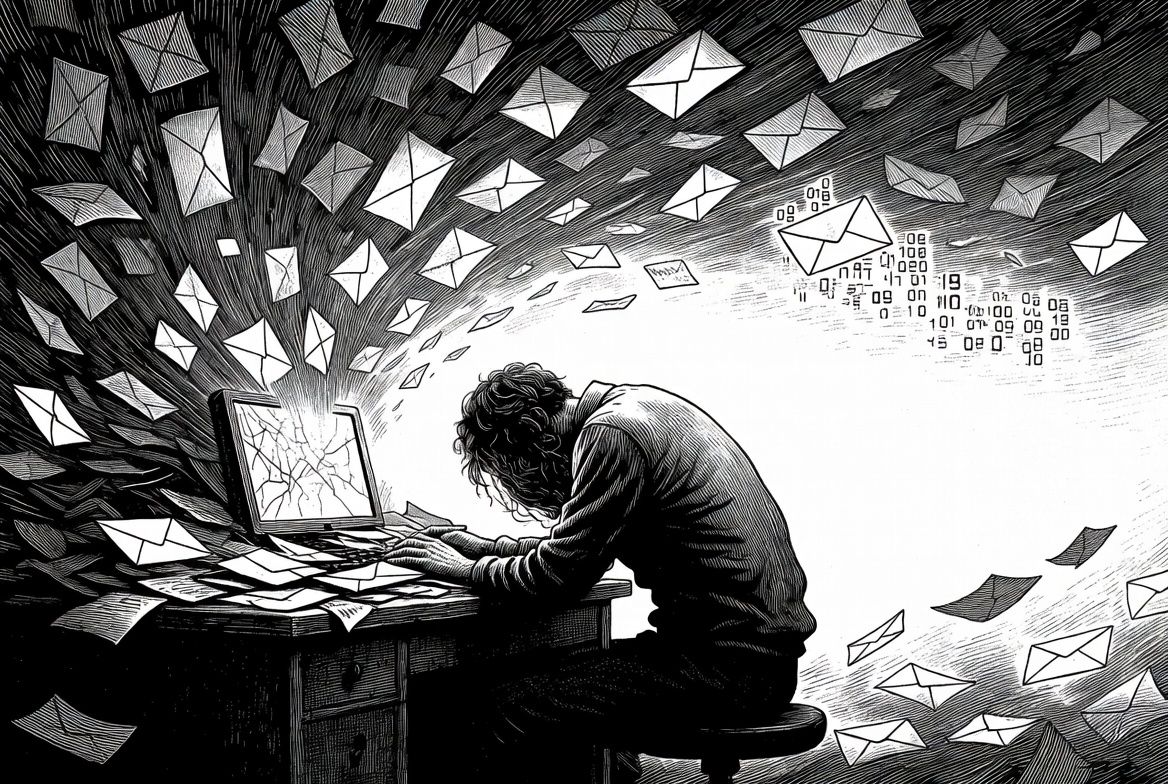
Email didn’t collapse in a single moment. It slowly crossed the line of no return.
For a long time, more email looked like progress. More messages meant more reach, more access, more chances to be seen. But volume has a ceiling where it stops behaving like growth and starts behaving like dilution. Once that point is crossed, each additional message doesn’t add value. It erodes it.
That point is long gone.
The volume problem that became a meaning problem
Hundreds of billions of emails now move through the system every day. Most of them are never meant for a human mind. Filters intercept a huge portion before it even arrives, yet what survives still feels overwhelming. The inbox is dense, crowded, restless. You don’t enter it with curiosity anymore. You manage it.
That shift in behavior came before anything else. People didn’t wake up one day and decide email was broken. They adapted to pressure. When you’re exposed to a constant stream of messages, careful reading becomes impractical. So you reduce the effort. You scan. You skim. Eventually, you stop engaging unless something proves its relevance instantly.
Attention tightens like that under load. And once it tightens, everything upstream has to fight harder just to be noticed.
Earlier versions of spam never really stood a chance in that environment. They were too obvious. Bad grammar, strange offers, exaggerated urgency. They were easy to filter out both technically and mentally. You could glance at them and move on without thinking.
What replaced them doesn’t announce itself.
From spam to simulation
Machine-generated emails now arrive with the texture of something written by a person who took a moment to think. The tone is smoother. The structure makes sense. The intent feels plausible. They don’t need to be perfect. They only need to pass your first filter, which is no longer “is this good?” but “is this worth a second of my attention?”
That’s a much lower bar, and a much more dangerous one.
Because once messages start clearing that first hurdle, the burden shifts to the reader. You are no longer deciding what’s useful. You are quietly trying to decide what’s real. Each email carries a small uncertainty. On its own, that uncertainty is manageable. Multiplied across dozens of messages, it becomes exhausting.
Most people resolve that exhaustion the same way. They disengage.
That disengagement doesn’t look dramatic. The inbox still gets opened. Messages still get delivered. But the quality of attention drops. Trust becomes selective. A handful of known senders retain it. Everything else exists in a grey zone where it might be legitimate, but not legitimate enough to earn time.
That environment breaks more than communication. It breaks measurement.
The collapse of measurement
For years, email operated on a feedback loop that felt reliable. You send something out, people open it, you track that behavior, and you adjust. The system gave you signals, and those signals guided decisions.
Then the signals started drifting.
When privacy protections changed how emails were loaded and tracked, “open” stopped meaning what it used to mean. Messages began registering activity without any human involvement. The numbers still moved, but they no longer mapped cleanly to reality. A campaign could appear successful without actually reaching anyone in a meaningful way.
Once that connection weakens, optimization becomes guesswork dressed as precision. You keep iterating, but you’re no longer sure what you’re iterating toward. The system keeps producing data. The data slowly loses its grounding.
Meanwhile, the underlying conditions continue to deteriorate. More automation. More generated content. More messages competing for a narrower slice of attention.
At that point, the problem isn’t just volume or quality. It’s the quiet erosion of a basic assumption.
The user adapts
Every communication channel relies on an implicit agreement. When you receive a message, you assume it came from a thinking source and carries some degree of intent. That assumption used to hold for email. It doesn’t hold consistently anymore.
Now the default posture is different. Messages are treated as noise unless they quickly prove otherwise. The burden of proof has shifted entirely onto the sender, and most messages fail before they even get evaluated.
That doesn’t mean email has disappeared. It still works, but in a more constrained way.
If you’re resetting a password, confirming a purchase, or exchanging messages with someone you already know or a brand you trust, email performs exactly as expected. The context does most of the work. Trust is already established, so the message doesn’t have to earn it from scratch.
Outside those contexts, the dynamics change. Sending a message to a broad, unknown audience requires you to cross a gap that didn’t used to be there. You’re not just competing for attention. You’re competing against doubt, fatigue, and a long history of irrelevant noise.
Other channels have absorbed some of that pressure. Messaging apps, social platforms, smaller communities. They operate with different expectations around identity and immediacy. They haven’t escaped the same forces entirely, but they distribute them differently.
What remains?
Email remains where it is, still running, still essential in specific roles, but no longer central to how attention flows.
It didn’t fail because people stopped needing communication. The need is constant. What changed is the environment around the channel. When producing a message becomes effortless, receiving one becomes costly. Not in money, but in attention, in trust, in the small decisions required to engage or ignore.
Over time, people adjust to that cost. They lower their willingness to pay it.
The system doesn’t shut down when that happens. It keeps operating. Messages continue to arrive. The infrastructure remains intact.
What fades is the expectation that any given message matters.








Leave a Reply