
Stripe veteran Lachy Groom bets on general AI for robots over commercialization
PUBLISHED: Sat, Jan 31, 2026, 1:08 AM UTC | UPDATED: Sat, Jan 31, 2026, 1:54 AM UTC

- ■
Physical Intelligence has raised over $1 billion at a $5.6 billion valuation, with Sequoia, Khosla, and Thrive Capital backing the company
- ■
Co-founder Lachy Groom refuses to give investors a commercialization timeline, focusing purely on building general-purpose robotic intelligence
- ■
Skild AI raised $1.4 billion at $14 billion valuation this month, taking the opposite approach with $30 million in early revenue from commercial deployments
- ■
The philosophical divide mirrors early AI development: revenue-first deployment versus research-driven foundation models
Physical Intelligence just crossed $1 billion in funding with a $5.6 billion valuation, and co-founder Lachy Groom still won’t tell his backers when they’ll see a return. The two-year-old startup, backed by Khosla Ventures, Sequoia Capital, and Thrive Capital, is building foundation models for robots – think ChatGPT but for mechanical arms learning to fold laundry and peel vegetables. While competitor Skild AI just hit a $14 billion valuation by focusing on commercial deployment and revenue, Groom is betting that pure research wins long-term.
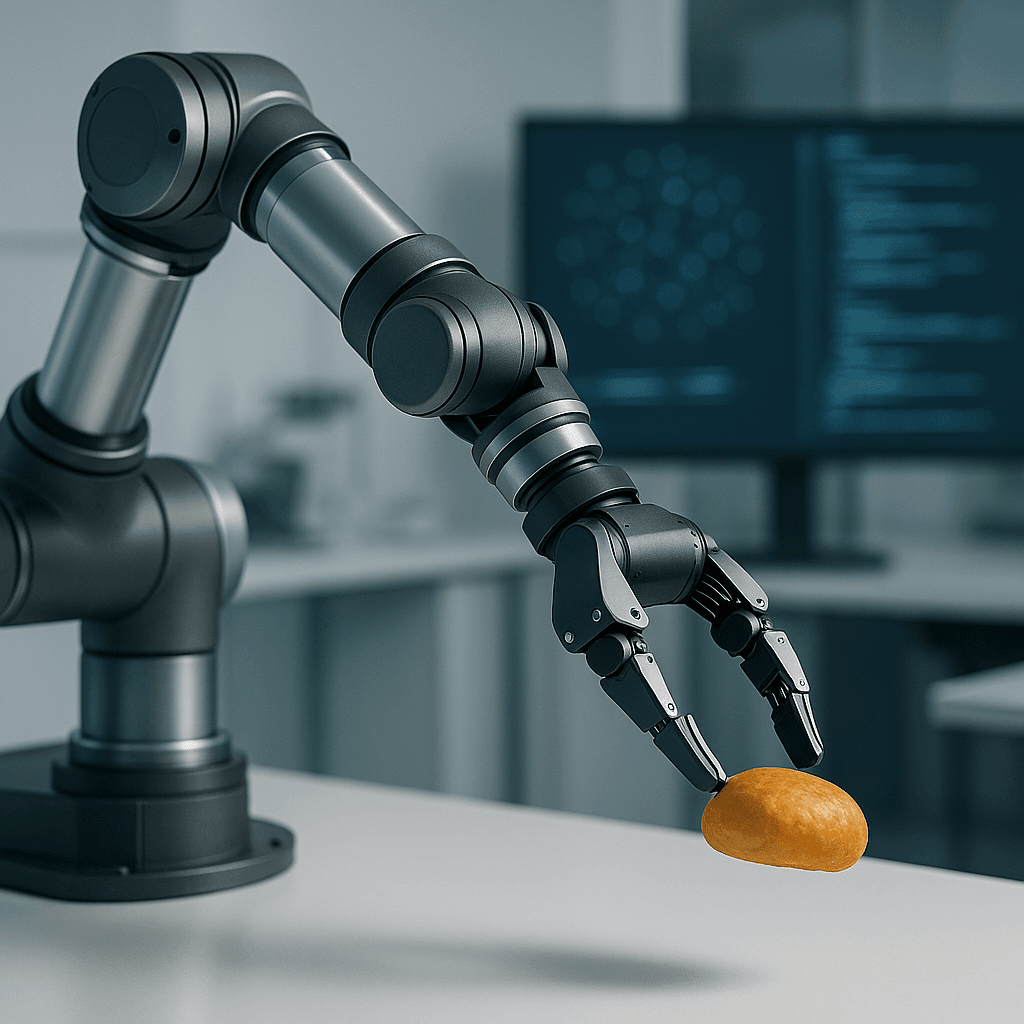
Inside a nondescript San Francisco building marked only by a pi symbol, robotic arms are fumbling through the mundane. One struggles to fold black pants. Another tries turning a shirt inside out with mechanical determination. A third peels a zucchini with surprising competence, depositing shavings into a container. This is where Physical Intelligence is building what it hopes becomes the brain behind every robot.
“Think of it like ChatGPT, but for robots,” Sergey Levine, UC Berkeley associate professor and co-founder, explains while gesturing toward the mechanical ballet. The setup looks deliberately unglamorous – these robotic arms cost about $3,500 each, with material costs under $1,000 if manufactured in-house. A few years ago, roboticists would’ve laughed at the idea these cheap arms could do anything useful. But that’s precisely the point, according to TechCrunch’s exclusive look inside the startup.
Data collected from robot stations here and in warehouses, homes, and test kitchens trains general-purpose foundation models. When researchers build a new model, it returns to these stations for evaluation. The sophistication lies not in the hardware but in the intelligence compensating for it. Even the espresso machine nearby isn’t a staff perk – it’s there for robots to learn from.
Lachy Groom, the 31-year-old co-founder who sold his first company at 13 and became an early Stripe employee before angel investing in Figma, Notion, and Ramp, found his next act in Physical Intelligence. “I was looking for five years for the company to go start post-Stripe,” Groom told TechCrunch during a brief window between meetings. “Good ideas at a good time with a good team – that’s extremely rare.”
The two-year-old company has now raised over $1 billion according to Bloomberg, with most spending going toward compute rather than traditional burn. When asked about runway, Groom clarified the company doesn’t burn much. Then he added something unusual: under the right terms, he’d raise more. “There’s no limit to how much money we can really put to work. There’s always more compute you can throw at the problem.”
What makes this arrangement particularly weird is what Groom doesn’t give his backers – including Khosla Ventures, Sequoia Capital, and Thrive Capital, who’ve valued the company at $5.6 billion. “I don’t give investors answers on commercialization,” he says. “That’s sort of a weird thing, that people tolerate that.”
The strategy, according to co-founder Quan Vuong who came from Google DeepMind, revolves around cross-embodiment learning. If someone builds a new hardware platform tomorrow, they won’t need to start data collection from scratch – they can transfer everything the model already knows. “The marginal cost of onboarding autonomy to a new robot platform, whatever that platform might be, it’s just a lot lower,” Vuong explains.
Physical Intelligence is already working with companies across logistics, grocery, and even a chocolate maker to test real-world automation. But there’s no revenue model yet, no customer announcements, no commercialization timeline.
That puts them in direct philosophical opposition to Pittsburgh-based Skild AI, which just this month raised $1.4 billion at a $14 billion valuation. While Physical Intelligence remains focused on pure research, Skild has already deployed its “omni-bodied” Skild Brain commercially, generating $30 million in revenue across security, warehouses, and manufacturing in just a few months last year.
Skild has even taken shots at competitors, arguing on its blog that most “robotics foundation models” are just vision-language models “in disguise” that lack “true physical common sense” because they rely too heavily on internet-scale pretraining rather than physics-based simulation and real robotics data.
It’s a sharp divide that mirrors debates from the early days of large language models. Skild is betting that commercial deployment creates a data flywheel that improves the model with each real-world use case. Physical Intelligence is betting that resisting near-term commercialization enables superior general intelligence. The answer will take years to resolve.
“It’s such a pure company,” Groom says of Physical Intelligence’s approach. “A researcher has a need, we go and collect data to support that need – or new hardware or whatever it is – and then we do it. It’s not externally driven.” The company had a 5-to-10-year roadmap of what the team thought would be possible. By month 18, they’d blown through it, he claims.
The 80-person team plans to grow “as slowly as possible,” Groom says. The biggest challenge isn’t the AI – it’s hardware. “Hardware is just really hard. Everything we do is so much harder than a software company.” Hardware breaks. It arrives slowly, delaying tests. Safety considerations complicate everything.
Groom tracked down the opportunity by following academic work from Levine and Chelsea Finn, a former Berkeley PhD student who now runs her own robotics lab at Stanford. Their names kept appearing in everything interesting in robotics. When he heard rumors they might be starting something, he tracked down Karol Hausman, a Google DeepMind researcher who also taught at Stanford. “It was just one of those meetings where you walk out and it’s like, This is it.”
After leaving Stripe, where he was an early employee, Groom spent five years as an angel investor. His first robotics investment, Standard Bots, came in 2021 and reintroduced him to a field he’d loved as a kid building Lego Mindstorms. But investing was just a way to stay active while searching for the right company to start or join. “I was on vacation much more as an investor,” he jokes.
Silicon Valley has always been willing to give founders like Groom extraordinary latitude – no commercialization timeline, no clear path to revenue, just a billion dollars and trust that they’ll figure it out. It doesn’t always work. But when it does, it tends to justify all the times it didn’t. Physical Intelligence is betting that building superior general intelligence beats rushing to market, even as competitors like Skild AI prove commercial demand exists right now. The pants-folding robot still fumbles. The shirt remains right-side-out. But the zucchini shavings pile up nicely, and that’s progress. Whether that progress leads to the ChatGPT moment for robotics or becomes an expensive science project will determine if Groom’s patient capital approach was visionary or just well-funded optimism.









Leave a Reply