
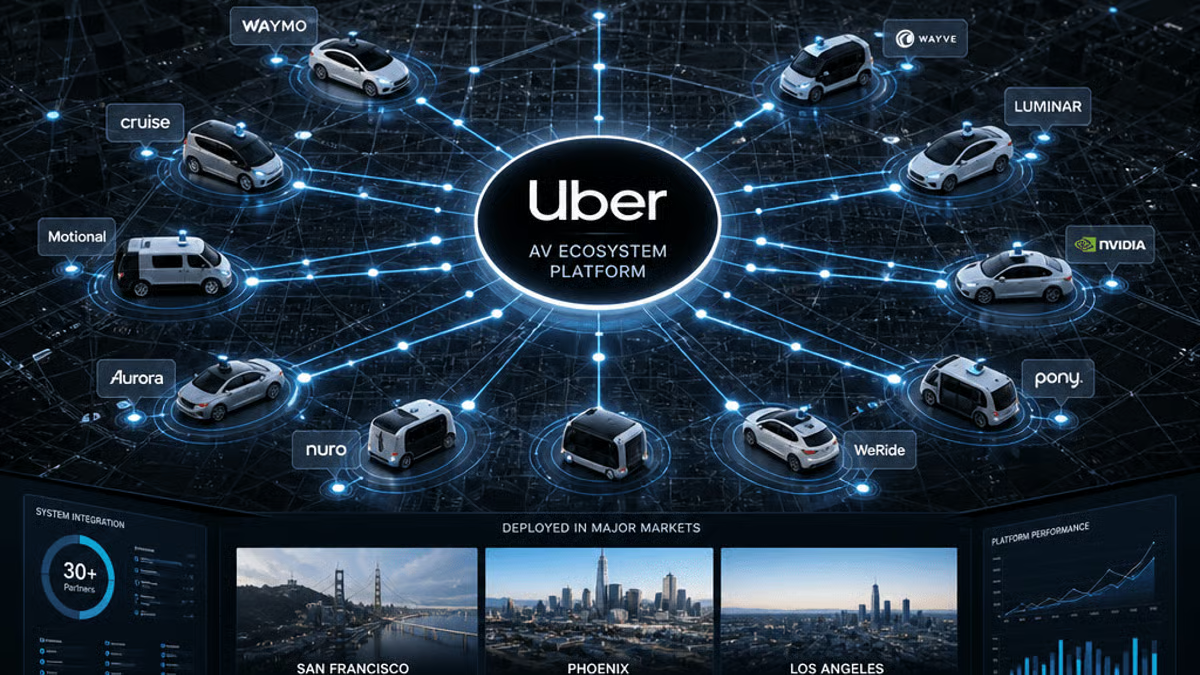
Uber isn’t waiting for self-driving cars to arrive – it’s building the entire ecosystem itself. The ride-hailing giant has quietly assembled a network of partnerships and direct investments spanning roughly 30 autonomous vehicle companies over just the past two years, according to TechCrunch’s exclusive tracker. The aggressive expansion signals Uber’s bet that the future of mobility won’t be dominated by a single AV player, but rather a platform that integrates them all.
Uber just revealed the scope of its autonomous vehicle ambitions, and it’s far bigger than anyone outside the company realized. The ride-hailing platform has inked deals with around 30 self-driving car companies over the past two years, transforming itself from a company that once tried and failed to build its own AV technology into the Switzerland of the robotaxi wars.
The partnerships range from integration agreements that put autonomous vehicles on Uber’s platform to direct equity investments in emerging AV startups. Wayve, the London-based autonomous driving company, sits among the roster of partners according to TechCrunch’s comprehensive tracker published today. The sheer breadth of relationships suggests Uber’s learned a costly lesson from its previous strategy.
Rewind to 2020, and Uber was desperately trying to offload its Advanced Technologies Group after burning through billions on in-house AV development. The company sold the division to Aurora in a deal that valued the unit at $4 billion – a fraction of what Uber had invested. That painful exit forced a strategic rethink that’s now paying dividends.
Instead of picking winners, Uber’s betting on everyone. The platform approach means that whether Waymo cracks full autonomy first, or a Chinese startup like WeRide scales faster in Asian markets, or legacy automakers like GM’s Cruise eventually recover from their stumbles, Uber wins. It’s the same playbook that made the company dominant in human-driven rides – be the marketplace, not the supplier.
The timing couldn’t be more critical. Autonomous vehicle deployment is accelerating across major metros, with Waymo already operating commercial robotaxi services in San Francisco, Phoenix, and Los Angeles. Tesla keeps promising its own ride-hailing network. Chinese AV companies are flooding their domestic market with driverless taxis at prices that undercut human drivers.
For the 30-odd companies on Uber’s partner list, the arrangement offers instant distribution to millions of potential riders already using the app. That’s a powerful incentive for startups struggling to build consumer awareness and trust. But it also creates dependency – if Uber’s platform becomes the primary way customers access AVs, the technology providers risk becoming commodified suppliers in a race to the bottom on pricing.
The partnership strategy also hedges against regulatory fragmentation. Different cities and countries are adopting wildly different approaches to AV regulation. By working with local and regional players alongside global giants, Uber can adapt to whatever framework emerges in each market. A European partner handles Brussels’ privacy requirements, a Chinese firm navigates Beijing’s data localization rules, and American companies deal with the state-by-state patchwork in the US.
Industry analysts see Uber’s moves as validation that the robotaxi market won’t be winner-take-all. Multiple technologies, business models, and use cases will likely coexist – dense urban cores versus suburban sprawl, fixed routes versus dynamic routing, luxury versus budget tiers. Uber’s trying to be the layer that sits on top of all that complexity and makes it simple for consumers.
But the strategy isn’t without risks. Managing 30 different technology integrations, each with unique hardware, software, and operational requirements, is a logistical nightmare. Liability questions remain murky when an AV operating on Uber’s platform causes an accident. And some partners are also potential competitors – many of the AV companies have stated ambitions to eventually operate their own ride-hailing services.
The investments Uber’s making in select partners add another dimension. Equity stakes give Uber financial upside if certain companies break out, but they also create conflicts of interest when deciding which AVs to prioritize on the platform. Drivers already complain about algorithmic opacity in how Uber distributes rides – imagine those tensions when some robotaxis get preferential routing.
Still, Uber’s moved faster than competitors like Lyft, which has partnerships but fewer of them, or traditional taxi companies that lack the technical infrastructure to integrate AVs at all. The race is now about ecosystem building, and Uber’s two-year head start in assembling this network could prove decisive as autonomous vehicles shift from pilots to mainstream deployment over the next few years.
Uber’s 30-company autonomous vehicle alliance represents a fundamental shift in how the mobility industry is approaching self-driving technology. Rather than the vertical integration model that dominated early AV development, we’re seeing platform economics take over – with all the network effects, lock-in dynamics, and winner-take-most potential that implies. For riders, that could mean more choices and faster deployment of robotaxis. For the AV companies themselves, it’s a Faustian bargain: immediate market access in exchange for potential long-term commodification. The next 18 months will reveal whether Uber’s aggregation strategy can actually manage the complexity of integrating dozens of different autonomous systems, or if the whole thing collapses under its own weight. Either way, the company’s clearly decided its future isn’t driving cars – it’s being the platform everyone else drives on.









Leave a Reply