

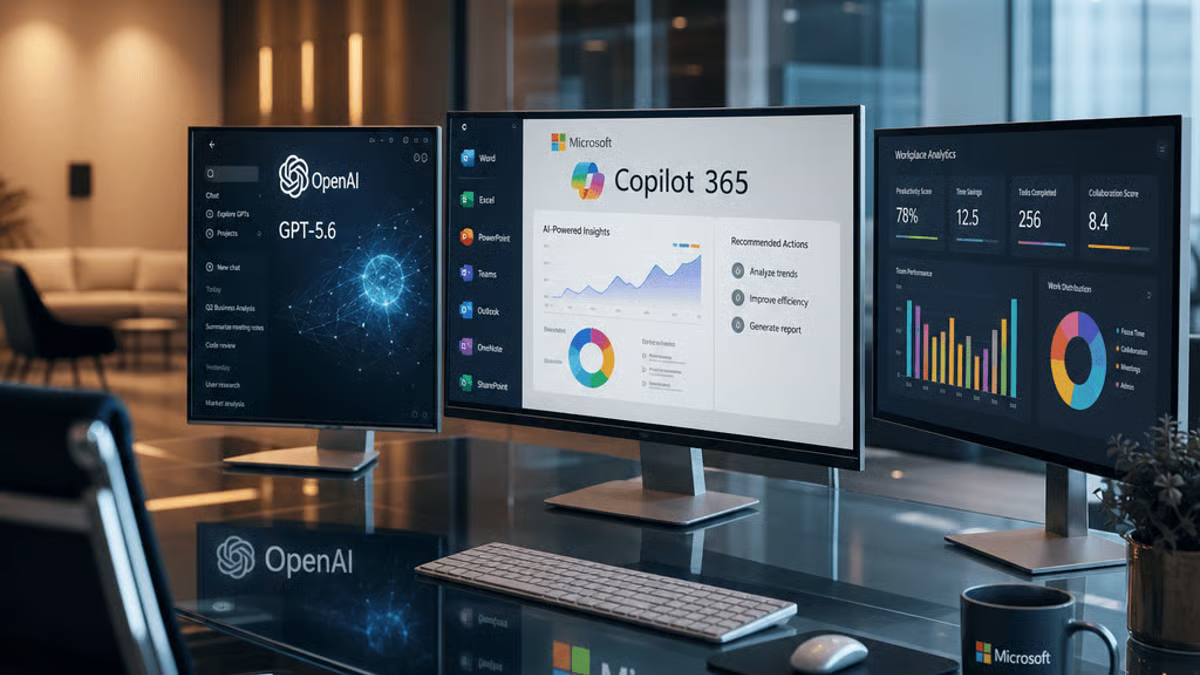
OpenAI just doubled down on its most lucrative partnership. The AI giant confirmed GPT-5.6 will serve as the “preferred model” powering Microsoft Copilot, silencing whispers of a potential split between the two tech behemoths. The announcement comes as both companies navigate increasingly complex competitive dynamics in the enterprise AI market, where their $13 billion partnership has reshaped how millions work daily.
OpenAI and Microsoft are making their relationship status crystal clear. After weeks of industry chatter about potential friction between the partners, OpenAI’s confirmation that GPT-5.6 will power Copilot sends an unambiguous signal: the most consequential partnership in AI isn’t going anywhere.
The integration means GPT-5.6 immediately reaches one of the largest enterprise user bases in tech. Microsoft Copilot, embedded across Word, Excel, PowerPoint, Teams, and Outlook, serves more than 400 million Microsoft 365 users globally. For OpenAI, that’s distribution most startups would kill for, and it cements the company’s position at the center of the productivity software revolution.
But the announcement carries extra weight given recent industry speculation. Over the past few months, whispers have circulated about strategic tensions between the two companies. Microsoft has quietly invested in OpenAI competitors, including a reported $100 million stake in Mistral AI, while simultaneously building out its own AI research capabilities. OpenAI, meanwhile, has been exploring partnerships with other cloud providers and enterprise software vendors, diversifying beyond its Microsoft dependency.
According to sources familiar with the partnership dynamics, the GPT-5.6 integration represents a mutual recommitment. Microsoft gets first access to OpenAI’s most advanced models for its flagship productivity suite, while OpenAI secures continued infrastructure support and enterprise distribution that would take years to replicate independently.
The technical implications matter just as much as the strategic ones. GPT-5.6 brings significant improvements in reasoning, context retention, and task execution compared to its predecessors. Early enterprise testers report the model handles complex spreadsheet analysis, document generation, and multi-step workflows with notably fewer errors. For knowledge workers drowning in email and meetings, that translates to tangible productivity gains.
The competitive landscape makes this partnership even more critical for both companies. Google has been aggressively pushing its Gemini models into Workspace apps, while Anthropic recently announced enterprise partnerships with Slack and Notion. The enterprise AI market is rapidly consolidating around a few key players, and the OpenAI-Microsoft axis represents the dominant force.
Industry analysts see the GPT-5.6 integration as a defensive move as much as an offensive one. “Neither company can afford to let this partnership weaken right now,” one enterprise software analyst told me on background. “Microsoft needs OpenAI’s models to compete with Google, and OpenAI needs Microsoft’s enterprise relationships to justify its valuation.”
The financial stakes are enormous. Microsoft’s AI business, powered largely by OpenAI technology, is on track to generate $10 billion in annual revenue by year-end, according to company projections. OpenAI, valued at $86 billion in its last funding round, derives a significant portion of its commercial revenue through Microsoft’s enterprise channels.
For CIOs and IT decision-makers, the announcement provides some clarity in an otherwise chaotic market. Organizations that have invested heavily in Microsoft 365 can now plan around GPT-5.6 as their core AI infrastructure, at least for the foreseeable future. That stability matters when you’re deploying AI tools to thousands of employees.
But questions remain about the long-term sustainability of the arrangement. Both companies are hedging their bets with alternative partnerships and internal development efforts. The enterprise AI market is evolving too quickly for anyone to rely on a single relationship, no matter how lucrative.
The GPT-5.6 integration into Copilot isn’t just a technical upgrade – it’s a statement about the future of enterprise AI. Despite the inevitable tensions that come with any high-stakes partnership, OpenAI and Microsoft are betting their enterprise strategies on each other for at least another cycle. For the hundreds of millions of workers using Microsoft 365 daily, that means the AI reshaping their jobs will continue coming from the same source. And for competitors trying to break into the enterprise productivity market, it means the wall just got a lot higher.








Leave a Reply