
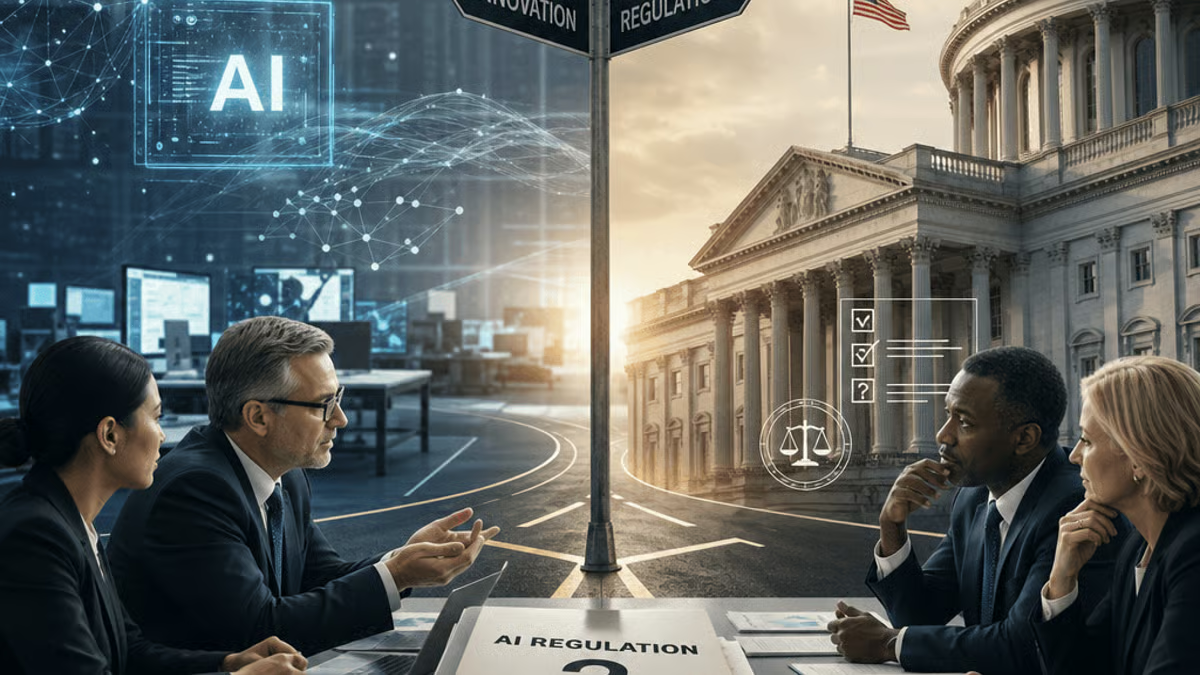
The White House just threw cold water on reports that it gave OpenAI regulatory approval to deploy GPT-5.6. In a statement to CNBC, officials flatly denied giving the AI company a “green light” for its next-generation model, stating deployment decisions “rest entirely with the companies.” The denial directly contradicts an earlier Axios report suggesting federal oversight had blessed the rollout.
The White House is pushing back hard on the idea that it’s in the business of approving AI model deployments. Officials told CNBC they did not give OpenAI a “green light” for GPT-5.6, making clear that such decisions “rest entirely with the companies.”
The denial comes hours after Axios reported that OpenAI had secured U.S. regulatory approval for its GPT-5.6 rollout – a claim that would have marked the first time federal authorities formally blessed an advanced AI model deployment. But the White House statement suggests no such approval process exists, at least not yet.
The contradiction highlights the murky state of AI governance as companies race to deploy increasingly powerful models. While the Biden administration has issued executive orders on AI safety and encouraged voluntary commitments from major labs, there’s no formal regulatory framework requiring companies to seek government permission before releasing new models.
OpenAI hasn’t publicly commented on GPT-5.6 or any regulatory discussions. The company’s last major release was GPT-4, which launched without explicit government approval but amid intense scrutiny from lawmakers and safety researchers. If GPT-5.6 exists, it would represent a significant leap in capability – the kind of advancement that’s sparked calls for mandatory pre-deployment testing and oversight.
The conflicting reports expose the gap between what some think AI regulation should look like and what actually exists today. Axios’s framing implied a formal approval process, while the White House’s response makes clear that no such mechanism is currently in place. That’s likely intentional – the administration has been careful not to overstep its authority while Congress debates actual AI legislation.
For OpenAI and its competitors like Google DeepMind and Anthropic, the White House clarification is probably welcome news. A formal approval process could slow deployments and create regulatory uncertainty. But it also means companies continue operating in a gray area where voluntary commitments and informal White House engagement substitute for actual rules.
The timing is notable. Multiple AI labs are believed to be working on next-generation models that could arrive later this year or in early 2027. If those systems demonstrate significantly enhanced reasoning or autonomous capabilities, pressure for mandatory oversight will intensify. The current hands-off approach may not survive contact with truly advanced AI.
What’s less clear is whether the original Axios report mischaracterized informal consultations as formal approval, or if there’s genuine disagreement within the administration about its role in AI deployment decisions. The White House’s quick denial suggests officials are eager to avoid any perception that they’re gatekeeping AI development – a politically fraught position given Republican criticism of Biden’s AI policies.
For now, companies like OpenAI remain free to deploy new models on their own timeline, subject to existing laws around consumer protection and safety but not AI-specific regulation. Whether that changes before GPT-5.6 or whatever comes next actually ships is the trillion-dollar question hanging over the industry.
The White House’s denial reveals just how unsettled AI governance remains even as the technology advances at breakneck speed. Companies are building systems that could reshape entire industries, but there’s still no formal process requiring them to get permission first. That ambiguity won’t last forever – either Congress will act or a crisis will force regulators’ hands. For OpenAI and the rest of the AI industry, the question isn’t whether oversight is coming, but whether they can shape it before it shapes them. This contradictory reporting is just the latest sign that everyone’s making this up as they go.











Leave a Reply