
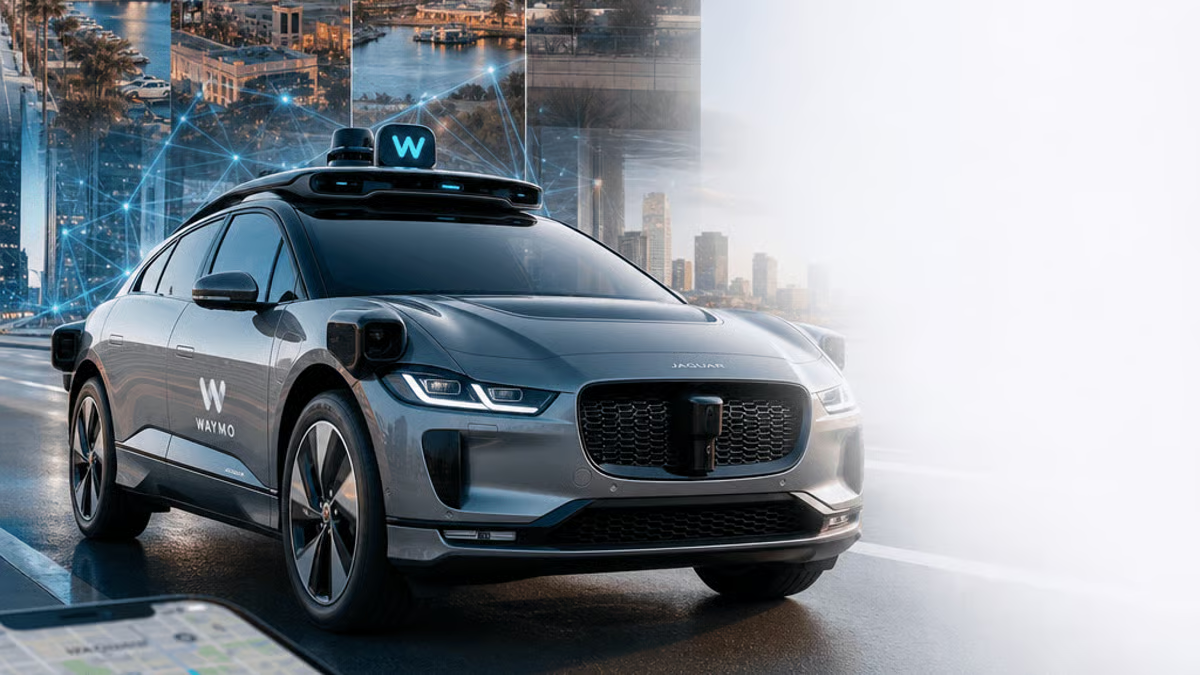
Waymo is accelerating its dominance in the U.S. robotaxi market with a major expansion push. The Alphabet-owned autonomous vehicle company just launched fully driverless ride-hailing services in four new cities—San Diego, Las Vegas, Tampa, and Denver—marking its most aggressive geographic expansion to date. The move cements Waymo’s lead over rivals like Cruise and Tesla in the race to commercialize self-driving technology, while signaling that autonomous transportation is shifting from pilot programs to mainstream reality.
Waymo just made its biggest bet yet that Americans are ready to trust robots with their commute. The company’s simultaneous launch across San Diego, Las Vegas, Tampa, and Denver more than doubles its geographic presence and puts fully autonomous vehicles on the streets of cities that span vastly different driving environments—from Vegas’s packed tourist corridors to Tampa’s unpredictable weather patterns.
The timing couldn’t be more strategic. While General Motors struggles to restart its Cruise robotaxi operations after last year’s high-profile safety incidents, and Tesla continues to promise but not deliver a dedicated autonomous ride service, Waymo is racing to lock in market share before competition truly materializes. The company has been quietly operating in San Francisco, Los Angeles, and Phoenix, racking up millions of autonomous miles and building the operational playbook it’s now deploying at scale.
What makes this expansion notable isn’t just the number of cities, but their diversity. San Diego brings dense urban cores mixed with sprawling suburbs. Las Vegas offers 24/7 operations with extreme pedestrian density on the Strip. Tampa introduces challenging weather conditions with frequent thunderstorms and heavy rain. Denver adds high-altitude driving and snow—conditions that have historically challenged autonomous systems. If Waymo can operate successfully across these environments, it effectively proves its technology works anywhere in the U.S.
The robotaxi market remains nascent but the trajectory is clear. Waymo has provided over 2 million paid rides since launching commercial operations, and the company recently opened its service to all users in San Francisco without a waitlist. That shift from controlled testing to open access signals a confidence level that’s drawing attention from both investors and regulators. Alphabet, Waymo’s parent company, has poured billions into the venture over nearly two decades, and this expansion suggests leadership believes the unit is approaching a commercial inflection point.
But scaling robotaxis isn’t just about technology—it’s about operations, local regulations, insurance, fleet maintenance, and community acceptance. Each new city requires months of mapping, regulatory approvals, and relationship-building with local officials. The fact that Waymo is launching in four cities simultaneously demonstrates it’s built repeatable processes that can deploy faster than competitors. This operational maturity might be more valuable than the underlying AI itself.
The competitive landscape is watching closely. Cruise is attempting a comeback after suspending operations following a pedestrian dragging incident in San Francisco that triggered regulatory scrutiny and leadership changes. The company recently received approval to restart testing in limited areas, but it’s operating under intense oversight. Meanwhile, Tesla CEO Elon Musk has repeatedly promised a robotaxi network using the company’s Full Self-Driving technology, but the timeline keeps slipping and the approach—relying on cameras rather than expensive lidar sensors—remains controversial among autonomy experts.
China’s autonomous vehicle companies are advancing rapidly in their domestic market, with Baidu‘s Apollo Go operating in multiple Chinese cities and Pony.ai expanding across Asia. But regulatory barriers make it unlikely Chinese robotaxis will operate in the U.S. anytime soon, giving Waymo room to establish dominance domestically.
The economics of robotaxis remain largely opaque. Waymo hasn’t disclosed whether its service is profitable on a per-ride basis, and the high cost of its sensor-laden Jaguar I-PACE vehicles suggests significant capital requirements. But as the company scales, the unit economics should improve—no human driver means no labor cost, which represents 60-80% of traditional ride-hailing expenses. If Waymo can achieve even modest profitability at scale, the business could justify Alphabet’s massive investment and potentially spin out as a standalone entity.
Regulators are taking notice too. The National Highway Traffic Safety Administration has been investigating incidents involving autonomous vehicles, and several cities have pushed back against robotaxi expansion after complaints about vehicles blocking traffic or behaving unpredictably. Waymo’s ability to launch in four new cities suggests it’s successfully navigating these regulatory relationships, but increased scrutiny is inevitable as autonomous vehicles become more common.
For riders in these new cities, the experience will be both familiar and surreal. Waymo’s app functions like Uber or Lyft—you request a ride, track the vehicle’s arrival, and get dropped at your destination. But there’s no driver, no small talk, no uncertainty about whether they know the best route. Just a vehicle that arrives, unlocks for your specific smartphone, and delivers you in eerie silence. Early adopters embrace it. Others remain deeply skeptical.
Waymo’s four-city expansion is the clearest signal yet that autonomous ride-hailing is transitioning from experimental technology to commercial reality. By establishing operations in diverse markets before competition can catch up, the company is building network effects and operational expertise that will be hard to replicate. The real test isn’t whether the technology works—Waymo has proven that over millions of miles. It’s whether enough people will choose a robot over a human driver, and whether the economics can scale profitably. These four new cities will provide critical data on both questions. For Alphabet, this represents either the validation of a decades-long bet or an increasingly expensive science experiment. The next 12 months will likely determine which.






Leave a Reply