
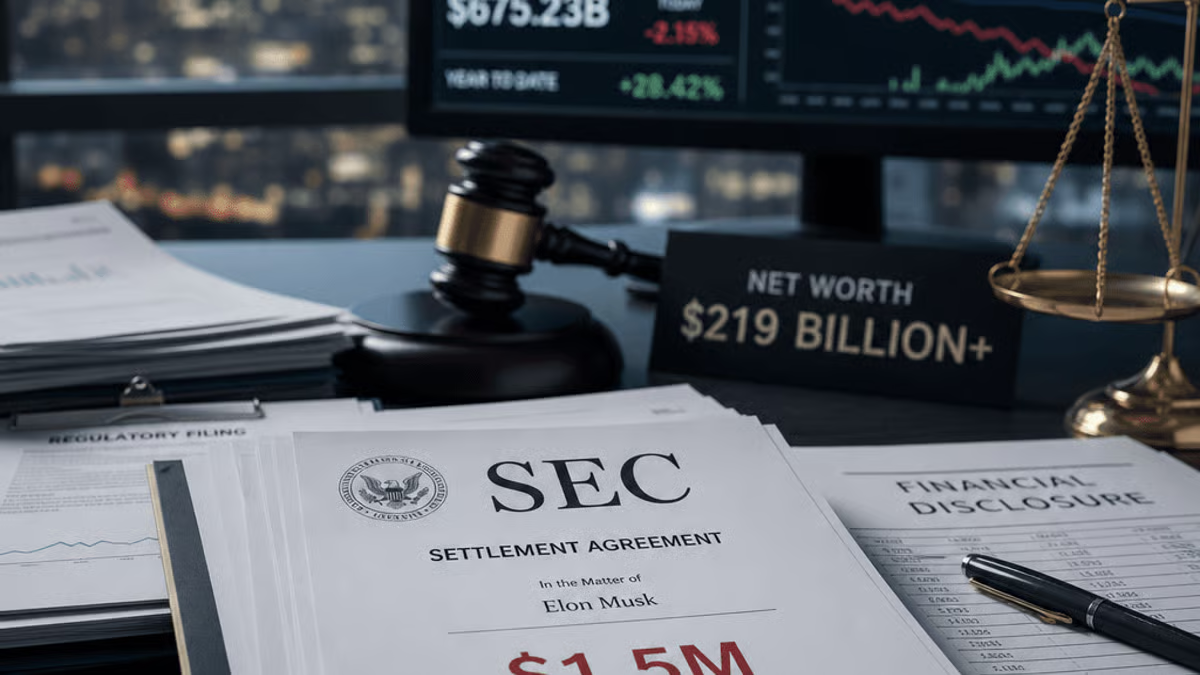
The legal battle between Elon Musk and federal regulators over his botched Twitter stock disclosure has officially ended. A federal judge approved a $1.5 million settlement between Tesla‘s CEO and the Securities and Exchange Commission on Wednesday, closing the book on a years-long dispute that dates back to Musk’s 2022 acquisition of the social media platform. The judge’s approval came with notable reservations about the adequacy of the penalty, raising questions about whether billionaires face meaningful consequences for securities violations.
The years-long regulatory drama between Elon Musk and the SEC has finally reached its conclusion, but not without a federal judge making her concerns crystal clear. Despite what she termed “misgivings” about the settlement’s adequacy, the judge approved the $1.5 million penalty that resolves allegations Musk violated securities disclosure rules during his 2022 Twitter takeover.
The case centers on a seemingly straightforward requirement that trips up even the savviest investors. When an investor crosses the 5% ownership threshold in a publicly traded company, they’re legally required to file a Schedule 13D with the SEC within 10 days. Musk blew past that deadline in early 2022 as he quietly accumulated Twitter shares, not filing until he’d already amassed a 9.2% stake worth roughly $2.9 billion at the time.
That delay wasn’t just a paperwork oversight. By continuing to buy shares at lower prices while other investors remained unaware of his growing position, Musk allegedly saved himself millions. The SEC argued this gave him an unfair advantage and deprived other shareholders of material information that would have moved the stock price.
Musk eventually acquired Twitter for $44 billion in October 2022, rebranding it as X and taking the company private. The disclosure violation became one of several legal tangles stemming from that chaotic acquisition, which included a lawsuit from Twitter itself when Musk initially tried to back out of the deal.
The settlement, reached earlier this year, requires Musk to pay $1.5 million to the federal government. For context, that’s roughly what Musk’s net worth increases every few hours on a good day in the stock market. Forbes currently pegs his fortune at over $250 billion, making him the world’s wealthiest person.
That mathematical reality didn’t escape the judge’s attention. According to TechCrunch, she voiced skepticism about whether the penalty would serve as any real deterrent, acknowledging the settlement amount pales in comparison to Musk’s resources. But despite those reservations, she ultimately approved the deal.
The approval represents a pragmatic end to litigation that could have dragged on for years. Settlement agreements typically reflect both parties’ desire to avoid the uncertainty and expense of trial. For the SEC, securing any admission of wrongdoing and a financial penalty counts as a regulatory win, even if critics argue the agency should have pushed harder.
For Musk, the $1.5 million payment is essentially a rounding error that makes a persistent legal headache disappear. It’s far from his first rodeo with the SEC. He famously settled fraud charges with the agency in 2018 over his “funding secured” tweets about taking Tesla private, paying $20 million and agreeing to step down as Tesla’s chairman.
That 2018 settlement required Tesla lawyers to pre-approve Musk’s tweets about the company, a provision he’s repeatedly tested. His contentious relationship with the SEC has become part of his public persona, with Musk often criticizing the agency on social media and questioning its authority.
The Twitter disclosure case also unfolded against the backdrop of significant political changes in Washington. With the Trump administration’s return to power and its generally deregulatory stance, the SEC’s aggressive pursuit of high-profile enforcement actions has faced increasing scrutiny. Some observers speculated the settlement’s modest size reflected a broader shift in the agency’s appetite for confrontation with powerful business figures.
Legal experts note that securities disclosure rules exist for good reason. They’re designed to level the playing field between institutional investors and regular shareholders, ensuring everyone has access to the same material information. When someone with Musk’s influence and resources skirts those requirements, it undermines market integrity regardless of the eventual penalty.
The judge’s public expression of doubt about the settlement’s adequacy is itself notable. Federal judges typically defer to settlement agreements negotiated by sophisticated parties, especially in complex securities cases. Her willingness to voice concerns while still approving the deal suggests she felt bound by legal constraints even as she questioned whether justice was fully served.
As X continues its transformation under Musk’s leadership, operating as a private company far from the SEC’s public market oversight, this settlement closes one chapter of his complicated regulatory history. But given his track record and penchant for pushing boundaries, it’s unlikely to be the last time his actions draw scrutiny from federal watchdogs.
The settlement’s approval with judicial reservations perfectly captures the awkward reality of regulating billionaire rule-breakers. Musk gets to move on for pocket change while the judge’s on-record skepticism underscores a persistent problem: when fines don’t hurt, do they deter? As Musk continues reshaping X and juggling his other ventures from Tesla to SpaceX, this case stands as another data point in the ongoing debate about whether America’s wealthiest face meaningful accountability. The SEC got its win on paper, but the judge’s misgivings suggest everyone knows the score.










Leave a Reply