
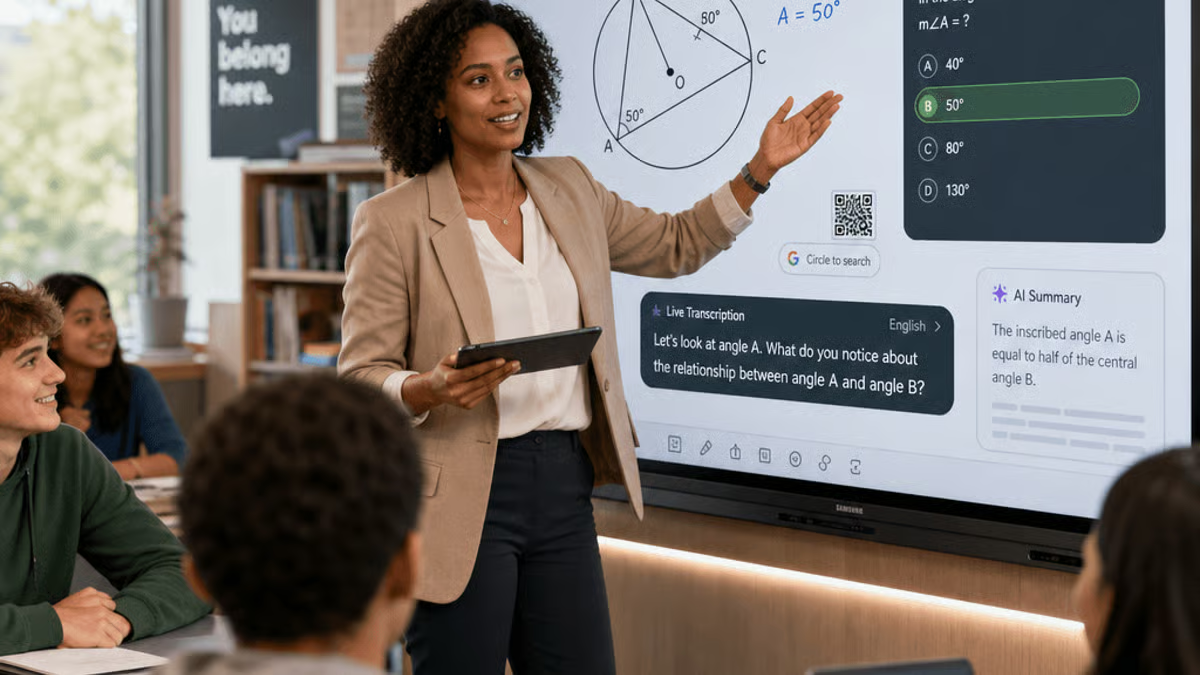
Samsung just rolled out a suite of AI-powered education tools at ISTELive 2026 in Orlando that could reshape how teachers manage their digital classrooms. The company introduced AMS (Account Management Solution), letting educators instantly access their personalized teaching environment on any compatible Interactive Display across campus with just a QR code or NFC tap. Paired with expanded Samsung AI Assistant capabilities – including live transcription, automatic quiz generation, and Circle to Search – the new software aims to cut down on classroom tech friction while giving teachers more time to actually teach.
Samsung is betting that AI can solve one of education’s most persistent pain points: teachers spending more time wrestling with technology than actually teaching. At ISTELive 2026 in Orlando, the company unveiled a connected classroom ecosystem built around its Android-based Interactive Display portfolio, introducing software innovations that promise to make shared classroom technology feel truly personal.
The centerpiece is AMS (Account Management Solution), which lets educators walk into any classroom equipped with a compatible Samsung Interactive Display and instantly access their teaching environment. A quick scan of a QR code or tap of an NFC-enabled ID card pulls up their apps, files, and personalized settings, no matter which campus building they’re in. For schools where teachers rotate between rooms or share spaces, it’s a practical answer to a logistical headache.
But Samsung isn’t stopping at seamless login. The expanded Samsung AI Assistant brings a handful of classroom-specific AI tools into the mix. Circle to Search lets teachers surface instructional content mid-lesson without breaking flow. Live Transcript captures everything said during class. AI Summary distills those transcripts into digestible recaps. And AI Quiz automatically generates formative assessments based on what was taught.
According to Jonathan del Rosario, Head of Product at Samsung Electronics America’s Display Solutions Division, the goal is augmentation, not replacement. “The educator remains driving force in the classroom,” del Rosario said during a joint session with Logitech. “We design our Interactive Displays to make lesson planning and classroom engagement easier, using AI to help teachers focus more on students while creating richer, more immersive learning experiences.”
That session with Logitech’s Madeleine Mortimore, Global Education Innovation & Research Lead, highlighted a broader shift happening in ed tech. Schools are moving away from one-off devices and toward integrated ecosystems where hardware, software, and pedagogy work together. Mortimore put it bluntly: “It’s no longer enough to have a device with an app and call it a day. The right combination of hardware and software enables students to hear and be heard, see and be seen, and interact effectively with both the technology and their peers.”
Educators at ISTELive seemed to agree. Tambra Clark, Technology Integration Facilitator at Birmingham City Schools and a Samsung Solve for Tomorrow Top 10 winner, called the transcription feature “the secret sauce.” She explained how it listens to lessons, creates summaries, and generates quizzes – turning the display into both a reflective tool for teachers and a diagnostic aid for identifying where students need extra support.
Jelena Zivko, Senior Instructional Technology Specialist with Volusia County School District, zeroed in on AMS as a game-changer for teachers who move between classrooms. “The seamless login experience means teachers can walk into any classroom and immediately have access to their lessons, files and personalized teaching environment,” Zivko said. She also noted potential uses for substitute teachers, multilingual instruction, and extending learning beyond the classroom through auto-generated summaries and transcripts.
Samsung’s education push extends beyond software. The company showcased its expanding Interactive Display lineup at the conference, including three upcoming models: WAF-S, WAFX-PS, and WAHX-M. The new hardware introduces Android 16, expanded AI capabilities, and – for the first time – a 98-inch Interactive Display designed for lecture halls and large collaborative spaces.
The timing is strategic. AI was easily the most talked-about topic at ISTE this year, with educators expressing strong interest in tools that enhance teaching rather than automate it away. Samsung’s approach leans into that sentiment, positioning AI as a practical classroom assistant that handles routine tasks like searching for resources, transcribing lessons, and creating quick assessments.
Underpinning the whole ecosystem is Samsung Education Portal, which gives IT teams centralized control over user management, device management, and emergency alerts across campus. It’s the kind of backend infrastructure that doesn’t make for flashy demos but matters a lot when you’re trying to deploy technology at scale across multiple buildings and grade levels.
The industry seems to be taking notice. Samsung’s WAFX-P Interactive Display picked up three Tech & Learning Best of Show Awards at ISTELive 26, winning in the Primary, Secondary, and Higher Education categories. The judges cited the display’s AI-powered tools, seamless connectivity, and intuitive classroom functionality as key differentiators.
What’s clear from Samsung’s ISTELive presence is that the company sees education as a growth vertical where AI can deliver immediate, measurable value. Unlike consumer AI features that sometimes feel like solutions in search of problems, classroom AI tools like auto-transcription and quiz generation solve real workflow issues that teachers face daily.
The connected classroom vision Samsung is pitching – where teachers move fluidly between spaces, AI handles administrative grunt work, and displays adapt to individual teaching styles – represents a significant evolution from the days when ed tech meant rolling in a cart with a projector. Whether schools have the budget and infrastructure to make that vision reality is another question, but the technology is clearly ready.
Samsung’s ISTELive 2026 showcase signals a clear bet that AI’s near-term value in education lies in removing friction, not replacing teachers. By combining seamless account management through AMS with practical AI tools like auto-transcription and quiz generation, Samsung is positioning its Interactive Display ecosystem as infrastructure for personalized, scalable learning environments. The real test will be whether schools can afford to deploy these systems campus-wide and whether the AI features prove reliable enough for daily classroom use. But if Samsung can deliver on its connected classroom vision – where technology adapts to teachers rather than the other way around – it could establish a compelling template for how ed tech should actually work.










Leave a Reply