
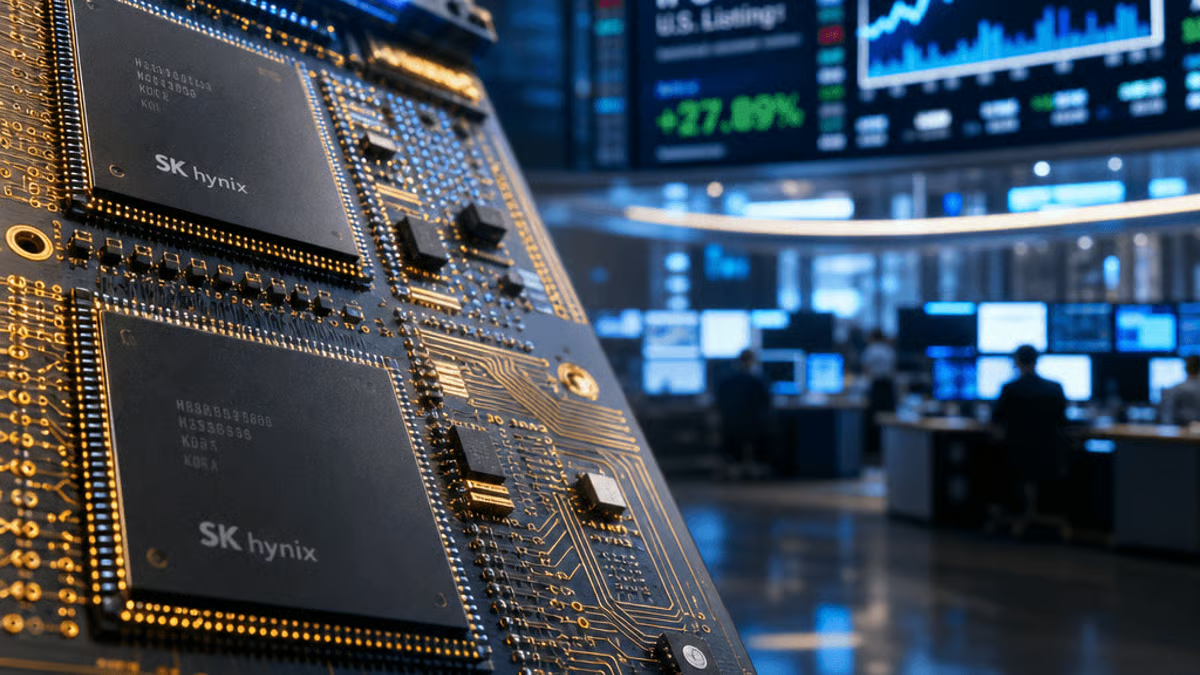
SK Hynix is about to give US investors their first direct shot at owning a piece of the AI memory gold rush. The South Korean semiconductor giant plans to debut on US exchanges this Friday in what’s shaping up to be one of the year’s most anticipated tech IPOs. The company’s riding a massive wave of demand for high-bandwidth memory chips that power everything from Nvidia‘s H100 GPUs to the data centers fueling OpenAI‘s ChatGPT.
SK Hynix is making its Wall Street debut at exactly the right moment. The memory chip maker has transformed from a cyclical commodity player into an AI infrastructure darling, and it wants US capital markets to take notice.
The company’s expected Friday listing comes as demand for specialized AI memory chips has completely reshaped the semiconductor landscape. SK Hynix has emerged as the dominant supplier of HBM3 and HBM3E chips, the high-bandwidth memory that sits directly on AI accelerators and determines how fast models can train and run inference. Without these chips, Nvidia‘s $40,000 H100 GPUs would be expensive paperweights.
That positioning has translated into eye-popping financials. While specific IPO terms haven’t been disclosed, the multi-billion dollar valuation reflects SK Hynix’s stranglehold on a market where supply can’t keep up with demand. The company’s HBM revenue has reportedly grown several hundred percent year-over-year as Microsoft, Google, and Meta race to build out AI infrastructure.
The timing isn’t accidental. Memory chip pricing has historically been volatile and cyclical, but AI workloads have created sustained demand that’s broken the old boom-bust pattern. Traditional DRAM and NAND flash markets still fluctuate, but HBM commands premium pricing and multi-year supply agreements. That stability makes SK Hynix a more attractive public company story than memory makers could tell in previous eras.
For US investors, the IPO offers something they couldn’t easily access before – direct exposure to the AI memory supply chain. Until now, Americans wanting to invest in SK Hynix had to navigate Korean exchanges or settle for ADRs with limited liquidity. Micron Technology has been the primary US-listed pure play in memory chips, and it’s benefited enormously from AI tailwinds, with shares up substantially over the past year.
But SK Hynix has arguably been more aggressive in pivoting its manufacturing capacity toward HBM. The company bet early on high-bandwidth memory when competitors were still focused on traditional DRAM. That foresight paid off spectacularly when OpenAI‘s ChatGPT kicked off the generative AI arms race in late 2022. Suddenly every tech giant needed massive GPU clusters, and every GPU cluster needed HBM.
The competitive dynamics are fascinating. Samsung, SK Hynix’s domestic rival, also produces HBM but has reportedly struggled with yield issues on the latest HBM3E generation. That’s given SK Hynix an even larger market share at precisely the moment when Nvidia is shipping its next-generation Blackwell chips, which consume even more high-bandwidth memory per GPU.
Analysts expect the IPO to value SK Hynix at a premium to traditional memory multiples, closer to what AI infrastructure companies command. The company isn’t just selling commodity DRAM anymore – it’s selling the critical enabler of AI scale. That narrative should resonate with growth investors who’ve piled into anything touching artificial intelligence.
There are risks, of course. Memory pricing could eventually normalize as more capacity comes online. Micron is ramping its own HBM production, and Samsung is working to fix its yield problems. Geopolitical tensions around semiconductor supply chains add another layer of uncertainty, particularly for a Korean company with manufacturing concentration in Asia.
But right now, SK Hynix has momentum. The company’s positioned at the intersection of two massive trends – the AI buildout and the diversification of semiconductor supply chains. US listing gives it currency for potential acquisitions, easier access to American talent, and proximity to its largest customers.
The IPO also signals something broader about the AI infrastructure stack. We’ve seen Nvidia become a trillion-dollar company on GPU sales. We’ve watched hyperscalers spend tens of billions on data centers. Now the market’s recognizing that the specialized components enabling all that compute deserve similar premium valuations. Memory isn’t just memory anymore when it’s the bottleneck determining whether an AI model trains in weeks or months.
SK Hynix’s Friday debut represents more than just another tech IPO. It’s a signal that the AI infrastructure layer has matured enough that specialized component makers can command premium public market valuations. For investors, it offers direct exposure to the memory chips powering every major AI system, from ChatGPT to autonomous vehicles. The real test will be whether the company can maintain its HBM leadership as competition intensifies and whether AI demand proves durable enough to justify what’s likely to be a rich valuation. But for now, SK Hynix is riding the AI wave straight to Wall Street, and investors are clearly hungry for the opportunity.











Leave a Reply